
A scalable marketing strategy is defined as a system that multiplies marketing results without a proportional increase in cost or effort. Unlike volume-based approaches that simply spend more to get more, a growth marketing strategy builds repeatable systems, automation, and high-leverage activities that compound value over time. Scaling marketing is about smart systems that run in the background, compounding results sustainably rather than chasing spend. Businesses that get this right can shift from fragile, paid-heavy growth to durable, organic-led pipelines. The difference between a business that plateaus and one that keeps growing often comes down to whether its marketing is built to scale.
What is a scalable marketing strategy built on?
The definition of scalable marketing rests on one core principle: leverage over volume. The goal is not to do more of everything. The goal is to find the activities that multiply output without multiplying effort, then build systems around them.
The key pillars of effective marketing scalability are:
- Leverage plays. A single high-leverage activity, such as an automated nurture sequence or an evergreen content programme, can drive results for months without ongoing manual input. The biggest scaling mistake is chasing volume instead of identifying and doubling down on that one activity.
- Systematisation. Every repeatable task should be documented and, where possible, automated. This includes lead qualification, email sequences, social scheduling, and reporting.
- Evergreen content and automated nurture flows. Businesses that transition from paid-heavy tactics to evergreen SEO and automated nurture flows can reduce acquisition cost by up to 70% and grow organic-led leads from roughly 10% to 60% of total pipeline within 12–18 months. That shift fundamentally changes the economics of growth.
- Referral and amplifier programmes. Building fans, not just customers, creates a growth loop that does not require additional ad spend. Referral programmes, case studies, and community-building all fall into this category.
- Technology as a force multiplier. Marketing automation platforms, CRM systems, and analytics tools handle tasks that would otherwise require additional headcount.
Pro Tip: Before adding any new channel or tactic, ask whether it can run without you. If the answer is no, build the system first.
The most effective marketing strategy for growth is not the one with the biggest budget. It is the one with the best systems behind it.

How should you structure your marketing team to support scale?
Team structure is where most growth-stage businesses quietly lose momentum. They hire more people into a broken structure and wonder why results do not improve. Managers often fail at scaling by hiring into broken systems. Structural redesign must come before headcount growth.
Marketing teams scale through three distinct phases, each requiring a different approach:
| Team size | Phase | Key characteristics |
|---|---|---|
| 1–10 roles | Foundation | Generalists covering multiple channels; focus on testing and documenting what works |
| 11–25 roles | Specialisation | Channel specialists emerge; marketing operations hired early to prevent manual work traps |
| 26+ roles | Full department | Layered management, dedicated ops, clear single-channel accountability, and shared data infrastructure |
Marketing teams scale in three phases tied directly to headcount, with different hiring priorities at each stage. Understanding which phase your business is in prevents the most common structural errors.
The Foundation phase is about proving what works, not building a department. One or two generalists testing channels and documenting results is more valuable than a large team running untested campaigns.
The Specialisation phase is where most businesses stumble. The temptation is to hire more channel managers. The smarter move is to hire a marketing operations person first. Hiring marketing operations at 10–15 people prevents the costly manual work traps that slow teams down as they grow. Without ops, every new hire adds complexity rather than capacity.
The Full Department phase requires clear ownership and shared data. Teams that scale well revisit their organisational structure regularly, resolving slow decisions, duplicated work, fractured reporting, and silos before they calcify. Single-channel accountability and regular organisational reviews are not optional at this stage. They are the mechanism that keeps growth on track.
What is the difference between automation and campaign orchestration?
Automation and campaign orchestration are related but distinct concepts. Confusing them leads to under-investment in the capability that actually drives scale.
Marketing automation handles individual, rule-based tasks. It sends a welcome email when someone subscribes. It scores a lead when they visit a pricing page. It is powerful, but it operates in isolation unless connected to a broader system.
Campaign orchestration goes further. Successful scaling requires moving from simple automation to campaign orchestration, unifying planning, content, and data to personalise experiences without adding complexity. Orchestration is the connective tissue between channels, teams, and data sources.
The practical benefits of orchestration include:
- Reduced bottlenecks. Marketing orchestration integrates workflows from planning through to execution, removing the manual handoffs that slow campaigns down.
- Faster approvals. When briefs, assets, and data live in one place, review cycles shrink.
- Consistent personalisation at scale. Orchestration allows a business to deliver relevant messages across email, paid, and organic channels without rebuilding the logic for each campaign.
- Quality control. Centralised workflows make it easier to maintain brand standards as output volume increases.
Successful scaling integrates campaign planning, content, and data into a single source of truth. That integration is what separates businesses that grow efficiently from those that grow chaotically.
Pro Tip: Start every campaign with clear objectives tied to measurable outcomes, such as generating a specific number of leads within a defined timeframe. Without that anchor, orchestration becomes coordination for its own sake.
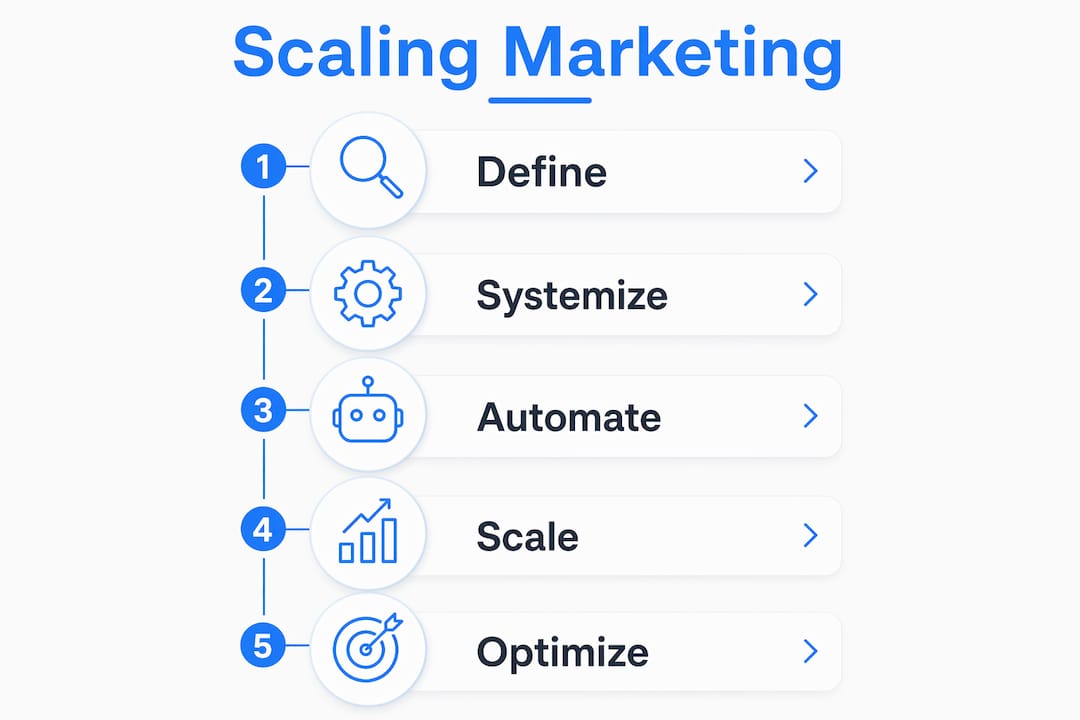
How do you implement a scalable marketing strategy step by step?
Building a marketing strategy for growth does not require a complete overhaul from day one. The most effective approach is sequential, starting with the highest-leverage activity and building systems around it before expanding.
-
Identify one high-leverage play. Choose a single activity that can multiply results without proportional effort. An automated email nurture sequence, an evergreen SEO content series, or a referral programme are all strong candidates. Test it, measure it, and document what works before adding anything else.
-
Document repeatable systems. Every process that runs more than once should be written down. This includes campaign briefs, approval workflows, reporting templates, and onboarding sequences. Documentation is what turns individual effort into organisational capability.
-
Measure the metrics that matter. Track cost per lead (CPL), conversion rate, and customer retention from the start. These three numbers tell you whether your systems are working or quietly leaking value. Without measurement, you cannot improve what you cannot see.
-
Invest early in marketing operations and data infrastructure. As your team grows past ten people, the cost of not having a dedicated ops function compounds quickly. A marketing operations hire at this stage pays for itself by preventing the manual work traps that slow every subsequent hire.
-
Transition from paid-heavy tactics to evergreen and automated channels. Shifting from paid to evergreen SEO and automated nurture flows reduces acquisition costs significantly and builds a pipeline that does not switch off when ad spend stops. CRM and lead nurturing systems are the infrastructure that makes this transition possible.
-
Build referral and amplifier programmes. Customers who refer others, share content, or advocate publicly are a growth channel that costs a fraction of paid acquisition. Invest in the post-purchase experience to activate this channel deliberately.
The sequence matters. Businesses that skip to step five without completing steps one through four end up with expensive technology running on top of broken processes.
Key takeaways
A scalable marketing strategy grows results by building systems and leverage plays, not by increasing spend or headcount proportionally.
| Point | Details |
|---|---|
| Leverage over volume | Identify one high-leverage activity and build repeatable systems around it before expanding. |
| Team structure drives scale | Redesign your organisational structure at each growth phase before adding headcount. |
| Hire ops early | Bringing in marketing operations at 10–15 team members prevents costly manual work traps. |
| Orchestration beats automation | Unifying planning, content, and data into one workflow delivers personalisation without added complexity. |
| Shift to evergreen channels | Moving from paid-heavy tactics to SEO and automated nurture flows can reduce acquisition costs by up to 70%. |
What most businesses get wrong about scaling marketing
Most businesses treat scaling as a volume problem. They assume that more budget, more content, or more headcount will produce more results. In my experience, that assumption is the single most expensive mistake a growth-stage business can make.
The businesses I have seen scale well share one habit: they redesign their structure before they grow into it. They do not wait until the team is fractured and reporting is broken. They ask, at each growth phase, whether their current structure can support the next stage. Usually, it cannot. That is not a failure. It is a signal to redesign before hiring.
Technology is the other area where I see businesses trip up. Automation tools and orchestration platforms are genuine force multipliers when the underlying processes are sound. When they are not, technology amplifies the chaos rather than reducing it. A sophisticated CRM running on top of an undocumented sales process does not fix the process. It just makes the mess more expensive.
The most encouraging thing I can say is this: the structural and systems work that makes marketing growth possible is not glamorous, but it is not complicated either. Document your processes. Measure your CPL. Hire ops before you think you need it. Choose one leverage play and prove it before adding another. These are not advanced strategies. They are the basics, done consistently, at the right time.
— Samar
How Beyondclix helps you build marketing that grows with you
Building a marketing system that compounds results over time requires the right combination of channels, data, and execution. Beyondclix works with established businesses and e-commerce stores to put exactly that in place.
From evergreen SEO that reduces your cost per lead over time, to integrated campaign management across paid and organic channels, Beyondclix operates as a single cohesive unit rather than a collection of siloed services. Every channel works toward the same measurable outcome. If you are ready to move from ad-dependent growth to a system that runs efficiently in the background, the Beyondclix services page outlines where to start. The team tailors every engagement to specific business outcomes, not just services delivered.
FAQ
What is the definition of scalable marketing?
Scalable marketing is a system that increases marketing results without a proportional increase in cost or effort. It relies on automation, evergreen content, and repeatable processes rather than simply spending more.
What is the most common mistake when scaling marketing?
The most common mistake is increasing volume instead of identifying one high-leverage activity and building a system around it. Adding more channels or budget to a broken process compounds the problem rather than solving it.
When should a business hire a marketing operations person?
Marketing operations should be hired when the team reaches 10–15 people. At that point, the cost of manual processes and coordination errors outweighs the cost of a dedicated ops hire.
How long does it take to see results from a scalable marketing strategy?
Transitioning from paid-heavy tactics to evergreen SEO and automated nurture flows typically produces measurable results within 12–18 months, including significant reductions in cost per lead and growth in organic pipeline share.
What is the difference between automation and orchestration in marketing?
Automation handles individual, rule-based tasks in isolation. Orchestration unifies planning, content, and data across channels into a single workflow, enabling personalised experiences at scale without adding manual complexity.
Recommended
Article generated by BabyLoveGrowth
Want this run for your business?
Talk to our team. We will show you where the money is leaking and what we would do about it.