
Ad creative is a major driver of advertising performance, accounting for a substantial portion of incremental sales uplift from paid campaigns. That contribution significantly exceeds that of targeting, reach, and recency combined. Yet most marketers estimate creative’s contribution at roughly 20%, less than half the actual figure. The gap between perception and reality is where budgets quietly leak out the back.
Strong creative produces several times more incremental sales than weak creative. Not marginally better. Several times. That means the quality of your ad creative is not a rounding error in campaign performance. It is the primary lever, and the teams treating it that way are compounding their advantage every time they run a campaign.
Here is what that looks like in practice:
- Creative quality drives 49% of ad-driven sales, more than any other campaign variable
- Weak creative cannot be rescued by better targeting or higher spend
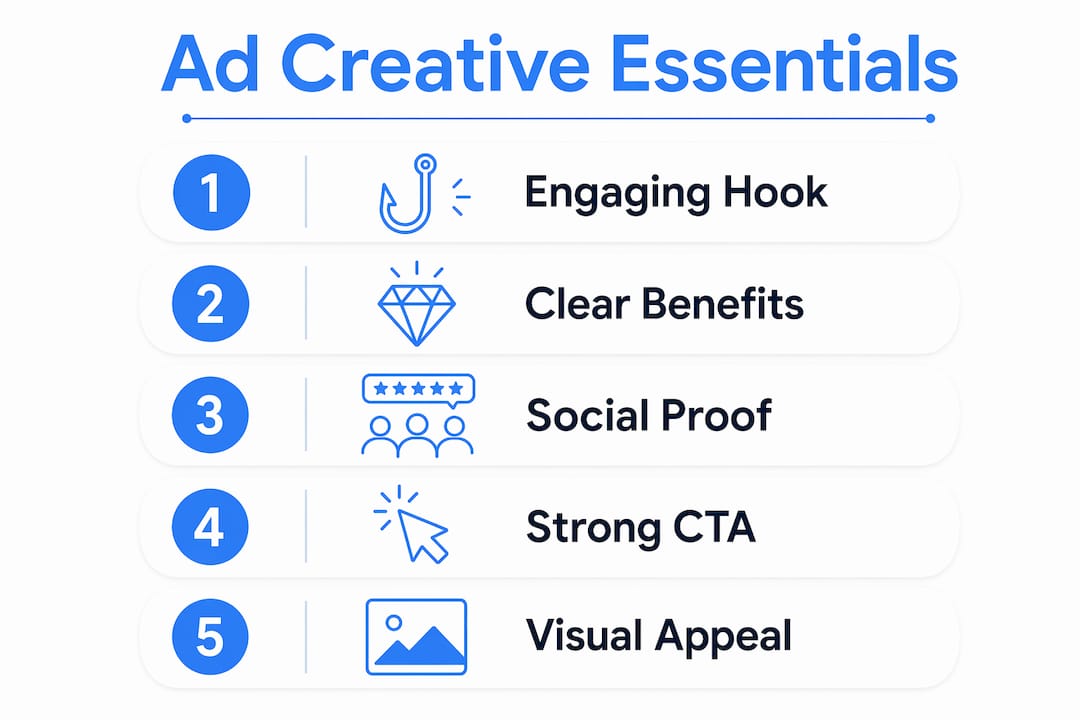
- The visual hook, message clarity, and call to action (CTA) are the three elements that determine whether a viewer converts or scrolls past
- Audience perception of your brand forms in the first 1–2 seconds of ad exposure
- Marketers who underinvest in creative leave the majority of their performance potential untouched
Why ad creative affects conversions more than targeting does
The mechanics are straightforward. Your ad creative is the first and often only contact point between your brand and a potential customer. Before your targeting logic, bidding strategy, or landing page gets a chance to do anything, the creative has already won or lost the viewer’s attention.

Clarity and specific benefits in ad copy consistently outperform clever or vague language. “Save 3 hours every Monday morning” converts better than “Save time with our tool” because it paints a concrete picture. Generic claims get scrolled past. Specific ones stop the scroll.
As platforms like Meta and Google automate targeting with AI, the creative itself has become the primary lever marketers can actually control. Audience segmentation is increasingly handled by the algorithm. What you feed that algorithm, the creative, determines whether it finds buyers or burns budget.
What makes ad creative convert: the core elements
Every high-converting ad shares a common architecture. Each element has a specific job to do in a very short window.
- Visual hook (first 1–1.5 seconds): The opening frame of a video or the hero image of a static ad must interrupt the scroll. Direct eye contact, bold contrast, or an unexpected visual all work. The old “3-second rule” is outdated; research from UC Irvine professor Gloria Mark shows average screen focus has dropped substantially, making the first 1.5 seconds more critical than ever.
- Empathy hook: Immediately after grabbing attention, the ad should show it understands the viewer’s problem. “Tired of spreadsheets that don’t talk to each other?” earns the next few seconds of attention from the right audience.
- Value proposition: Focus on outcomes, not features. “Our software writes your reports for you” beats “AI-integrated reporting tool” every time.
- Single, clear CTA: Ambiguity kills conversion. One action, one button, one outcome. “Shop Now,” “Get Your Free Trial,” or “Book a Call” each work when they are the only ask.
- Supporting text: The description or secondary copy adds urgency or reinforces the offer. Treat it as a supporting argument, not an afterthought.
- Format choice: Static images, UGC-style videos, carousels, and meme-format ads each serve different engagement purposes and reach different audience segments.
Pro Tip: Test your hook in isolation before investing in full creative production. Run three to five different opening frames or first lines of copy against the same ad body. The hook is where most conversions are won or lost.
Creative variety is a performance lever, not a nice extra
Ads with creative variety see noticeably higher conversion rates and reach a broader audience than repetitive creatives. That figure comes from a Meta, AppsFlyer, and Dentsu analysis of 1.1 million creative variations. The implication is direct: running the same ad repeatedly is not a neutral choice.
Creative fatigue is measurable, not just a feeling. Conversion rates drop by approximately 45% after viewers see the same creative four times, due to creative fatigue. Click-through rates fall by around 45% after viewers see the same creative four times, due to creative fatigue.
The algorithm compounds this problem. Meta’s Andromeda system, fully rolled out in October 2025, rewards creative diversity by lowering CPMs for accounts with varied ad libraries and raising them for accounts running similar-looking ads. Visual recognition models can now detect when different ads are essentially the same creative with minor text changes.
What genuine diversity looks like in practice:
- Mix polished studio content with lo-fi UGC-style video. UGC ads see 4x higher engagement than polished brand content across DTC brands.
- Vary messaging angles: problem-focused, benefit-focused, and transformation-story ads each tap different psychological entry points.
- Rotate formats. Carousel ads can achieve 30–50% lower cost-per-click compared to static single-image ads, while video leads all formats in click-through rate.
- Top-tier advertisers ship 12–19+ creatives weekly, compared to a median of 6–7 for mid-tier accounts.
Psychological principles that drive ad conversions
The most effective ad creative is built on how buyers actually think, not how marketers assume they think.

Loss aversion is the most underused lever in direct-response advertising. Losses feel roughly twice as significant as equivalent gains to the human brain. Framing an offer around what the customer is currently losing by not acting, rather than only outlining gains, consistently lifts conversion. “You’re handing competitors the intelligence you could be using” outperforms “Get competitor intelligence” in direct-response contexts.
Awareness stage matching is where most ad spend is wasted. Most brands build ads for buyers who are close to purchase, while the majority of potential buyers sit in earlier awareness stages and scroll straight past. Mapping buyer awareness stages before writing a single headline is an effective way to cut acquisition costs. Teams that match creative to awareness stage often see notably lower cost-per-acquisition compared to generic ads.
Cognitive friction kills conversions quietly. An ad with a strong hook, genuine social proof, and a clear CTA will still underperform if the visual design requires parsing competing elements simultaneously. One visual focus point per frame, one key message per copy block, one action per CTA. Reducing cognitive friction through clarity and psychological alignment outperforms aesthetic focus alone.
Cleverness versus clarity: Specific, benefit-driven copy converts better than witty or vague language. “Save 3 hours every Monday morning” paints a tangible picture. “Save time with our tool” says nothing falsifiable.
Pro Tip: Change one psychological variable per test: same visual, different hook mechanism. Same copy angle, different social proof format. Changing too many elements at once means you learn nothing about what actually moved the needle.
Understanding how buyers at different awareness stages respond to messaging is explored further in audience awareness analytics, which can sharpen how you match creative angles to where your audience actually sits.
How creative shapes the tone and success of a whole campaign
Ad creative does more than drive clicks. It sets the emotional and perceptual tone that shapes brand association, trust, and long-term customer value.
- Brand perception forms at the creative level. The visual style, copy register, and emotional tone of your ads determine how audiences feel about your brand before they ever visit your website.
- Trustworthiness is a creative output. Manufactured scarcity, fake urgency, and vague claims erode trust on repeat exposure. Once an urgency signal is discredited, it stops working entirely.
- Funnel alignment matters. A curiosity-driven hook that lands on an aspirational brand page creates mismatch. The emotional register of the ad must carry through to the first screen the viewer sees after clicking.
- Algorithm signals flow from creative quality. Strong creative gives platform algorithms a reliable performance signal, which improves delivery efficiency and lowers cost-per-acquisition over time.
- Lifetime value starts with the ad. The expectations your creative sets determine who clicks, and who clicks determines who buys, returns, and refers others.
76% of marketers report that advertising effectiveness is weakened by ineffective creative or the inability to measure it. The creative is not just the top of the funnel. It is the foundation the entire campaign is built on.
How Beyondclix drives conversions through creative in New Zealand
Beyondclix treats ad creative as the core lever for maximising return on ad spend, not an afterthought to targeting and budget decisions. Their methodology integrates creative strategy, analytics and tracking, and platform management into a single cohesive system, so every creative decision is grounded in performance data rather than instinct.
For New Zealand businesses running Meta Ads or Google Ads, Beyondclix applies the 3:2:2 testing framework, testing three creatives, two primary texts, and two headlines simultaneously to surface winning combinations faster and reduce wasted spend. Creative decisions are driven by what the data shows works for local audiences, not what performed in a different market.
The results speak directly to the research. Campaigns managed by Beyondclix consistently achieve higher ROAS by prioritising creative diversity, refreshing ads before fatigue sets in, and aligning messaging to where New Zealand buyers sit in the awareness journey.
Ready to stop guessing which ad will work? Talk to Beyondclix about building a creative strategy that converts, or explore the full range of digital marketing services available for New Zealand businesses.
Key takeaways
Ad creative is the dominant driver of advertising performance, accounting for 49% of incremental sales uplift, and no amount of targeting refinement compensates for weak creative.
| Point | Details |
|---|---|
| Creative drives 49% of sales uplift | Targeting, reach, and recency combined still fall short of what creative quality contributes alone. |
| Fatigue hits fast | Conversion rates drop by approximately 45% after viewers see the same creative four times, due to creative fatigue. |
| Variety lifts conversions | Ads with creative variety see 29% higher conversion rates than repetitive creatives. |
| Psychology beats aesthetics | Matching creative to buyer awareness stages reduces cost-per-acquisition by 20–35%. |
| Test one variable at a time | The 3:2:2 framework isolates what drives performance and avoids burning budget on noisy data. |
FAQ
Why are my ads not converting?
Weak or repetitive ad creative is the most common cause. Creative quality accounts for 49% of incremental ad-driven sales, so poor messaging, unclear CTAs, or creative fatigue will undermine even well-targeted campaigns.
Why does creativity matter in advertising?
Creative is the only element of an ad the viewer actually experiences. It shapes attention, trust, emotional response, and the decision to act, making it the primary driver of whether a campaign succeeds or fails.
What is the 40-40-20 rule in advertising?
The 40-40-20 rule attributes portions of results to audience, offer, and creative respectively. More recent research shows creative drives 49% of incremental sales uplift, highlighting its growing importance in digital campaigns.
Is investing in ad creative worth it?
Yes. Strong creative produces several times more incremental sales than weak creative, and campaigns with diverse creative libraries see 29% higher conversion rates. The return on creative investment compounds across every campaign cycle.
Recommended
Want this run for your business?
Talk to our CEO. We will show you where the money is leaking and what we would do about it.