
Email is a primary revenue engine for e-commerce when automated flows, measurement, and segmentation are in place. The role of email in e-commerce revenue comes down to three things: you own the audience outright (no algorithm decides who sees your message), you can trigger sends based on real purchase behaviour, and every send is attributable to a dollar outcome when tracking is set up correctly.
The three primary revenue roles are:
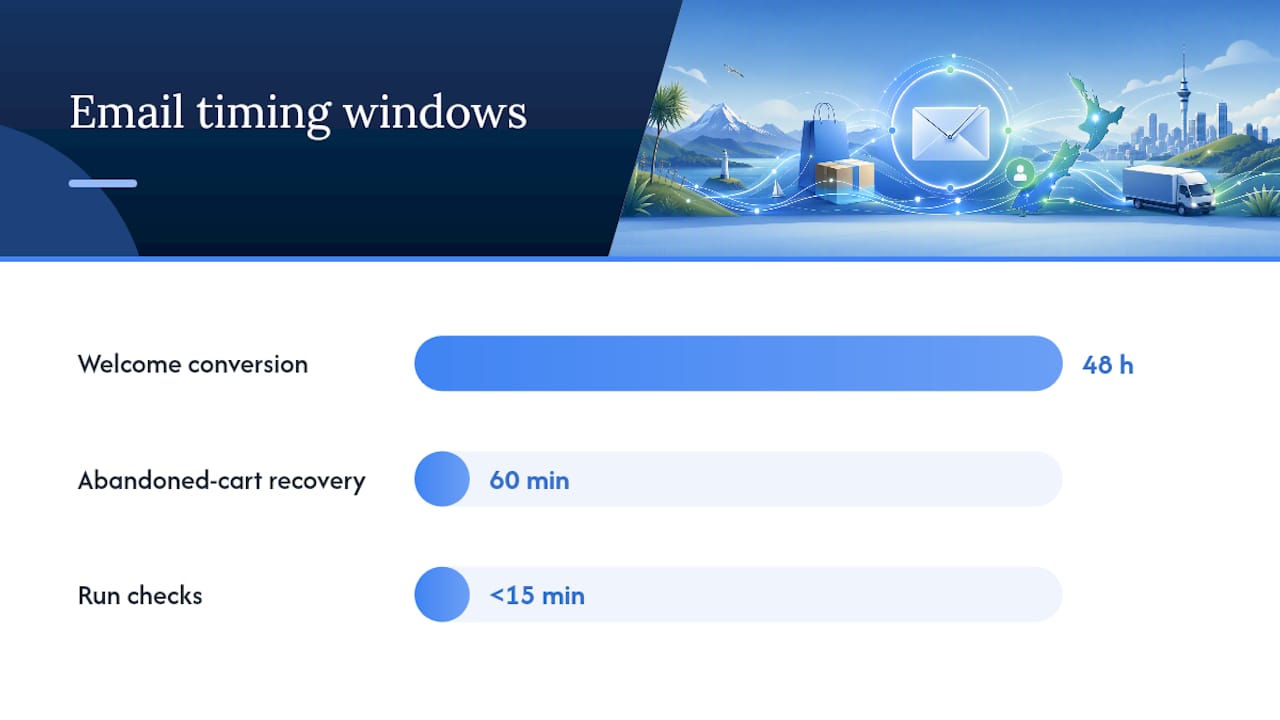
- Acquisition: Welcome series convert new subscribers into first-time buyers, often within 48 hours of sign-up.
- Recovery: Abandoned cart and checkout flows recapture purchase intent at its peak, typically within 60 minutes of the drop-off event.
- Retention: Post-purchase, cross-sell, and lifecycle flows extend customer lifetime value without spending another dollar on acquisition.
Before reading further, run these three checks right now (under 15 minutes):
- Is your welcome series live and sending to new subscribers within an hour of sign-up?
- Is your abandoned cart flow triggering within 60 minutes of a cart being left?
- Is your email platform passing revenue data back to GA4 via UTM parameters?
If any answer is no, you have recoverable revenue sitting idle today.
Pro Tip: Connect your e-commerce platform to your email service provider (ESP) before anything else. Without order-level data flowing into your ESP, every automation you build is guessing.
Key takeaways
| Point | Details |
|---|---|
| Flows outperform campaigns on RPR | Automated flows generate ~41% of email revenue from ~5% of sends, per Klaviyo’s 2026 data. |
| Welcome and cart flows come first | These two automations deliver the fastest return and should be live before any other build. |
| Measure RPR, not open rates | Revenue per recipient and placed order rate are the reliable commercial KPIs; open rates are distorted by privacy tools. |
| NZ compliance is non-negotiable | The Unsolicited Electronic Messages Act requires consent, sender identification, and a working unsubscribe on every commercial email. |
| Beyondclix connects email to revenue | Beyondclix builds and measures email automation for NZ e-commerce stores, tying every send to attributed sales data. |
Table of Contents
- How does email directly drive e-commerce revenue?
- The mechanical pathways that turn sends into sales
- Which KPIs actually tell you whether email is making money?
- Best practices that lift revenue, plus NZ compliance requirements
- Which platforms do NZ merchants use, and what should you prioritise?
- What do the benchmarks say, and what does that mean for your store?
- How Beyondclix approaches email revenue measurement
- Your 30/60/90-day plan to grow email-driven revenue
- What the data keeps telling us about email and revenue
- Beyondclix helps NZ e-commerce stores turn email into a measurable revenue channel
- Sources
- FAQ
How does email directly drive e-commerce revenue?
Email marketing for e-commerce is not a single tactic. It is a system of campaign types, each targeting a different moment in the customer journey and each with a distinct revenue mechanism. Understanding which campaign does what lets you prioritise the builds that pay off fastest.
Welcome series
A welcome series converts subscriber intent into a first purchase. The subscriber has just raised their hand, so purchase probability is at its highest. A well-structured three-email welcome sequence introduces the brand, addresses the most common objections, and presents a time-limited offer. The revenue mechanism is urgency plus relevance at peak interest.
Abandoned cart flows
Cart abandonment is where most stores lose the most recoverable revenue. A shopper added items, reached the cart, and left. The five highest-impact automations for e-commerce are welcome, abandoned cart, browse abandonment, post-purchase, and win-back, with abandoned cart frequently the top earner. A three-email sequence sent at 1 hour, 24 hours, and 72 hours after abandonment covers the full recovery window.
Transactional and post-purchase emails
Order confirmations and shipping updates have open rates far above any campaign because customers actively look for them. Embedding a cross-sell block or a referral prompt inside a shipping confirmation costs nothing extra and converts at a meaningful rate because the reader is already engaged.
Browse abandonment
A shopper viewed a product page but did not add to cart. Browse abandonment emails re-surface that product with social proof or a stock-scarcity signal. The revenue mechanism is intent re-activation before the shopper finds the same product elsewhere.
Promotional campaigns
Seasonal sales, new arrivals, and flash promotions drive short-term revenue spikes. These are the highest-volume sends but the lowest revenue per recipient (RPR) of any campaign type. They work best when sent to segmented lists rather than the full database.
Win-back and re-engagement
Lapsed customers who bought once and went quiet are cheaper to reactivate than acquiring a new customer. A win-back sequence of two to three emails with a personalised offer based on past purchase category can recover a meaningful slice of dormant revenue.
VIP and loyalty flows
High-spend customers respond well to early-access offers and exclusive previews. The revenue mechanism here is AOV uplift and purchase frequency, not volume.
Pro Tip: Build your welcome series and abandoned cart flow first. According to AcquireX, these two automations consistently deliver the highest return relative to the time it takes to build them. Everything else can follow once these are live and generating revenue.
That is the compounding nature of automation.
The mechanical pathways that turn sends into sales
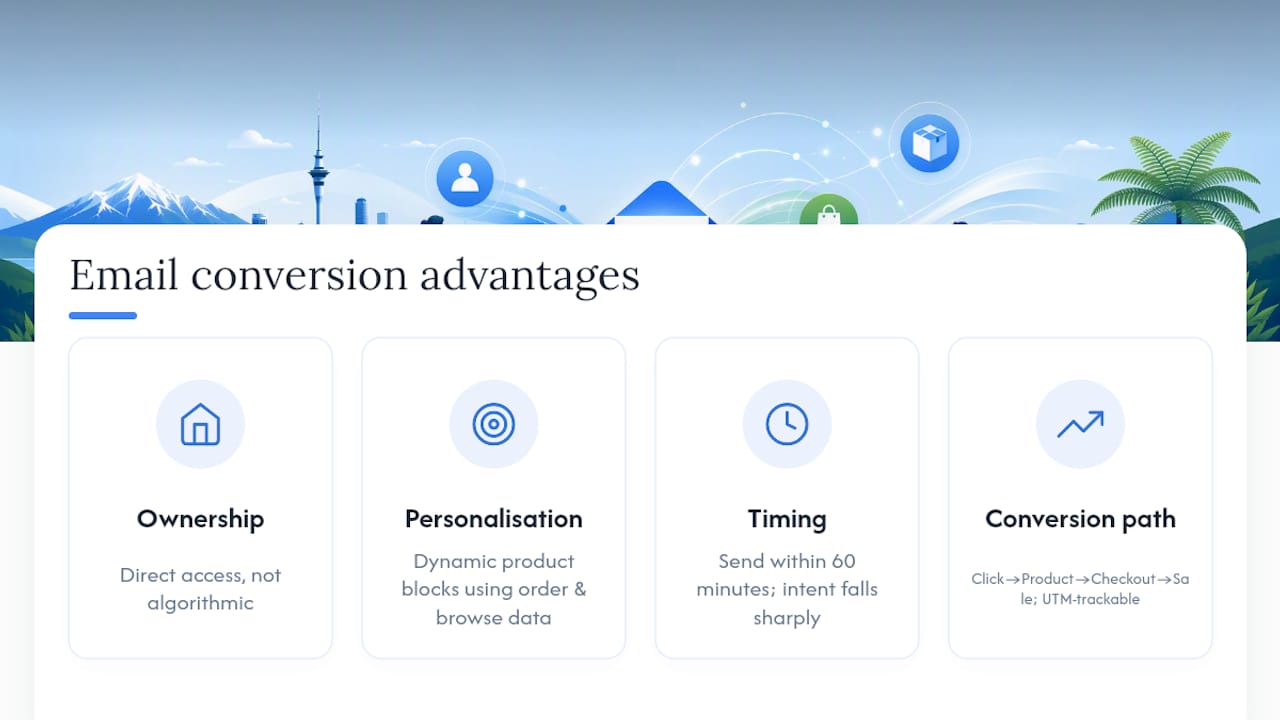
Email converts because of four structural advantages that paid and social channels cannot replicate at the same cost.
Ownership. When you build an email list, you own direct access to those customers. Shopify’s guidance makes this point directly: email’s freedom from algorithmic distribution is a primary reason it frequently delivers higher ROI for e-commerce brands than social channels. Compare that to paid social, where reach is rented and costs rise with competition.
Personalisation and product recommendations. When your ESP receives order history and browse data from your store, it can insert dynamic product blocks showing items the subscriber has viewed, bought previously, or that are frequently bought together. This lifts both conversion rate and average order value (AOV) because the email is showing the right product to the right person rather than a generic catalogue.
Timing. The conversion probability of an abandoned cart email drops sharply after the first hour. Sending within 60 minutes catches the shopper while the purchase intent is still active and before a competitor’s retargeting ad has had time to redirect them.
Conversion pathway. The click-to-revenue path in email is short: click → product page → checkout → attributed sale. Every step is trackable with UTM parameters and GA4 event mapping. This means you can see exactly which email, which subject line, and which product block generated each order, and optimise accordingly.
The distinction between first-touch and assisted revenue matters here. An email that re-engages a lapsed customer who then converts via a Google search two days later will show as assisted revenue in GA4, not direct email revenue. Both count. Measuring only last-click email revenue understates the channel’s true commercial contribution.
Which KPIs actually tell you whether email is making money?
Open rates are a distraction. Apple’s Mail Privacy Protection and similar tools inflate open rates artificially, making them unreliable as a proxy for commercial performance. Branvas’s 2026 benchmark guide is direct on this: revenue per recipient (RPR) and placed order rate are more reliable for commercial decisions than open rates.
Core KPIs for e-commerce email
| KPI | What it measures | Why it matters for revenue | Benchmark reference |
|---|---|---|---|
| Revenue per recipient (RPR) | Revenue generated per delivered email | Direct measure of commercial efficiency per send | Flows typically outperform campaigns significantly |
| Placed order rate | Orders placed as a % of delivered emails | Measures conversion, not just clicks | Flows: 2%+ |
| Click-to-conversion rate | Orders as a % of clicks | Shows landing page and offer effectiveness | Varies by category |
| Average order value (AOV) | Average spend per order attributed to email | Measures upsell and cross-sell effectiveness | Compare to site-wide AOV |
| Customer lifetime value (LTV) | Total revenue per customer over time | Shows retention email impact | Track cohort by acquisition source |
| List growth rate | Net new subscribers per period | Measures acquisition funnel health | Positive month-on-month |
| Deliverability rate | % of sends reaching the inbox | Affects every downstream metric | Around 95% is the target |
| Unsubscribe rate | % unsubscribing per send | Signals list fatigue or irrelevance | Below 0.1% per send |
Attribution and measurement checklist
- Add UTM parameters (source, medium, campaign, content) to every link in every email.
- Confirm GA4 is receiving email traffic as a distinct source/medium (email / newsletter or similar).
- Map purchase events in GA4 so order value is captured, not just sessions.
- Check your ESP’s native revenue reporting against GA4 to identify discrepancies.
- Review assisted conversions in GA4 to capture email’s contribution beyond last-click.
- Set up a revenue dashboard in your ESP that shows RPR and placed order rate by flow and campaign.
Pro Tip: The most common measurement failure is UTM parameters missing from transactional emails. Order confirmations and shipping updates drive real click-through traffic, and without UTMs, that revenue gets misattributed to direct or organic. Fix this in your ESP template settings, not manually per campaign.
For deeper analytics and tracking setup, including GA4 event mapping and ESP integration, this is typically a one-time technical investment that pays back in measurement clarity, for years.
Best practices that lift revenue, plus NZ compliance requirements
What to implement, in order of impact
The sequence matters. Do not spend time on subject-line emoji testing before your flows are live and your tracking is clean.
- Connect order data to your ESP. Segmentation and personalisation are impossible without it.
- Activate welcome and cart flows. These two automations generate revenue from day one.
- Segment your list by purchase behaviour. At minimum: never-purchased, one-time buyers, repeat buyers, lapsed (90+ days since last order).
- Add dynamic product recommendation blocks to cart, browse, and post-purchase flows.
- Set frequency controls. Sending to your full list more than twice a week without segmentation suppresses engagement and damages deliverability.
- Run subject-line A/B tests on your highest-volume sends once flows are generating consistent data.
- Optimise for mobile. Over 60% of commercial emails are opened on mobile devices. Single-column layouts, large tap targets, and concise preview text are non-negotiable.
- Build suppression lists. Remove customers who have purchased recently from promotional sends to avoid cannibalising margin.
New Zealand compliance: what you must do
New Zealand’s Unsolicited Electronic Messages Act 2007 governs commercial email. The practical requirements are:
- Consent: You must have express or inferred consent before sending commercial email. Consent obtained via a checkout opt-in tick-box or a sign-up form qualifies as express consent. Inferred consent applies to existing customers with a recent commercial relationship.
- Identification: Every commercial email must clearly identify the sender.
- Unsubscribe: Every commercial email must include a functional unsubscribe mechanism. Unsubscribe requests must be honoured within five working days.
- Record-keeping: Keep records of how and when consent was obtained for each subscriber.
Non-compliance carries financial penalties. The practical fix is to use a double opt-in flow for all new subscribers, maintain consent timestamps in your ESP, and audit your unsubscribe processing quarterly.
Deliverability hygiene
Poor deliverability means your emails land in spam before a subscriber ever sees them, which makes every other optimisation irrelevant. The three technical foundations are SPF, DKIM, and DMARC records on your sending domain. Beyond that, clean your list every 90 days by suppressing subscribers who have not opened or clicked in six months, and warm new sending domains gradually rather than blasting a cold list from day one.
Which platforms do NZ merchants use, and what should you prioritise?
The three ESPs most commonly used by NZ e-commerce merchants are Klaviyo, Mailchimp, and Campaign Monitor. Shopify is the dominant e-commerce platform integration point for all three.
| Platform | Best for | Revenue-focused features | E-commerce integrations | Pricing model | Revenue tracking |
|---|---|---|---|---|---|
| Klaviyo | Mid-to-large stores needing deep automation | Advanced flows, predictive segmentation, product recommendations | Native Shopify, WooCommerce, BigCommerce | Per-contact, scales with list size | Native revenue dashboard, GA4 integration, UTM defaults |
| Mailchimp | Small stores and beginners | Basic automations, audience segmentation, product blocks | Shopify, WooCommerce (via integration) | Free tier available; paid tiers per contact | Basic e-commerce reporting, GA4 via UTM |
| Campaign Monitor | Agencies and multi-brand merchants | Journey builder, segmentation, transactional email | Shopify, WooCommerce via third-party connectors | Per-campaign or monthly subscriber | Revenue reporting via UTM; less native than Klaviyo |
Klaviyo’s native Shopify integration is the most direct path to order-level revenue data in your ESP, which is why it dominates among stores that take email revenue seriously. Mailchimp suits merchants who are just starting out and want a free tier to validate the channel before investing. Campaign Monitor is a strong choice for agencies managing multiple client accounts.
Integration priorities for revenue tracking
Getting the integration right matters more than the platform choice. Follow this sequence:
- Order sync: Connect your e-commerce platform so every order, including the customer email, product, and value, flows into your ESP in real time.
- Server-side event linking: Where possible, use server-side event tracking rather than relying solely on pixel-based tracking, which is affected by browser privacy settings.
- UTM defaults: Set default UTM parameters at the ESP account level so every link in every email is tagged automatically.
- Data retention and PII handling: Confirm your ESP’s data retention settings comply with NZ’s Privacy Act 2020, particularly around how long customer data is stored and whether it is processed offshore.
Get order-level sync and server-side events working before investing in advanced personalisation. Fancy product recommendation blocks built on incomplete data will underperform a simple flow built on clean data.
What do the benchmarks say, and what does that mean for your store?
Klaviyo’s 2026 benchmark data, drawn from over 183,000 brands, shows that automated flows generate around 41% of total email revenue from roughly 5% of sends. Campaigns make up the bulk of send volume but deliver far lower revenue per send. That ratio is the single most important number in e-commerce email strategy: flows are disproportionately efficient.
A New Zealand department store case study published by LVRA Global demonstrates what this looks like in practice. After rebuilding their email programme with cart and browse automation and department-specific segmentation, the store recorded a 54% year-on-year increase in email-attributed revenue and recovered NZD $640,000 through automation alone. That outcome came from structural changes to flows and data connectivity, not from sending more emails.
A worked example: abandoned cart revenue recovery
Suppose your store has numerous cart abandonment events per month, a multi-email cart flow, and a modest placed order rate across the sequence. This translates to a number of recovered orders per month. At a reasonable average order value (AOV), the flow generates meaningful recovered revenue automatically, every month, without additional ad spend. Increase the placed order rate through better timing, a stronger offer in email, and a more relevant subject line, and the same number of events generate significantly more recovered revenue. The difference is optimisation, not volume.
Pro Tip: When calculating the revenue impact of a flow improvement, use placed order rate multiplied by monthly trigger volume multiplied by AOV. This gives you a dollar figure to justify the time investment in testing and refinement, and it is the same calculation your ESP’s native reporting should be showing you.
How Beyondclix approaches email revenue measurement
The most common problem Beyondclix sees with e-commerce email programmes is a disconnect between sends and sales data. Merchants have flows running, but the ESP is not receiving order history, so segmentation is based on email behaviour alone rather than actual purchase patterns. The result is a programme that looks active but leaves significant revenue on the table.
The measurement-first process Beyondclix uses follows four steps:
- Connect: Integrate the ESP with the e-commerce platform at the order level, and map purchase events to GA4 with UTM defaults in place.
- Measure: Establish baseline RPR and placed order rate by flow type before making any changes.
- Build and test: Activate or rebuild welcome and cart flows with correct timing, then A/B test subject lines and offer structures against the RPR baseline.
- Iterate: Review RPR and placed order rate monthly, segment by lifecycle stage, and expand automation to browse abandonment and post-purchase once the core flows are stable.
Connecting email to sales data is not a nice-to-have. It is the foundation that makes every other optimisation measurable. Without it, you are optimising for open rates and clicks while your actual revenue impact stays invisible. The stores that grow email revenue consistently are the ones that treat measurement as the first task, not the last.
NZ practitioners have found that linking order and browse history to the ESP unlocks personalisation and measurable, always-on revenue in ways that broadcast campaigns simply cannot match. Beyondclix’s client results reflect this measurement-first approach across e-commerce accounts.
Pro Tip: Ask your ESP for a revenue-by-flow report before your next planning meeting. If the report does not exist or shows zero revenue for flows you know are live, your tracking is broken. Fix that before any other optimisation.
Your 30/60/90-day plan to grow email-driven revenue
This plan is structured for a store that has an ESP in place but has not yet built a complete automation stack or connected revenue tracking.
Days 1–30: foundations
- Audit your ESP-to-platform integration. Confirm order data is flowing in real time.
- Set UTM defaults at the account level in your ESP.
- Verify GA4 is receiving email traffic and purchase events with correct attribution.
- Activate or rebuild your welcome series (3 emails: brand introduction, social proof, offer).
- Activate or rebuild your abandoned cart flow (3 emails: 1 hour, 24 hours, 72 hours).
- Set up a weekly revenue report in your ESP showing RPR and placed order rate by flow.
Primary KPI to watch: Flows live and generating attributed revenue within 30 days.
Who owns this: Developer (integration), marketing (copy and flow logic), or agency if neither is available in-house.
Days 31–60: refinement
- Segment your list into at minimum four groups: never-purchased, one-time buyers, repeat buyers, lapsed.
- Add dynamic product recommendation blocks to cart and post-purchase flows.
- Build a browse abandonment flow (2 emails: 4 hours, 48 hours).
- Run your first subject-line A/B test on the highest-volume campaign send.
- Review deliverability metrics. Clean subscribers inactive for 90+ days.
- Confirm NZ compliance: consent records, unsubscribe processing, sender identification.
Primary KPI to watch: RPR uplift versus the Day 30 baseline; placed order rate by flow.
Who owns this: Marketing, with developer support for dynamic blocks.
Days 61–90: scale and optimise
- Build a post-purchase cross-sell flow triggered 7–14 days after first purchase.
- Build a win-back flow for customers lapsed 90+ days.
- Test send-time optimisation for your top two flows.
- Review AOV by flow to identify upsell opportunities.
- Set up a monthly LTV cohort report to track retention email impact over time.
- Primary KPI to watch: Email-attributed revenue as a percentage of total store revenue; LTV by acquisition cohort.
- Who owns this: Marketing, with agency support for advanced segmentation and testing.
What the data keeps telling us about email and revenue
Most e-commerce stores are sitting on a recoverable revenue gap in their email programme. The flows are either not live, not connected to sales data, or not optimised past the default template. The FSB’s beginner guide to e-commerce email makes the point clearly: define your goals, choose your ESP, and get welcome and cart flows live before anything else. That sequence is right. The stores that treat email as a broadcast channel for promotions are leaving the automated, always-on revenue sitting idle.
The other pattern worth naming: merchants who invest in measurement first, before creative or frequency, consistently see better outcomes. When you know your RPR by flow, you know exactly where to spend the next hour of optimisation time. Without it, you are guessing.
Beyondclix helps NZ e-commerce stores turn email into a measurable revenue channel
E-commerce stores that want email to pull its weight on revenue need three things working together: the right automation stack, clean data flowing between their store and ESP, and measurement that connects sends to sales. That is precisely what Beyondclix delivers for established NZ merchants.
Beyondclix’s email remarketing service covers the full stack: ESP integration, welcome and cart flow builds, segmentation, and GA4 revenue attribution setup. For stores that want a broader growth programme, the e-commerce growth guarantee ties outcomes to measurable revenue targets rather than activity metrics. The analytics and tracking service handles the GA4 and UTM setup that makes every email send attributable to a dollar figure.
If your welcome and cart flows are not live, your tracking is not connected, or your RPR is not improving month-on-month, get in touch with Beyondclix to get a clear picture of what your email programme should be generating.
Sources
- Ecommerce Email Marketing Flows That Recover Lost Revenue – AcquireX
- 80+ Email Marketing Benchmarks for Ecommerce (2026) – Branvas
- Benefits of email marketing (Shopify blog)
- Beginner’s guide to email marketing for e‑commerce – FSB
FAQ
How does email marketing directly increase e-commerce sales?
Email drives sales through automated flows triggered by customer behaviour, such as cart abandonment and post-purchase sequences, which reach shoppers at the moment of highest purchase intent. Ownership of the subscriber list means every send reaches the audience directly, without algorithmic interference.
What is the 80/20 rule in e-commerce email?
In e-commerce email, the principle holds that a small share of sends, specifically automated flows, generate a disproportionate share of revenue.
What is revenue per recipient in email marketing?
Revenue per recipient (RPR) is the average revenue generated per delivered email, calculated by dividing total email-attributed revenue by the number of emails delivered. It is the most direct measure of an email programme’s commercial efficiency and is more reliable than open rates for guiding investment decisions.
Does email marketing work for small NZ e-commerce stores?
Yes. The NZ department store case study from LVRA Global shows that structural changes to flows and segmentation, not list size, drive revenue outcomes. A small store with a well-connected ESP and live welcome and cart flows will outperform a larger store broadcasting to an unsegmented list.
What are the legal requirements for commercial email in New Zealand?
Under the Unsolicited Electronic Messages Act 2007, commercial emails must have the recipient’s consent, clearly identify the sender, and include a working unsubscribe mechanism. Unsubscribe requests must be processed within five working days, and consent records should be maintained for each subscriber.
Recommended
- Why digital marketing drives leads for NZ businesses – BeyondClix Blog
- Ecommerce marketing East Auckland: local agency guide – BeyondClix Blog
- Wezealor.com alternatives for NZ businesses in 2026 – BeyondClix Blog
- Digital advertising formats for leads: your 2026 NZ guide – BeyondClix Blog
Want this run for your business?
Talk to our CEO. We will show you where the money is leaking and what we would do about it.