

A homeowner in Hamilton wants a heat pump before summer. Five years ago they’d have typed “heat pump installers” into Google and clicked through a few websites. Today some of them open ChatGPT instead, describe the house, ask which size they need and who installs locally, and read one long, tailored answer. If your business isn’t in that conversation, you never hear about the job.
Since earlier this year, New Zealand businesses can pay to be in it. ChatGPT now shows ads underneath its answers, NZ businesses can buy them directly, and on 9 November 2026 OpenAI changed how you bid for them in a way that makes the platform far more practical for a business that wants enquiries, not just eyeballs. This guide explains what ChatGPT Ads are in plain words, what just changed, what it costs to try, and how to tell whether it’s worth your money.
What ChatGPT Ads are, in plain words
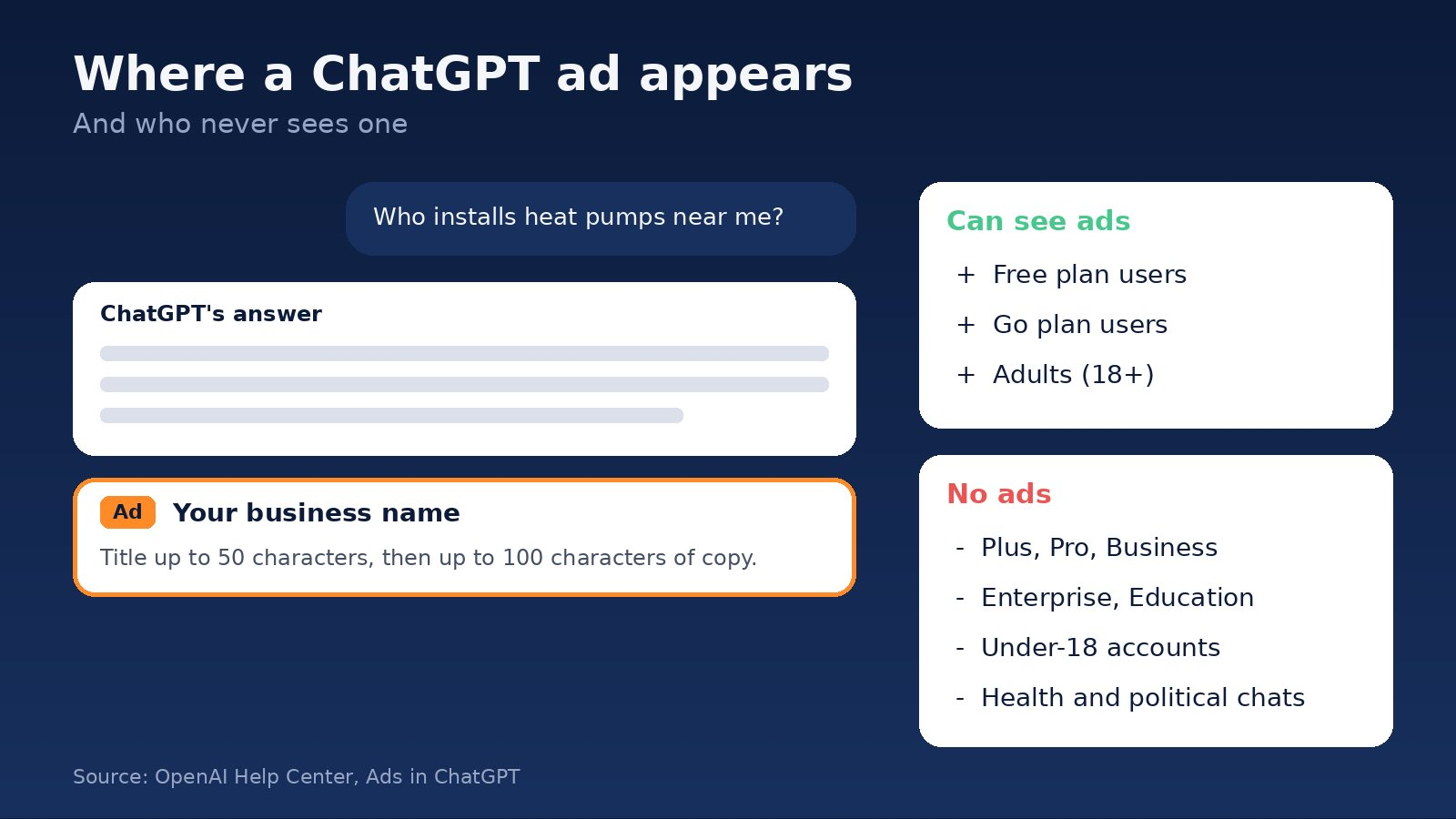
ChatGPT Ads are paid placements that appear below ChatGPT’s answer when a conversation is relevant to what you sell. Someone asks about running shoes, accounting software or a weekend away, and a clearly labelled ad for a relevant business can appear under the reply.
The important part for a business owner is what the ad doesn’t do. OpenAI says ads run on separate systems from the chat model and don’t influence the answers ChatGPT gives (OpenAI Help Center: Ads in ChatGPT). You can’t pay to be recommended in the answer itself. You’re buying the spot underneath it, which is closer to a search ad than to a mention.
OpenAI also says advertisers don’t get access to people’s chats, chat history, memories or personal details. You get aggregated performance data, such as total views and clicks, not a transcript of what anyone asked (OpenAI Help Center).
Is it available here?
Yes. New Zealand was one of the first markets OpenAI named when it announced ad testing, alongside Australia and Canada (OpenAI: Testing ads in ChatGPT). OpenAI’s availability page now lists New Zealand as open for self-serve buying in Ads Manager, provided the legal entity that advertises and gets billed is based here (OpenAI Help Center: Ads Manager availability).
The platform has grown quickly. On 21 October 2026 OpenAI said more than 100,000 advertisers had run campaigns since launch and that ads were available in 89 countries (OpenAI: ChatGPT Ads expands to 26 new countries). Those are OpenAI’s own figures, so read them as momentum, not proof.
Who sees the ads, and who doesn’t
This matters more than it sounds, because it decides who you’re actually paying to reach.
- Only Free and Go plan users see ads. Plus, Pro, Business, Enterprise and Education accounts don’t (OpenAI Help Center). If your best customers are corporate buyers who use ChatGPT through a company Business or Enterprise account, they won’t see your ad there.
- No ads for under-18s. Accounts OpenAI identifies as belonging to under-18s are excluded.
- No ads near sensitive conversations. OpenAI says ads aren’t eligible to appear near personal health, mental health or political topics, and political advertising isn’t currently allowed (OpenAI Help Center; OpenAI ad policies).
For most consumer-facing NZ businesses (trades, home services, retail, hospitality, travel, education) that still leaves a large, everyday audience. For health providers and financial services, the rules are stricter and still changing, so check eligibility before you plan a budget.
What changed on 9 November: you can now say what a lead is worth
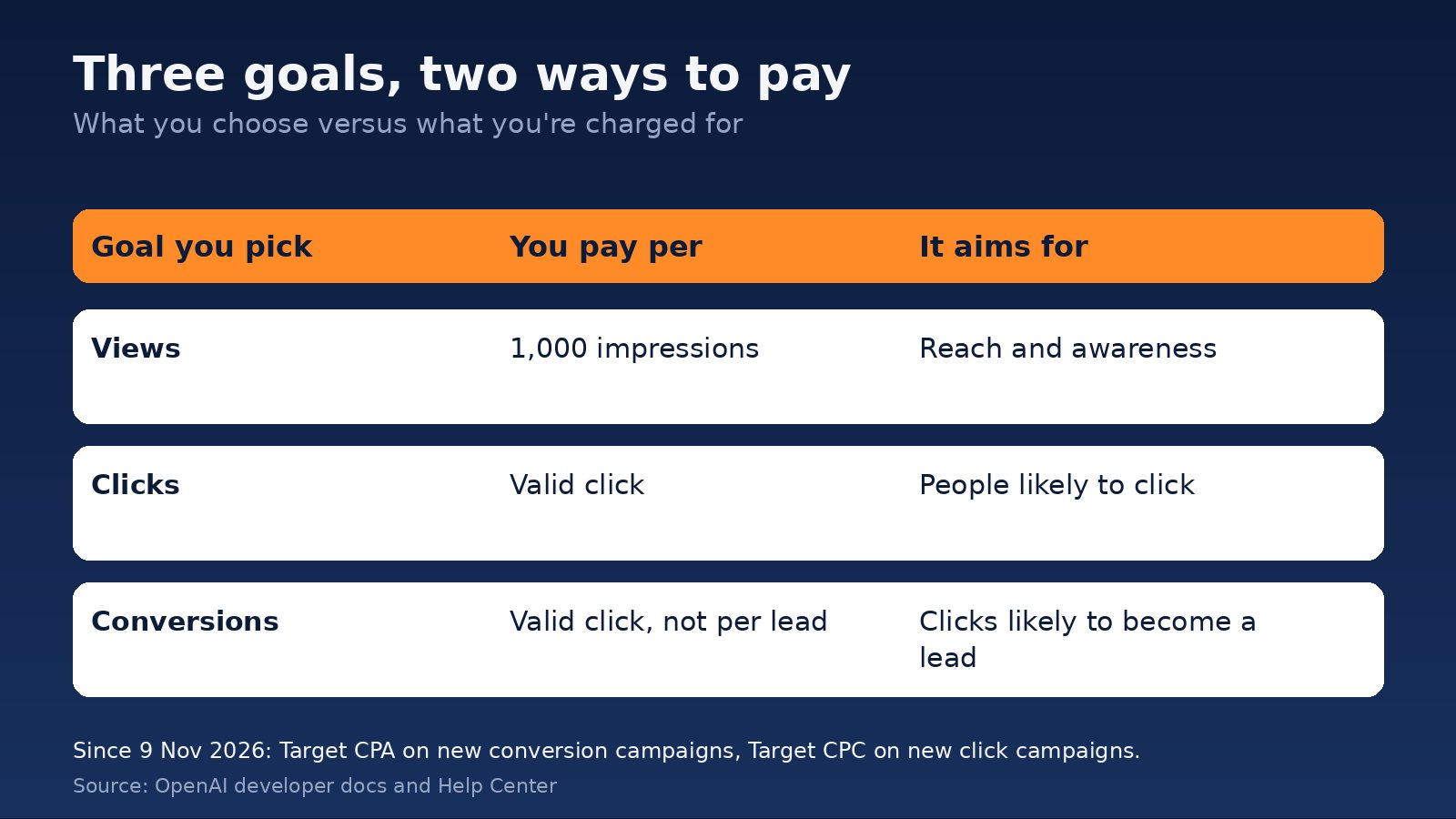
Until this week, a business wanting enquiries from ChatGPT Ads set a maximum bid and hoped the numbers worked out. From Monday 9 November 2026, new conversion campaigns use Target CPA instead. CPA stands for “cost per acquisition”: in plain terms, the average amount you’re happy to pay for one enquiry, booking or sale. New click campaigns get the equivalent, Target CPC, an average cost per click (OpenAI Help Center: Bidding strategies and how pricing works).
Three things about this change are worth knowing before you spend:
- It’s an average, not a price. OpenAI is explicit that your target isn’t a fixed price per lead. Some will cost more, some less.
- Set it from real numbers. OpenAI recommends basing the target on recent actual performance and warns that a target set too low may restrict delivery. In other words, if you tell it you’ll only pay $5 for a lead that really costs $60, your ads will barely show.
- The old settings are going. Existing campaigns keep their old Max Bid and Max CPC settings for now, but those retire on 1 January 2027 (OpenAI Help Center). If you or your agency started a campaign earlier this year, it needs moving over before the holidays.
The catch most people miss: you still pay per click
Choosing a “conversions” goal doesn’t mean you only pay when someone enquires. OpenAI’s documentation says conversion-optimised campaigns aim delivery at clicks more likely to lead to your chosen action, but billing “does not change to pay per conversion”. You’re charged for valid clicks, and the auction sets the actual price (OpenAI developer docs: Conversion-optimized campaigns). Your real number is spend divided by enquiries.
What it costs to try
There are two costs, the same as any ad platform: what you pay OpenAI for the ads, and what you pay someone to set up and run them.
On the ads side, OpenAI’s campaign guide sets a daily minimum of NZ$25 for New Zealand (OpenAI Help Center: Creating campaigns for ChatGPT Ads). Run every day for a month, that’s roughly NZ$750 in media before anyone manages it.
On the management side, our published plans are on the pricing page, and your ad spend goes straight to OpenAI. If a quote for ChatGPT Ads doesn’t separate those two numbers, ask why.

How you’d know it’s working
ChatGPT Ads can only learn which clicks become customers if your website tells it. OpenAI offers two ways: a pixel, which is a snippet of code on your site, and a Conversions API, which sends results from your server or booking system. OpenAI describes the Conversions API as a more reliable tracking source than the pixel alone (OpenAI developer docs).
Each conversion campaign optimises toward exactly one standard action, chosen from OpenAI’s list. For a service business, the useful ones are “lead created” (a form submitted or a request for contact) and “appointment scheduled” (a booking, demo or consultation). Retailers would use “order created” (OpenAI developer docs: Supported events). Pick carefully: OpenAI says you can’t change a campaign’s goal or event after it’s created. You’d have to build a new one.
Then judge it the way you’d judge any channel:
- Cost per enquiry, not cost per click. A cheap click that never enquires is the most expensive kind.
- Quality of the enquiry. Ask your team whether ChatGPT leads are real jobs, tyre-kickers or spam.
- Side by side with Google Ads. If you already run Google Ads, the honest test is whether a ChatGPT enquiry costs about the same, less, or more. Tag the links with UTM codes so ChatGPT traffic shows up separately in Google Analytics.
If your website doesn’t track enquiries properly today, fix that first. It’s the same problem we covered in what tracking and privacy changes do to your lead numbers, and it applies to every paid channel, not just this one.
Is it right for your business yet?
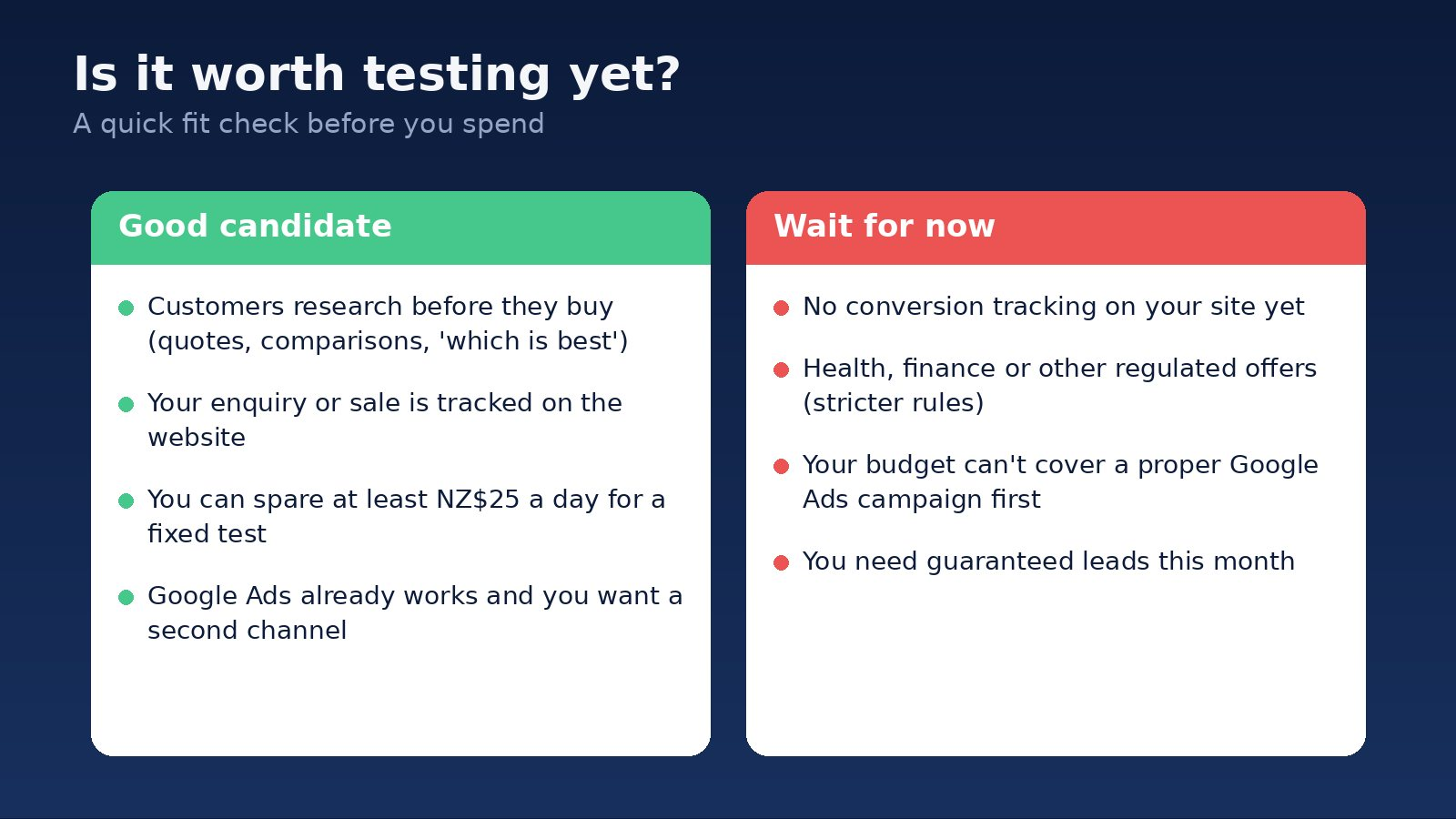
ChatGPT Ads suit businesses whose customers ask questions before they buy. “What size heat pump for a three-bedroom house?” “Which accounting software suits a tradie?” “Is a glass or tiled splashback better?” Those are conversations where a relevant ad is useful rather than annoying, and where the person is often close to a decision.
It’s a weaker fit if you need guaranteed volume this month, if your offer falls into a restricted category, or if your total marketing budget can’t yet cover a properly run Google Ads campaign. Google Search still catches the person who already knows what they want and types it in. For most NZ businesses, that remains the first place to spend. See our guide to Google Ads in Auckland if you’re not there yet.
And be wary of anyone promising guaranteed results. The platform is in beta and changes month to month: in the last few weeks alone OpenAI has added 26 countries and replaced its bidding system. It’s new for every advertiser and every agency, including us. The businesses that do well will be the ones that test it carefully, measure it honestly and keep their best channel running while they do.
What the ads themselves look like
Each ad is short: a title of 3 to 50 characters and up to 100 characters of body copy, plus an image and a link to your website (OpenAI developer docs: Campaign management). There are no keywords in the Google sense. Instead you can add “context hints”, plain descriptions of what you offer and who it helps. OpenAI is clear these aren’t exact-match keywords and don’t guarantee your ad appears in a given conversation; specific beats vague, so “ducted heat pumps for older Hamilton villas” beats “heat pumps” (OpenAI developer docs: Targeting).
This is also separate from showing up in ChatGPT’s answers for free, which depends on your website, reviews and reputation. If that’s the bigger question for you, read getting your business mentioned when customers ask AI.
Where to start
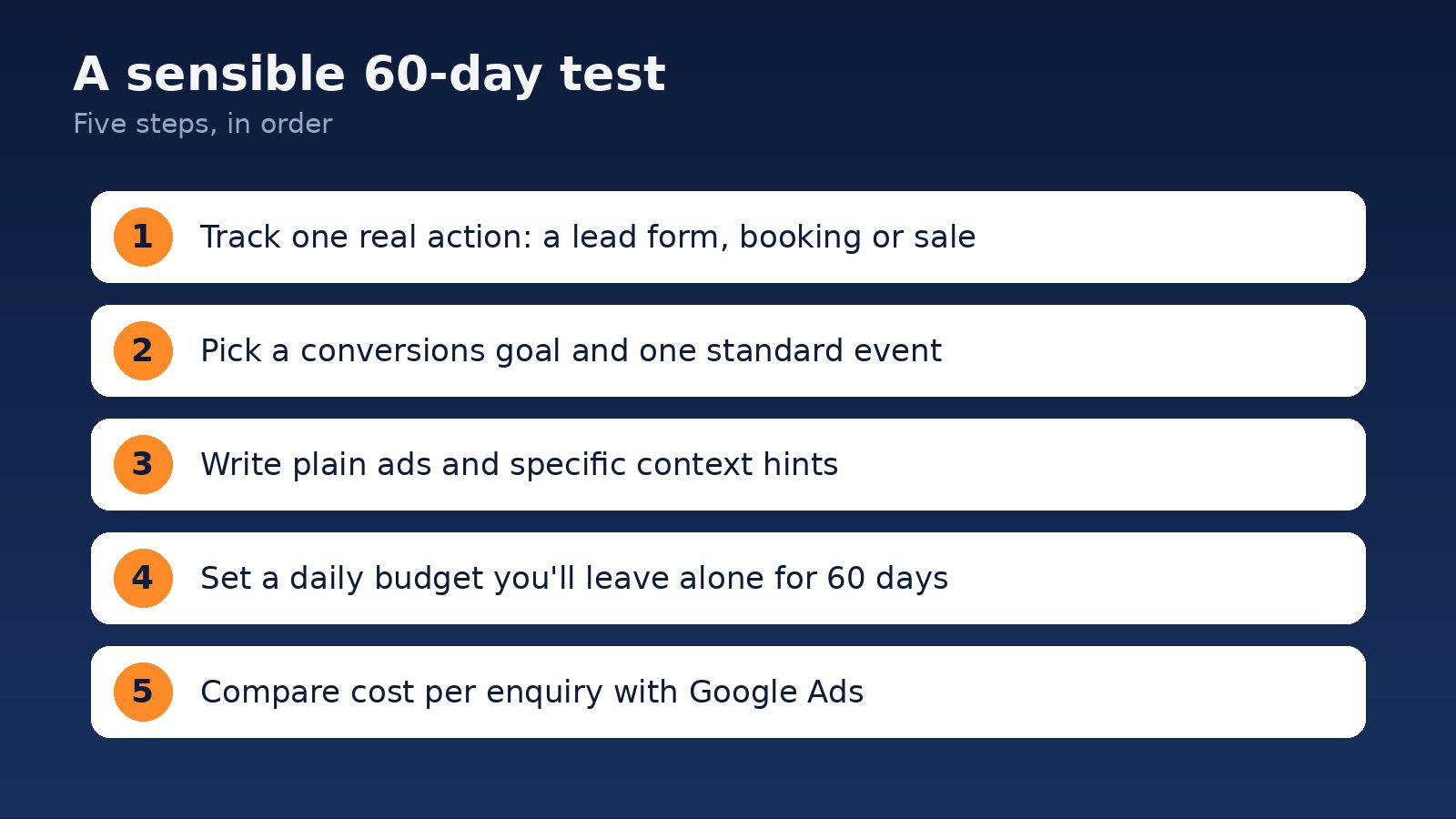
Get your tracking right first, choose one goal you won’t need to change, write plain ads in your customers’ words, then leave a fixed budget alone for about 60 days and compare the cost per enquiry with what you already run. Grow it, fix it or stop it based on that number, not on the hype.
If you’d like help deciding whether ChatGPT Ads suit your business, or a test set up and measured properly alongside your existing campaigns, see our ChatGPT Ads service or browse our other services.
Frequently asked questions
Can New Zealand businesses advertise on ChatGPT?
Yes. OpenAI lists New Zealand as available for self-serve buying in Ads Manager, as long as the legal entity advertising and being billed is based in New Zealand.
How much do ChatGPT Ads cost in NZ?
OpenAI sets a daily minimum of NZ$25 per campaign for New Zealand, which is about NZ$750 a month if it runs every day. Conversion campaigns still bill per valid click. Management fees, if you use an agency, are separate.
Can I pay to have ChatGPT recommend my business in its answer?
No. OpenAI says ads run separately from the chat model and don’t influence its answers. Ads appear beneath the answer and are labelled.
What changed with Target CPA on 9 November 2026?
New conversion campaigns now use Target CPA, an average cost per enquiry or sale you’re aiming for, instead of a maximum bid. New click campaigns use Target CPC. The older Max Bid and Max CPC settings retire on 1 January 2027.
Who sees ChatGPT ads?
Adults on ChatGPT’s Free and Go plans. Plus, Pro, Business, Enterprise and Education users don’t see ads, under-18s are excluded, and ads don’t appear near health, mental health or political conversations.
Should I move my Google Ads budget to ChatGPT?
Not all of it, and not straight away. Treat ChatGPT Ads as a measured test alongside a working Google Ads campaign, then compare cost per enquiry after about two months.
Sources
- OpenAI Help Center: Ads in ChatGPT (vendor documentation)
- OpenAI Help Center: Ads Manager availability (vendor documentation)
- OpenAI Help Center: Creating campaigns for ChatGPT Ads (vendor documentation)
- OpenAI Help Center: Bidding strategies and how pricing works in ChatGPT Ads (vendor documentation)
- OpenAI: Testing ads in ChatGPT (vendor announcement)
- OpenAI: ChatGPT Ads expands to 26 new countries (vendor announcement, 21 October 2026)
- OpenAI: Ad policies
- OpenAI developer docs: Conversion-optimized campaigns
- OpenAI developer docs: Supported events
- OpenAI developer docs: Campaign management
- OpenAI developer docs: Targeting
Want this run for your business?
Talk to our team. We will show you where the money is leaking and what we would do about it.