
For established New Zealand marketing teams, the best move is agency-run A/B testing and experimentation delivered as part of an integrated digital growth programme. Not a standalone tool subscription, not a freelancer running one-off splits. A multidisciplinary agency that owns the full loop: research, hypothesis, building, QA, analysis, and learning capture. The section on evaluating and choosing an agency gives you a practical scoring checklist to shortlist providers.
Key takeaways
Agency-run experimentation delivers compounding digital growth when ownership of strategy, measurement, and learning sits with a multidisciplinary team running a documented, repeatable programme.
| Point | Details |
|---|---|
| Ownership beats execution | Whoever holds the backlog and learning log determines long-term programme value. |
| Traffic and tracking first | Broken tracking or insufficient traffic makes A/B test results meaningless before you start. |
| Retainer models dominate NZ | Expect 3–6 month minimum retainers; price to test throughput, not a flat fee. |
| Evaluate on four dimensions | Weight ownership, measurement expertise, team capability, and reporting transparency highest. |
| Beyondclix for integrated delivery | Beyondclix combines GA4-ready analytics, paid channels, and CRO under one roof for NZ businesses. |
Table of Contents
- Why ownership of experimentation matters more than who runs the tests
- When should you hire a CRO agency instead of building in-house?
- What a quality agency experimentation programme actually delivers
- How to evaluate and choose an experimentation agency
- What to expect on costs and timelines for agency-run experimentation in NZ
- Why Beyondclix is a practical choice for NZ businesses wanting agency-run experimentation
- Legal and privacy considerations for A/B testing in New Zealand
- Why the “tools” framing misses the point for most NZ teams
- Beyondclix can run your experimentation programme from day one
- FAQ
Why ownership of experimentation matters more than who runs the tests
Most businesses frame this as a resourcing question: who will build and run the tests? The decisive question is actually who owns the strategy and the learning. Ownership means maintaining the backlog, setting the prioritisation logic, designing the measurement plan, and capturing what each experiment teaches the business. Execution, by contrast, is building the test variant and running QA. You can outsource execution indefinitely without ever compounding value, if nobody is institutionalising the insights.
When a business lacks the full bench (research, UX design, front-end development, QA, and statistical analysis), an agency can kickstart the programme and hold that capability until an in-house team is ready to absorb it. The risk is fragmentation: experiment history scattered across tools, learnings living only in the agency’s head, and no clean handover when the engagement ends.
- Ownership of strategy should sit with whoever will embed learnings into product and marketing decisions.
- Execution can be delegated, but the backlog, prioritisation logic, and measurement plan must be documented and transferable.
- Tool fragmentation compounds when multiple agencies or freelancers each use their own platforms without a shared experiment log.
- Knowledge retention drops sharply when there is no structured handover plan at the end of an engagement.
Pro Tip: Insist on a documented experiment log and a written handover plan before signing any agency contract. These two artefacts are what separate a programme that compounds value from one that resets every time a contract ends.
When should you hire a CRO agency instead of building in-house?
Hire an agency when you lack the combined capability or need speed-to-impact while keeping long-term ownership options open. Building in-house takes time and salary budget that most established businesses cannot absorb quickly enough to generate the validated wins needed for leadership buy-in.
| Business stage | Traffic / volume | Recommended path |
|---|---|---|
| Established, no CRO team | Moderate to high | Full-service agency retainer |
| Established, partial team | Moderate to high | Agency for strategy + delivery bench |
| Established, has analyst | Low | Qualitative fixes + agency audit |
| Growth-stage, limited dev | Any | Agency with reserved capacity model |
| Mature, full in-house team | High | In-house with agency QA or peer review |
The clearest signals to hire: insufficient multidisciplinary resourcing, no dev or QA bandwidth for test builds, a need for fast validated wins to secure leadership buy-in, or a desire for a packaged delivery bench that can scale test throughput without adding headcount.
One caveat worth stating plainly: agencies vary widely in what they mean by “strategy.” Some use the word to describe writing a test brief. Others mean owning the full prioritisation framework, measurement plan, and learning loop. Clarify scope and ownership before you sign, and ask specifically who holds the experiment log when the engagement ends.
What a quality agency experimentation programme actually delivers
A quality agency runs experimentation as a repeatable programme, not a series of one-off A/B tests. The loop is: research → hypothesis → prioritise → build → QA → run → analyse → iterate. Each cycle feeds the next, and the backlog grows richer with every completed experiment.
Core team roles
| Role | Contribution to the programme |
|---|---|
| CRO strategist | Owns backlog, prioritisation, hypothesis quality, and learning capture |
| Data analyst | Measurement plan, sample-size calculation, results analysis, and reporting |
| UX / product designer | Research synthesis, wireframes, and variant design |
| Front-end developer | Test build, variant QA, and tagging |
| QA specialist | Cross-browser and cross-device verification before launch |
How to evaluate and choose an experimentation agency
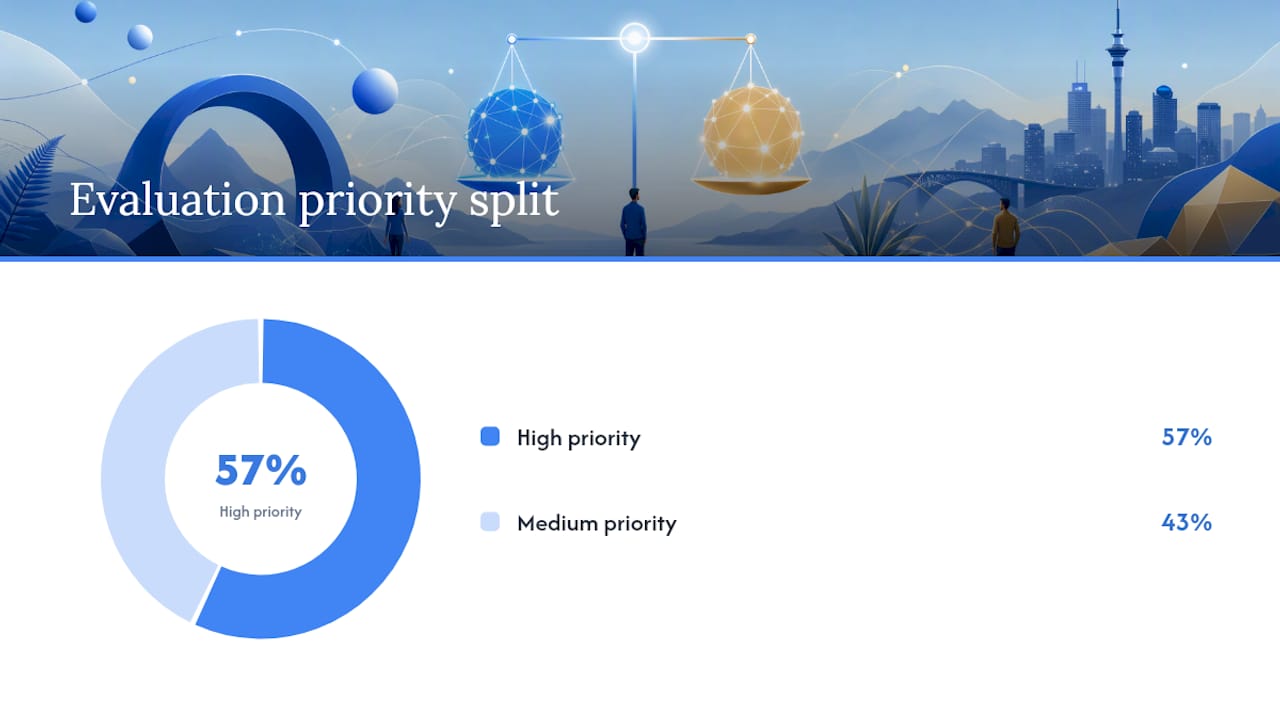
Weight your scoring towards ownership of learning, measurement expertise, multidisciplinary delivery, and reporting transparency. Those four dimensions separate agencies running a genuine programme from those running isolated tests.
| Evaluation dimension | What to look for | Suggested weight |
|---|---|---|
| Who owns strategy vs execution | Clear documented ownership; transferable backlog | High |
| Team and capability | Named roles: strategist, analyst, designer, developer, QA | High |
| Measurement and analytics | GA4 implementation, consent-compliant tracking, server-side events | High |
| Prioritisation method | Scored hypothesis backlog (e.g. PIE or ICE framework) | Medium |
| Pricing and billing model | Retainer or reserved capacity; clear deliverables per period | Medium |
| Reporting transparency | Experiment log shared with client; closed-loop outcome reporting | High |
| NZ market experience | Local commerce knowledge; familiarity with NZ consumer behaviour | Medium |
Sample questions to ask in a pitch or RFP:
- “Can you show us an anonymised experiment log from a current client?”
- “Who holds the backlog and measurement plan if we end the engagement?”
- “How do you handle tests on pages with low traffic?”
- “What does your GA4 implementation audit cover?”
Red flags: an agency that promises high test velocity without sizing your traffic first; vague reporting language with no experiment-level detail; no clear answer on who owns the experiment history; or a measurement plan that does not mention GA4 or consent-compliant tracking.
What to expect on costs and timelines for agency-run experimentation in NZ
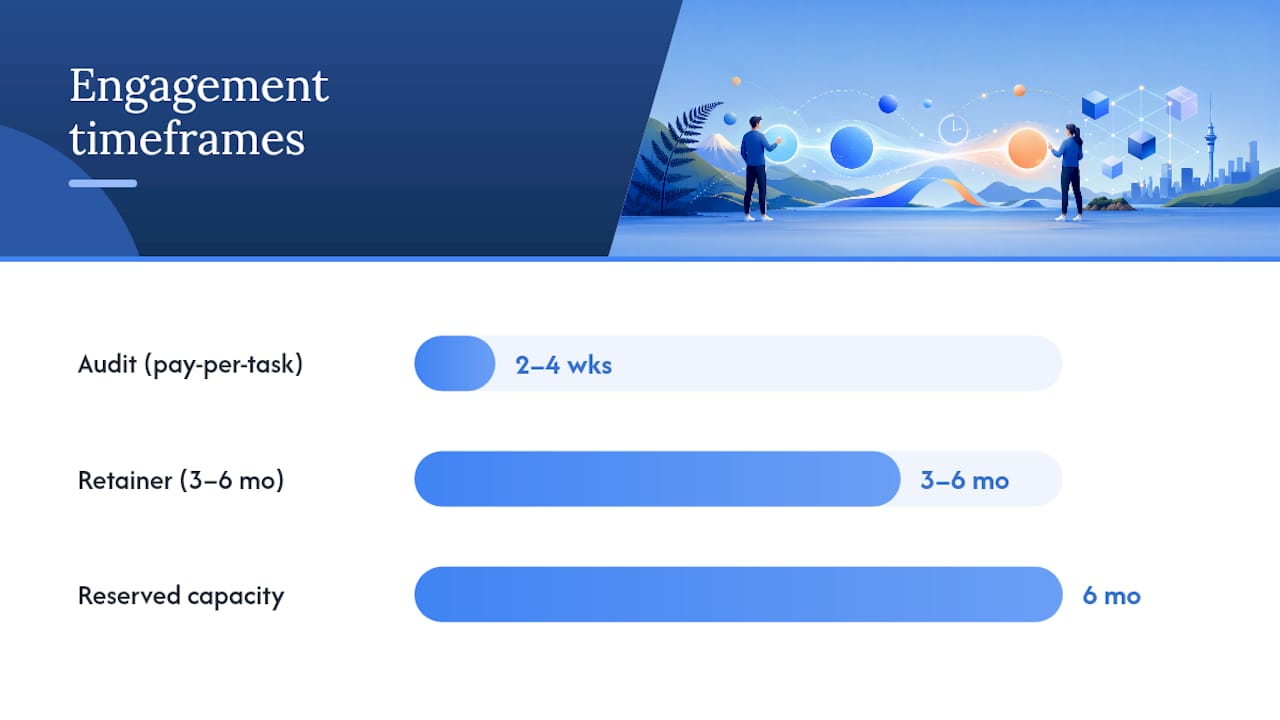
Retainer and reserved-capacity models are the most common engagement shapes in New Zealand. Budgets scale with the multidisciplinary throughput you need and the traffic volumes your site generates.
| Engagement model | Typical deliverables | Approximate timeframe |
|---|---|---|
| Audit (pay-per-task) | Measurement health check, prioritised opportunity list | 2–4 weeks |
| Retainer (white-label or direct) | Ongoing backlog, 1–3 tests per month, monthly reporting | 3–6 month minimum |
| Reserved capacity | Dedicated delivery bench, higher test throughput, custom reporting | 6 months |
Timeline from engagement start to first meaningful test result: expect 4–8 weeks for discovery and measurement setup, then 4–6 weeks per test cycle depending on traffic volume, dev availability, and client approval speed.
Pro Tip: Price to throughput, not to a flat test fee. Ask how many fully analysed tests per month one delivery specialist can manage at your traffic level. That number is the real unit of value, not the headline test count.
A prerequisite that often delays programmes: if your conversion tracking is broken or incomplete, the agency will need to fix it before any test result is meaningful. Budget for a measurement health check as the first deliverable.
Why Beyondclix is a practical choice for NZ businesses wanting agency-run experimentation
Beyondclix delivers integrated experimentation as part of a broader digital growth strategy, combining measurement, paid advertising, and conversion optimisation under one roof. That integration matters because the best experimentation programmes feed learnings back into ad creative, landing page design, and audience targeting simultaneously.
- Measurement and analytics: Analytics and tracking setup includes GA4 implementation, consent-compliant event tracking, and custom dashboards for closed-loop reporting.
A typical retainer scope includes: a measurement health check and baseline audit in weeks 1–2; a prioritised hypothesis backlog by week 4; one to three tests per month from month two; and monthly closed-loop reporting with experiment logs shared with the client.
Legal and privacy considerations for A/B testing in New Zealand
New Zealand’s Privacy Act 2020 governs how businesses collect and use personal data, including behavioural data gathered during A/B tests. Any experiment that collects identifiable user data, such as form submissions, session recordings, or heatmaps tied to individual sessions, must comply with the Act’s information privacy principles. Consent-compliant tracking is not optional: if your site serves users under cookie consent frameworks, your experimentation platform and analytics stack must respect those consent signals.
The Office of the Privacy Commissioner provides guidance on data collection obligations. For e-commerce stores processing payments or handling customer accounts, the combination of the Privacy Act 2020 and the Consumer Guarantees Act 1993 means that any test variant affecting checkout flows, pricing display, or product descriptions carries legal as well as conversion risk. Test variants that misrepresent pricing or product terms, even temporarily, can create liability.
This article provides general information only, not legal advice. Confirm your specific obligations with a qualified New Zealand legal professional or the Office of the Privacy Commissioner.
Why the “tools” framing misses the point for most NZ teams
Most articles about conversion rate optimisation (CRO) for digital growth focus on which software platform to pick. That framing serves businesses with a full in-house team ready to run experiments. For the majority of established NZ marketing teams, the constraint is not the platform. It is the absence of a strategist who owns the backlog, a developer who can build clean variants without breaking the site, and an analyst who will not peek at results before the sample size is reached.
The agencies that retain clients longest are the ones that productise the programme loop into a retainer and report on closed-loop outcomes, not just test counts. That is the standard worth holding any shortlisted agency to. A high test-velocity pitch with no mention of sample-size discipline or experiment logs is a warning sign, not a selling point.
Beyondclix can run your experimentation programme from day one
Beyondclix gives NZ marketing teams a done-for-you experimentation programme without the overhead of building a multidisciplinary in-house team. Where most agencies treat CRO as a bolt-on, Beyondclix runs it as part of an integrated growth engine: paid channels, analytics and tracking, and conversion testing working together so every learning improves both your site and your ad spend simultaneously.
The first 30–60 days include a measurement health check, a prioritised hypothesis backlog, and your first test plan, all documented and owned by you from day one. To request a discovery audit or discuss a retained CRO engagement, contact Beyondclix or review the full services offering to see how experimentation fits your broader growth programme.
FAQ
What is agency-run A/B testing and CRO?
Agency-run CRO is a managed experimentation programme where an external team handles research, hypothesis development, test builds, QA, analysis, and reporting on your behalf, rather than you running tests in-house.
How much traffic do you need before A/B testing makes sense?
There is no universal threshold, but low-traffic pages rarely produce statistically meaningful results. When traffic is insufficient, qualitative research and best-practice UX fixes typically deliver faster gains than underpowered A/B splits.
What engagement model is most common for NZ agencies?
Retainer and reserved-capacity models are most common, typically with a 3–6 month minimum commitment to allow enough test cycles to produce compounding learnings.
How does Beyondclix handle experiment documentation and handover?
Beyondclix maintains documented experiment logs and a prioritised backlog throughout the engagement, with all artefacts transferred to the client so learnings are retained regardless of how the engagement evolves.
What privacy rules apply to A/B testing in New Zealand?
New Zealand’s Privacy Act 2020 governs behavioural data collection during experiments. Any test collecting identifiable user data must comply with its information privacy principles, and consent-compliant tracking is required where cookie consent frameworks are in place.
Recommended
- Digital growth strategy components for NZ businesses in 2026 – BeyondClix Blog
- Wezealor.com alternatives for NZ businesses in 2026 – BeyondClix Blog
- Digital advertising formats for leads: your 2026 NZ guide – BeyondClix Blog
- Facebook ads agency Auckland: drive real ROI in 2026 – BeyondClix Blog
Want this run for your business?
Talk to our CEO. We will show you where the money is leaking and what we would do about it.