

A family in Brisbane is planning a week in New Zealand. They do not type “Queenstown activities” into Google and click through ten websites like they used to. They ask an AI assistant: “What is the best family activity near Auckland for first-time visitors in July, and how do I book it?” They get one short answer, with a few names in it. If your business is not one of those names, they never see you, and you never know they asked.
That is the situation a lot of hospitality and adventure operators are heading into, just as the visitors return. This post covers what is happening, and what to fix on your own website and listings so you are the business that gets named.
The visitors are back
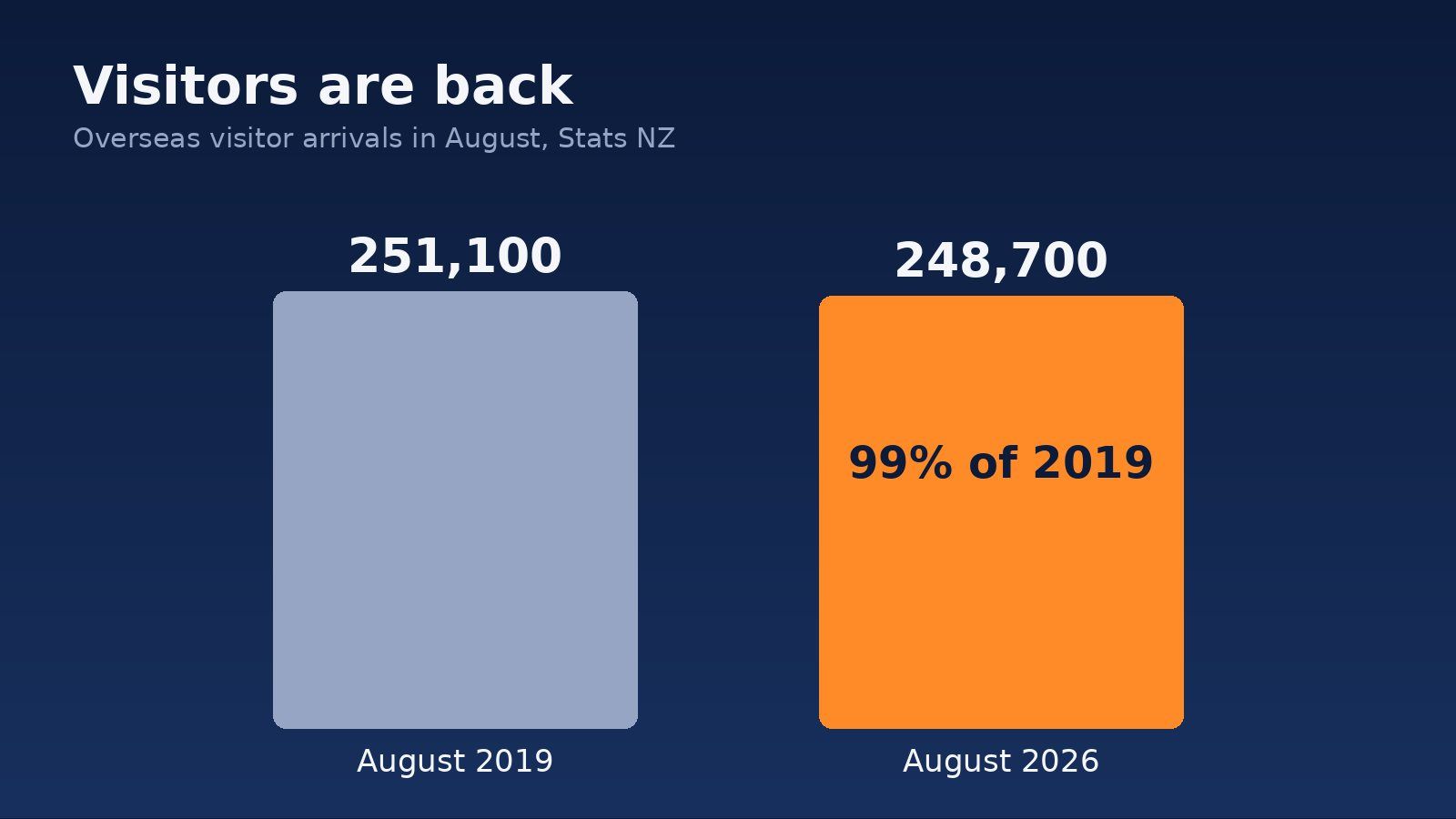
Stats NZ’s international travel release on 14 October 2026 put overseas visitor arrivals at 248,700 for August, up 18,400 on August 2025, according to the release as republished by Mirage News. That is 99 percent of the 251,100 recorded in August 2019. Australia sent a record 125,600 for an August month, about 51 percent of the total, and China was the biggest mover, up 6,500.
Tourism New Zealand’s own figures look at a longer window. In a presentation to the West Coast tourism sector in 2026, its digital experience lead reported 3.7 million arrivals in the year to June 2026, up 8.9 percent on the year before and about 95 percent of the pre-COVID level. Tourism and Hospitality Minister Louise Upston described the sector as New Zealand’s second largest export earner.
For a café, lodge, tour or activity operator, that means more customers are on their way. The question is who they choose.
How visitors now pick what to do
The same Tourism New Zealand presentation spends a lot of time on this. It cites research from the United States and Canada, by Future Partners and Miles Partnership, on how travellers plan: about 62 percent said they use search-led websites, roughly 50 percent use online travel agencies or social media, and around 40 percent use AI. Those are North American travellers, not a count of who visits New Zealand, so read them as a direction. The point is that planning is spread across several places, and AI is now one of them.
Tourism New Zealand’s lead made the sharper point. The old journey gave an operator several chances to be found: a search, a blog, a review, a listing. When a traveller asks an AI tool one question and gets one answer, those chances shrink to one. If the tool misreads you, there is no second look.
This is not a reason to panic, and it does not replace Google. It is a reason to make sure the basics are in order, because those basics are what these tools read.
What an AI tool reads about you
Tourism New Zealand’s advice is plain. A traveller tool pulls from your website, your Google Business Profile, booking-site listings like Booking.com, Expedia and GetYourGuide, your reviews, and any certifications or awards you hold. Its word for what matters most is consistency. If your name, location and offer differ between those places, the tool becomes unsure, and an unsure tool does not recommend you.
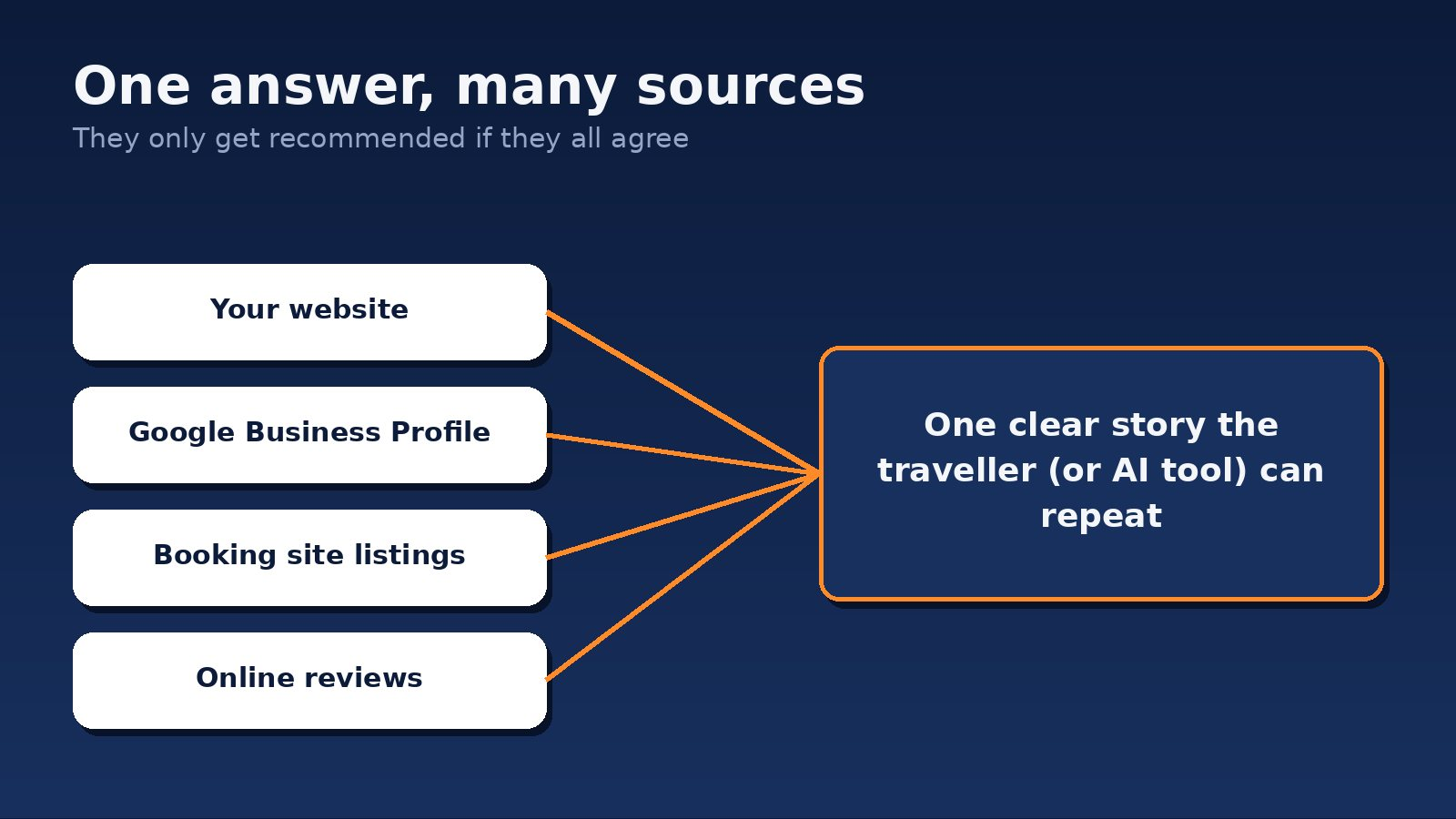
The presentation gives an example of the failure in practice: one tour called “Glacier Tours” on one site and “Glacier Adventures NZ” on another. A human would shrug. A tool reading both may treat them as two businesses, or trust neither.
The profile that gets named, and the one that does not
Compare two ways of describing the same business. The first is the sort of line most of us have written: “We offer unforgettable local experiences and warm hospitality.” It says nothing about where you are, what you sell or who it is for. Tourism New Zealand’s presentation shows the same weakness, a description from which a tool cannot tell the region, the category or the traveller.
The stronger version names all three. Here is an illustration of the style, written by us, not a real business:
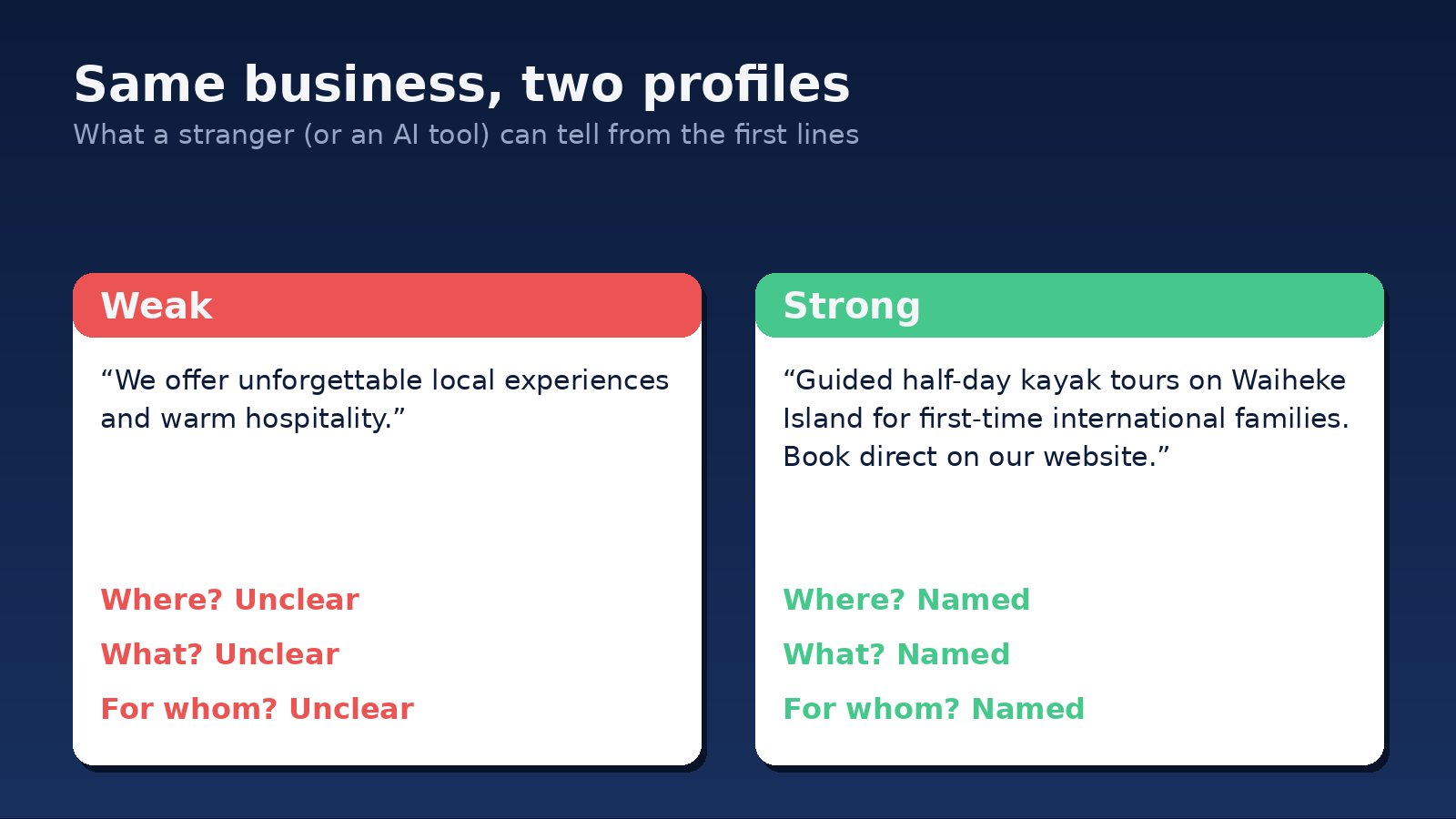
The strong version also works for a human reader. A parent skimming your homepage on their phone wants to know in two seconds whether this is for them.
Six questions your homepage should answer
Tourism New Zealand frames a strong operator profile as six questions. They are a good checklist for any hospitality or activity business, from a bar in Ponsonby to a zipline on Waiheke:
- What is it called? Use the exact same business name on your site, your Google profile and every booking site.
- Where does it operate? Name the suburb or town and region, not just “New Zealand”.
- What does it offer? Say it in plain terms a person would search: “guided half-day kayak tour”, not “an unforgettable adventure”.
- Who is it best for? Families with young children, couples, groups, first-time visitors. Do not try to be for everyone.
- Why should people trust it? Name your reviews, your safety practice and any certification, in plain text and not just as logos.
- How do they book? Give a real path, such as a direct booking page or a named listing. “Contact us” is not a path.
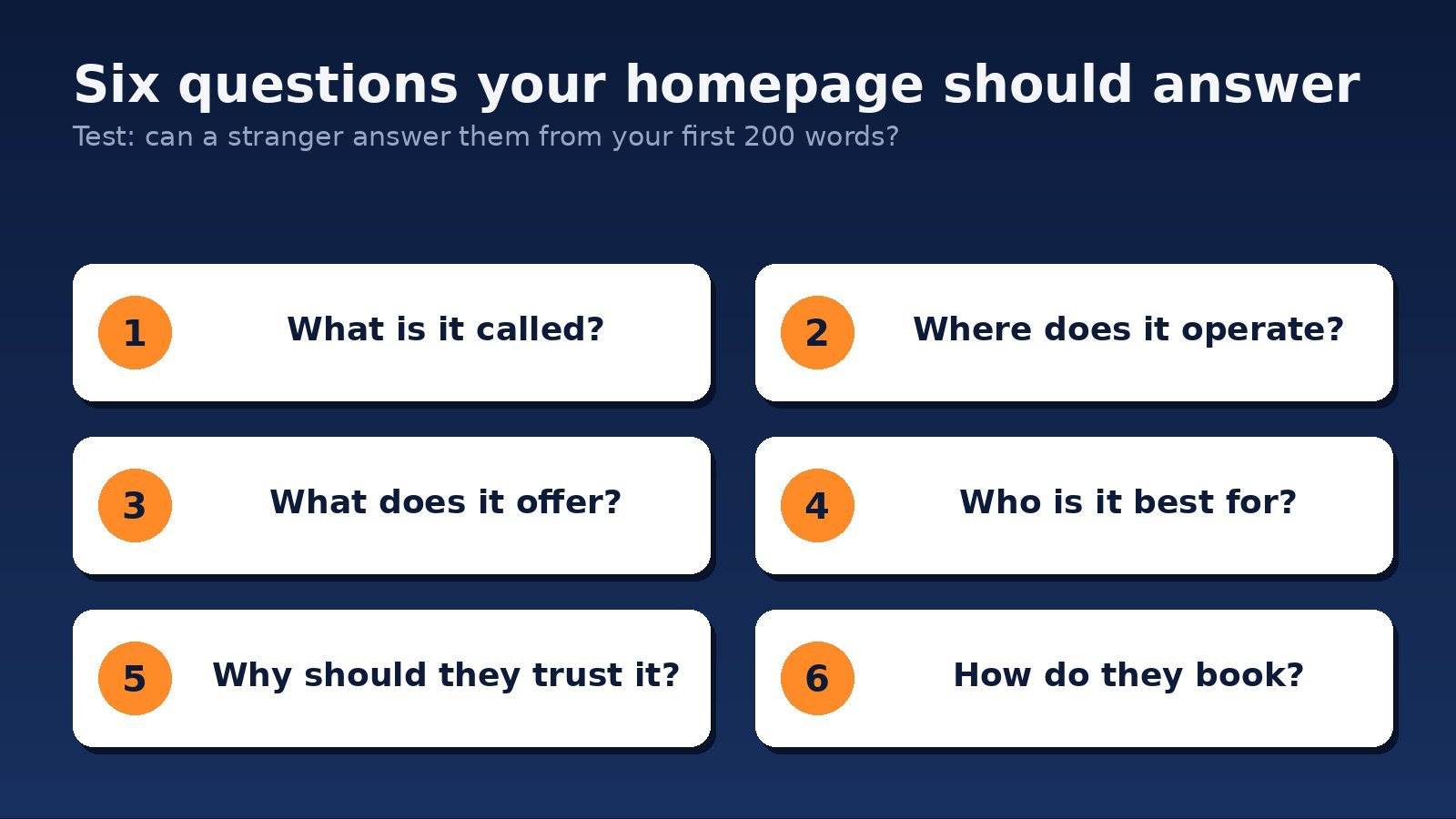
That test is worth doing today. Open your homepage, read the first 200 words, and see if a stranger could answer all six. Most operators find they answer two or three. The fix is rewriting one page, which costs you an afternoon, not a budget.
Your Google profile does the heavy lifting
For a physical venue, the Google Business Profile is often where the booking decision starts. Google’s own guidance on local ranking says relevance, distance and prominence decide who appears, and that more reviews and positive ratings can help. It also says replying to reviews shows you value feedback. That is vendor documentation, but it is the rulebook for the page your customers see.
Check three things this week:
- The business name, address and hours match your website and booking listings exactly.
- Your description uses the plain-words approach above.
- You have replied to your recent reviews, good and bad, with specifics. Visitors read the replies as well as the stars.

Where paid ads fit
Good foundations are the cheap part. Google Ads can put you in front of someone who is searching for exactly what you offer in your area, and for an activity operator with a seasonal calendar, ads let you push harder when a weekend has space and ease off when it is full. But ads send people to the same profile and website. If those do not answer the six questions, you pay for the click and lose the booking.
The commercial questions an owner should ask before spending:
- What does it cost? Ad costs vary a lot by activity, season and area, so be wary of anyone who quotes a number without looking at your market. Set a monthly cap you are comfortable with and agree it in writing.
- How long until it works? Fixing a profile and a page can show up within weeks. A campaign needs a few weeks of data before it is worth judging.
- How will I know it is working? You should see bookings and calls, not just clicks. Ask for phone calls and booking-form submissions to be tracked separately, so you know which ads brought paying customers.

Adventure operators: make booking the easy part
Tourism New Zealand lists “Active Escapes” among its FY27 themes, with the stated aim of making New Zealand the most desirable and bookable active holiday destination in the world. Notice the word bookable. Adventure buyers often decide fast and on a phone, sometimes from the other side of the world, and they want to see the date, the price, what is included and the safety information without writing an email.
If you run activities, put the safety and certification details in plain text on the page, show who the experience suits (age, fitness, group size), and give a booking link that works on a phone. If you sell through booking sites, make sure the listing matches your own page. These are small jobs. They are also exactly what both a nervous parent and an AI tool are looking for.
What to ask any agency, including us
- How will you show me which bookings came from which channel?
- Will my Google profile and listings stay in my name?
- What will you fix on my website before you spend my ad money?
If you want a second opinion on how your business reads to a visitor and to Google, see how we work with local businesses or get in touch. Call or fill in the form and we will tell you plainly what we would fix first.
Frequently asked questions
Are international visitors back in New Zealand?
Nearly. Stats NZ reported 248,700 overseas visitor arrivals in August 2026, which is 99 percent of August 2019, with record August arrivals from Australia.
Do visitors really use AI to plan trips?
Some do, and the share is growing. Research cited by Tourism New Zealand, from the US and Canada, found around 40 percent of travellers use AI when planning, alongside search websites at about 62 percent. Treat it as a direction rather than a New Zealand figure.
How do I get my business recommended by an AI tool?
Make your name, location, offer, audience, trust signals and booking path clear and identical across your website, Google profile, booking listings and reviews. Tourism New Zealand’s advice is that consistency matters most.
What should a hospitality or adventure website say first?
Who you are, where you are, what you offer, who it suits, why people should trust you and how to book. A stranger should be able to answer those from the first 200 words.
Do I need Google Ads as well?
Not before the basics. Ads work best once your profile and website answer visitors’ questions. After that they help you fill quiet dates in the season.
Sources
- Stats NZ: International travel, August 2026 (14 October 2026), as republished by Mirage News
- Inside Government NZ: Overseas visitor numbers close in on pre-pandemic figures (15 October 2026), including Minister Louise Upston’s comments
- Tourism New Zealand presentation to the West Coast sector, Rush Pathak (2026), citing Future Partners and Miles Partnership, The State of AI in Travel 2026
- Google Business Profile Help: Improve your local ranking on Google (vendor documentation)
Want this run for your business?
Talk to our team. We will show you where the money is leaking and what we would do about it.