

Someone’s glasses are two years old and the world has gone slightly soft. They know they should book an eye test. They also half-remember it costing a lot, so they put it off. A month later they search “optometrist near me”, open three tabs, and book whichever practice made the price and the next step easiest to find.
That is the buying journey for most optometry practices, and it is mostly decided on a phone before anyone walks through your door. If you run a practice, or manage marketing for one, this guide covers where the new patients come from, what holds them back, and what to fix first.
Cost is the barrier, so answer it up front
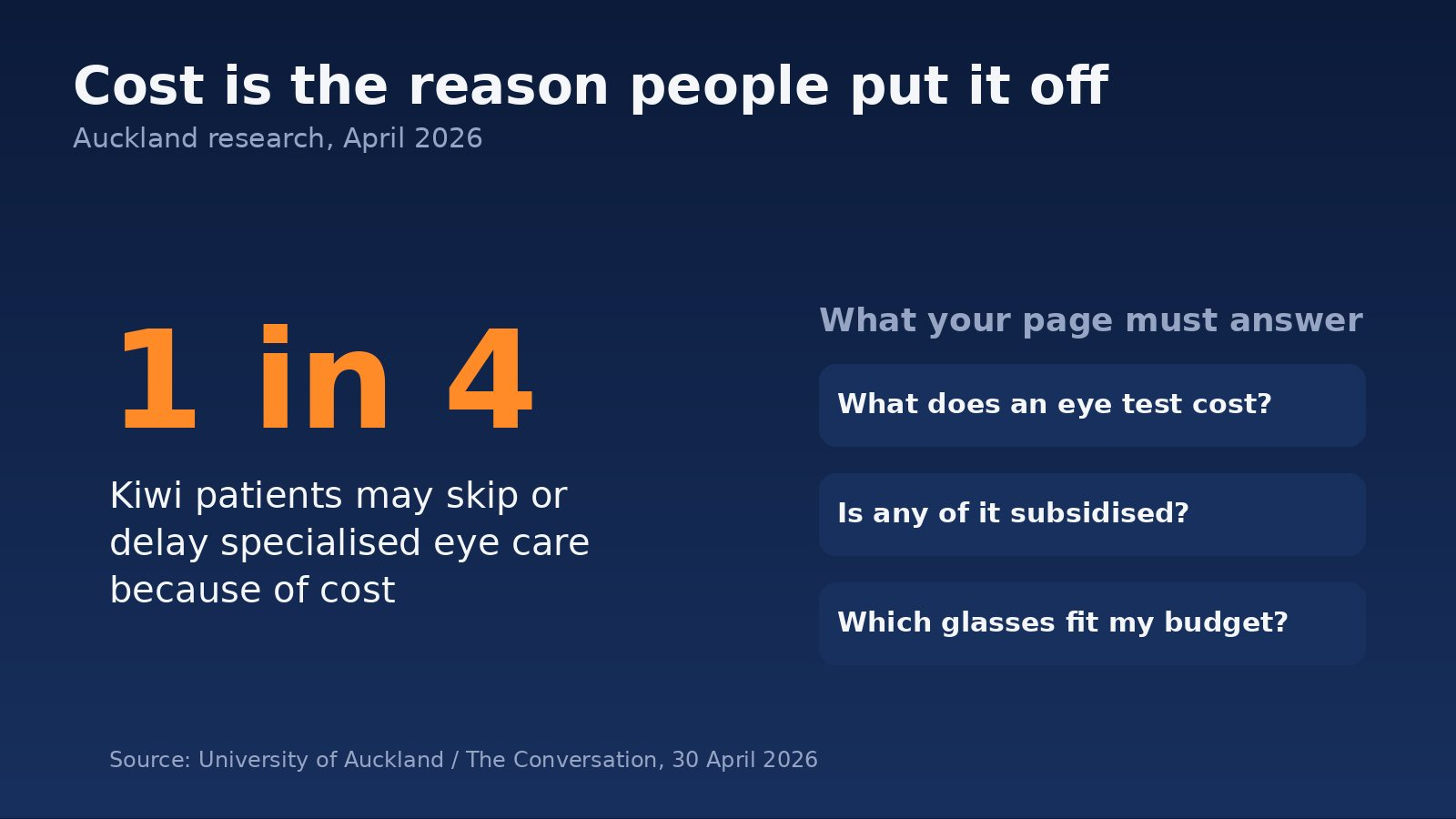
New University of Auckland research, published in April 2026, puts a number on something practices already feel. The authors say as many as one in four Kiwi patients may skip or delay specialised eye care because of cost. They also note that routine exams and glasses are delivered almost entirely by private optometrists with very little public funding.
The same research looks at what free routine eye care might cost the country. That is a policy debate, and nobody can say how it will end. For your practice the useful point is simpler: the person weighing up whether to book is already worried about the bill.
So a website that hides pricing works against you. A page that states what a standard eye test costs, what is included, and what help exists lowers the worry before the patient picks up the phone. A person who is unsure will usually book the practice that answers the question, not the one that makes them ring to find out.
Explain the subsidy that exists
For children there is real help. The University of Auckland article notes that children of Community Services Card holders can get up to $287.50 for an eye test and glasses through Enable New Zealand, and Enable says its children’s spectacle subsidy covers children aged 15 and under who meet the criteria. Per Enable’s own page, the child must be assessed by an optometrist or ophthalmologist who is an approved assessor registered on the DSS Accreditation Framework. Enable lists 28,099 claims approved in 2020/21.
If your practice is registered, say so plainly on a page of its own: who qualifies, what to bring, and that you handle the claim. If it is not registered, you may be losing the parents who go looking for exactly that. Check current amounts with Enable before you publish a figure, because older notices quote different numbers.
Where new patients actually come from
The audience is online. DataReportal’s Digital 2026: New Zealand reports 5.06 million internet users in October 2025, which is 96.2% of the population, and 4.24 million social media user identities. Almost everyone you want to reach is a search or a scroll away.
For an optometry practice, three channels carry most of the weight.
- Google Business Profile and local search. “Optometrist near me” and “eye test [suburb]” are bookings in waiting. A complete profile with correct hours, photos of the practice, a booking link and recent reviews does more than most ads.
- A website that answers the first-visit questions. What an eye test involves, how long it takes, the price, parking, whether you see children, and how to book in two taps.
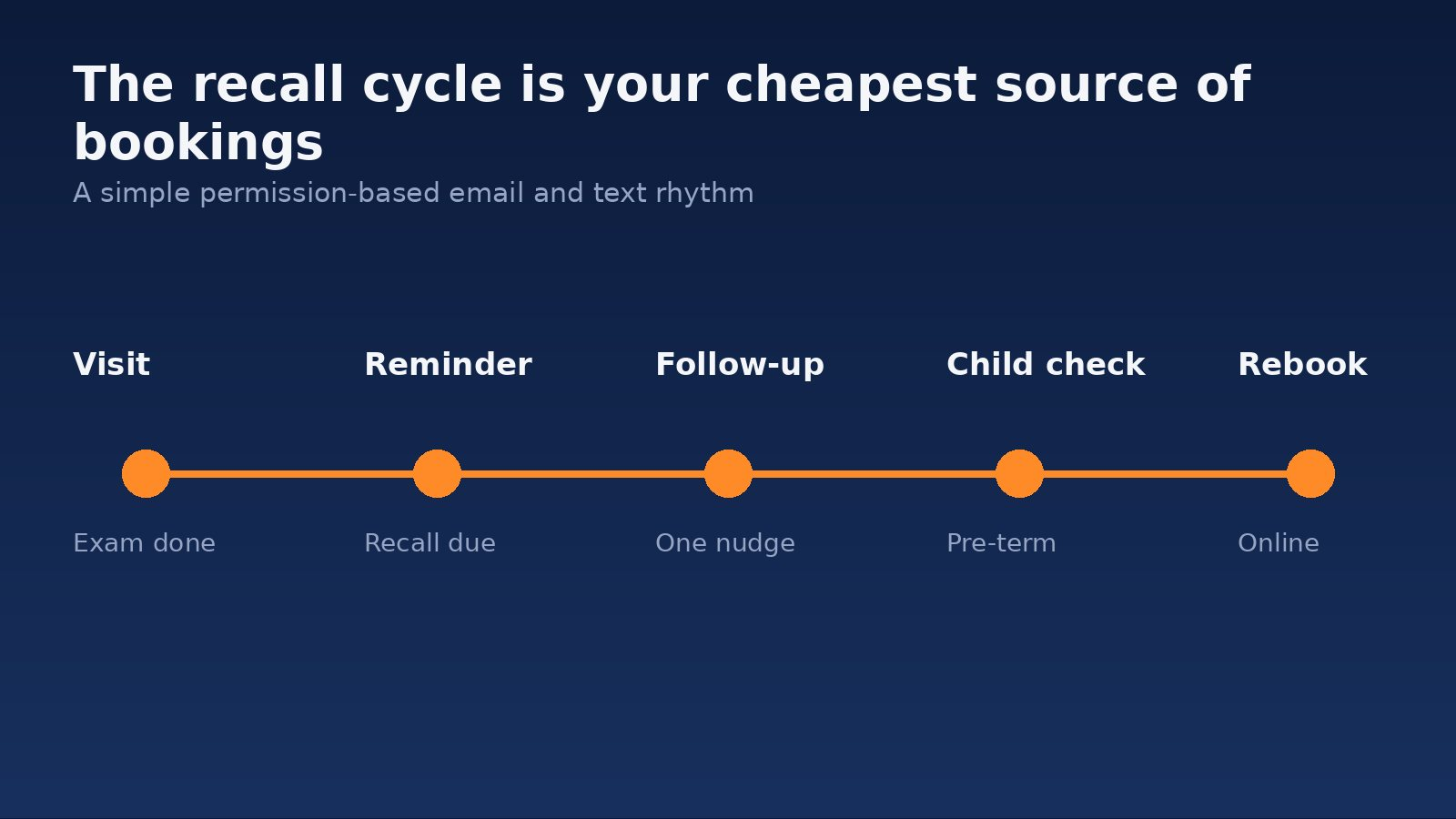
- Recall to existing patients. The patient who had an exam two years ago is your cheapest booking. A friendly email or text reminder, sent with permission, brings them back without paying per click.
Paid search sits on top of that. Google Ads can put you in front of people searching for an eye test in your area, within weeks of launch. SEO takes longer, usually a few months before you see movement, but it keeps working after you stop paying.

Your website is the front desk
Most optometry sites look like a brochure: a hero photo, a list of services and a phone number. The ones that book people share three habits.
- One obvious next step. “Book an eye test” is visible without scrolling, on a phone, and leads to a short form or an online booking page.
- Specific pages for specific needs. A page for children’s eye tests, one for contact lenses, one for glasses, one for eye health checks. Each page can rank for its own search and answer its own questions.
- Real people and real rooms. Photos of your team and your practice build trust faster than stock images of smiling strangers.
If you are weighing a rebuild, our website design and build service follows this pattern: mobile first, one clear action, and tracking so you can see which pages produce bookings.
What you can say in your ads and on your site
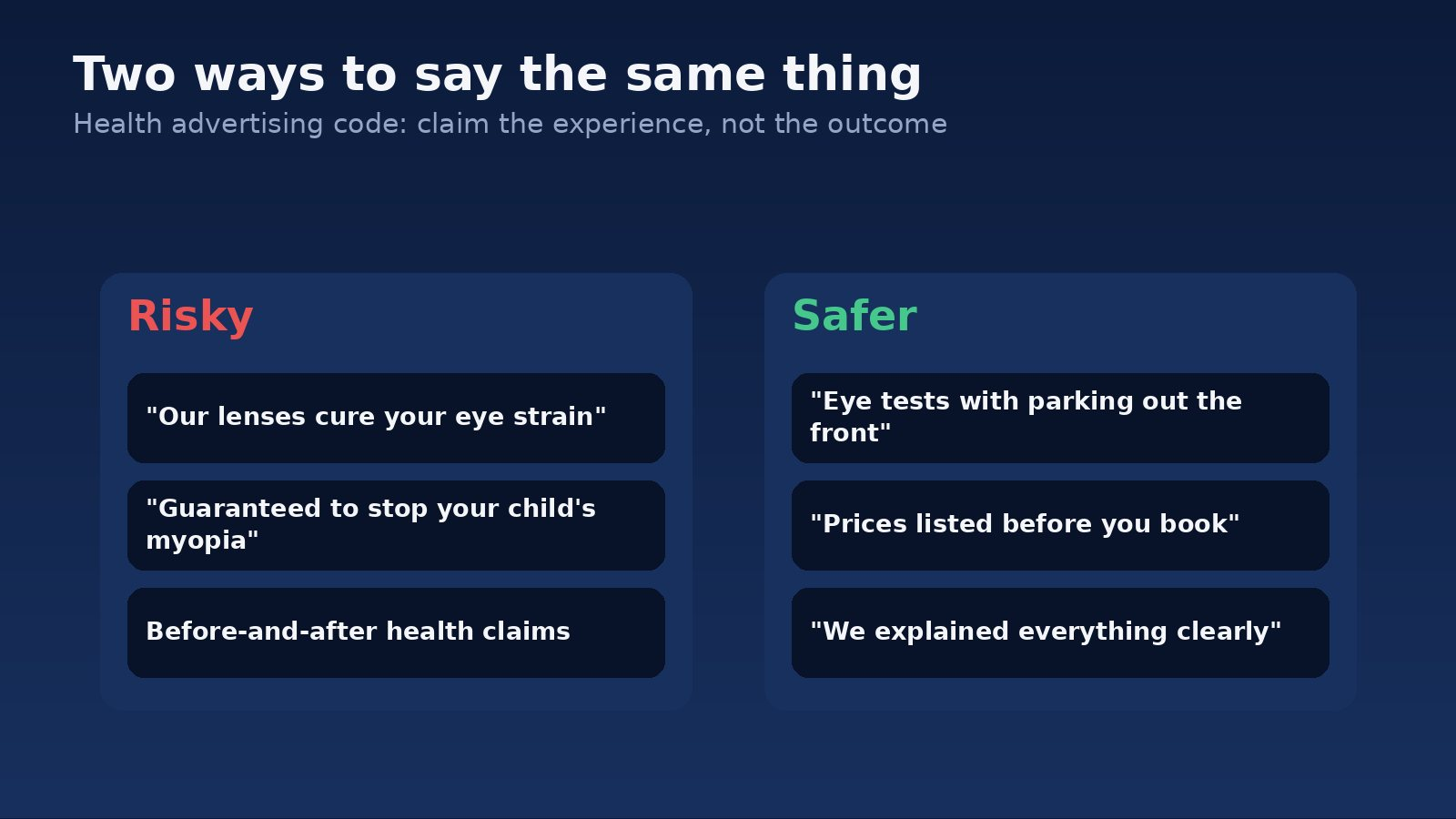
Eye tests are a health service, so assume the advertising rules for health apply to you. The Advertising Standards Authority’s updated Therapeutic and Health Advertising Code covers, per its media release, advertising for medicines, medical devices, natural health products, dietary supplements and health services. It applied to new advertising from 1 April 2026 and to all advertising from 1 July 2026. The release says the code gives clearer guidance on testimonials, including user-generated content, and strengthens protections for vulnerable audiences.
The sensible reading for a practice is cautious. Avoid promising outcomes for eye conditions or for a child’s vision. Be careful with testimonials that describe a health result, and keep evidence for any factual claim you make. Reviews about how welcoming the team was, how clearly things were explained and how easy it was to book are the safer kind. If you are unsure whether a particular claim is fine, check the code itself or take advice from your professional body.
Google adds its own layer. Per Google Ads Help (vendor documentation), health is a sensitive interest category, and advertisers in those categories cannot use features such as Customer Match, audience expansion or lookalike segments. Keyword and location targeting still work, and for a local practice those are the targets that matter: people searching for an eye test, near you, right now.
Reviews and recall: the cheap wins
Ask every patient who had a good experience to leave a Google review, and ask about the visit. “Friendly, quick and explained everything” is the review you want. Reply to each one, including the unhappy ones, in a calm and factual tone, and never share a patient’s clinical details in a reply.
Then build a recall habit. When someone leaves with a prescription, you already know roughly when they will need another exam. Use your practice software, or a simple email tool, to send a reminder before that date. Add a note for parents ahead of the school year. Keep it short, include a booking link, and send it only to people who agreed to hear from you. Our email remarketing service sets this kind of sequence up so it runs without anyone remembering to send it.
How you will know it is working
This is the question to ask any agency, including us. For an optometry practice the numbers that matter are not clicks. They are bookings.
- Online bookings and enquiry forms by source, so you can see whether Google, your profile or an email produced them.
- Phone calls from each channel, using a tracking number, because many patients still ring.
- Cost per booked eye test for paid campaigns, compared with what an average new patient is worth over several years.
If a report only shows impressions and clicks, ask what it says about bookings. If the answer is nothing, the tracking is not set up properly.
Where to start
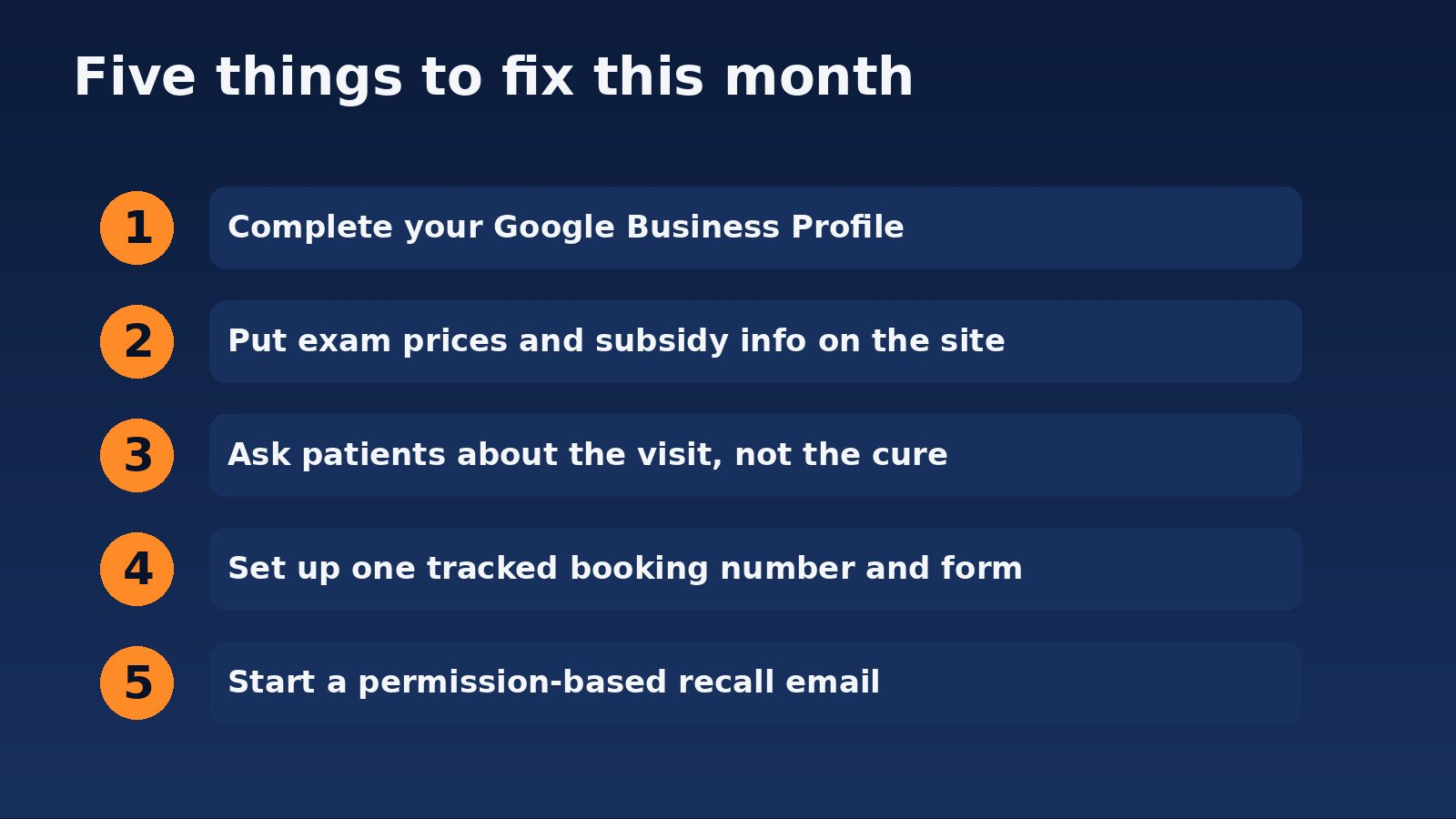
You do not need to do everything at once. Fix your Google Business Profile this week. Put prices and the subsidy explanation on your website next. Then turn on tracking so you can see what is producing bookings, and only then decide whether paid search is worth adding.
BeyondClix works with New Zealand service businesses across Google Ads, SEO, websites and tracking. If you would like a plain-English view of what your practice’s online presence is doing, see our services or get in touch, and we will tell you what is worth changing first.
Frequently asked questions
How do optometry practices get new patients online?
Mostly through local search: Google Business Profile, a website with clear booking, and reviews. Recall emails to existing patients bring many repeat bookings without paying per click.
Should I put eye test prices on my website?
Generally yes. University of Auckland research suggests as many as one in four Kiwi patients may skip or delay specialised eye care because of cost, so clear pricing and help available can remove a reason not to book.
Does the health advertising code apply to optometrists?
The ASA code covers health services and medical devices, so you should assume it applies. Avoid outcome promises and unsubstantiated claims, and check the code or take advice if unsure.
Can I target ads at people with eye conditions?
Not with advertiser-curated audiences. Google treats health as a sensitive category and does not support Customer Match, audience expansion or lookalike segments there, but keyword and location targeting still work.
How long does it take to see results?
Paid search can produce enquiries within weeks of launch. Local SEO usually takes a few months to move. Recall emails to existing patients can produce bookings within days of the first send.
What does the children’s spectacle subsidy involve?
Enable New Zealand administers it for children aged 15 and under who meet the criteria. The child must be seen by an approved assessor registered on the DSS Accreditation Framework, and the practice submits the claim.
Sources
- University of Auckland: An affordable vision for NZ’s eye health (30 April 2026)
- Enable New Zealand: Children’s spectacle subsidy
- ASA media release: Updated ASA Code delivers clear rules for therapeutic and health advertising (4 December 2025)
- Google Ads Help: Restricted targeting in personalized advertising (vendor documentation)
- DataReportal: Digital 2026: New Zealand
Want this run for your business?
Talk to our team. We will show you where the money is leaking and what we would do about it.