

Content marketing’s role in paid strategy is straightforward: it makes your paid ads work harder, cost less, and convert better. Businesses that prioritise content see conversion rates nearly six times higher than those that don’t, and that lift doesn’t happen by accident. Quality content raises your ad quality scores, improves landing page relevance, and builds the kind of trust that a paid ad alone can’t manufacture.
Here’s what that looks like in practice for New Zealand businesses:
- Ad quality scores improve when your landing pages carry genuinely useful, relevant content aligned with your ad copy.
- Cost-per-click drops because Google and Meta reward higher quality scores with cheaper placements.
- Conversion rates climb when prospects land on pages that answer their questions rather than just pitch a product.
- Brand trust compounds over time, meaning your paid campaigns benefit from the credibility your content has already built.
- ROI extends beyond the campaign because content assets keep working after your ad spend stops.
Paid media delivers speed. Content delivers depth. Together, they give New Zealand marketers both.
How content attracts and engages your audience within paid campaigns
Paid ads get eyes on your brand, but content determines whether those eyes stay. The most effective paid campaigns in New Zealand pair precise ad targeting with content that genuinely matches what the audience is looking for at that moment in their buying journey.

Think about the difference between a Google Search ad that leads to a generic homepage versus one that lands on a detailed blog post answering the exact question the user typed. The second experience feels less like an interruption and more like a helpful answer. That distinction shows up in your bounce rate, your time-on-page, and ultimately your conversion data.
Content types that consistently perform well within paid strategies include:
- Short-form video on Meta and YouTube, where storytelling and demonstration outperform static product shots.
- Long-form blog posts used as landing pages for informational search ads, particularly for considered purchases.
- Infographics repurposed as display ad creatives, giving complex information a visual shortcut.
- Case studies and testimonials embedded in remarketing sequences to address objections at the decision stage.
- Email nurture sequences triggered by paid ad clicks, carrying prospects through the funnel with value-led content rather than repeated sales pushes.
Content also enables personalised paid messaging by giving you audience segments to work with. A visitor who read your buyer’s guide behaves differently from one who only saw your homepage. Paid campaigns that reflect that difference, serving different ads to each segment, consistently outperform one-size-fits-all approaches.
Pro Tip: Before launching a paid campaign, audit your existing content library. Often the best landing page already exists as a blog post or guide. Sending paid traffic to a well-optimised existing article can outperform a purpose-built campaign page, and it costs nothing extra to test.

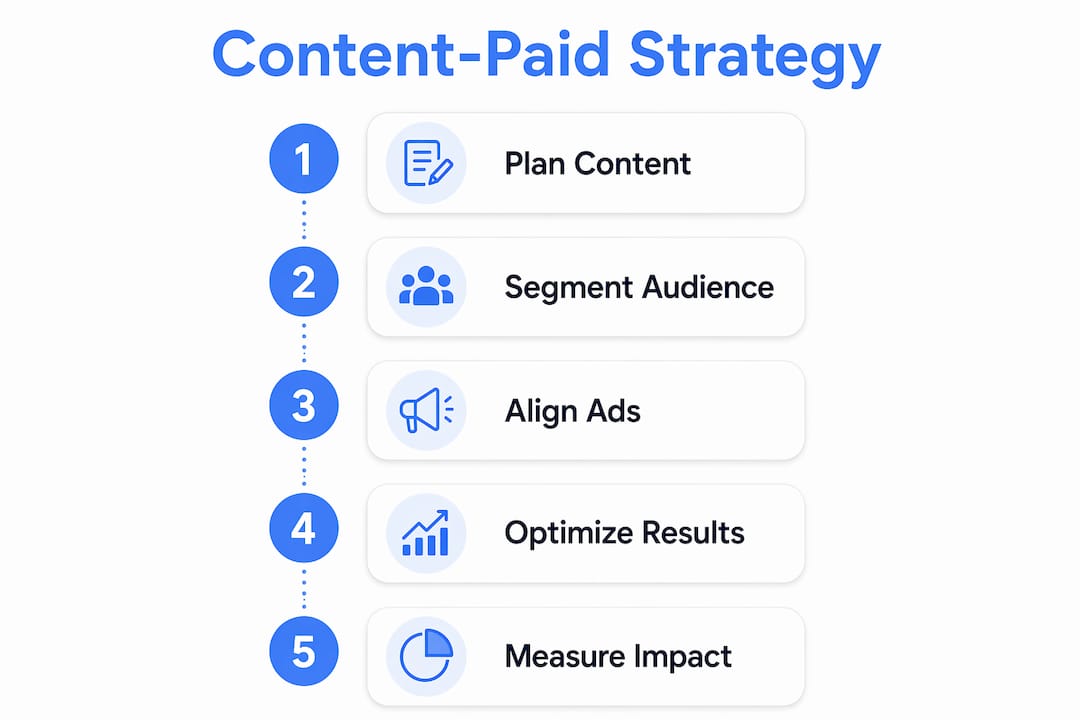
Driving traffic and conversions by combining content with paid ads
The conversion gains from integrating content and paid media come from a specific mechanism: alignment. When your ad copy, your landing page content, and your offer all speak the same language, the user experience feels frictionless. When they don’t align, you pay for clicks that bounce.
Organic search generates the highest volume of leads and the best conversion rates compared to paid channels in isolation. That finding points to something useful: the qualities that make organic content convert well, relevance, authority, and specificity, are exactly what paid landing pages need more of. Bringing those qualities into your paid strategy is not a content marketing exercise. It’s a conversion rate exercise.
Practical ways to drive this integration:
- Mirror your ad headline in your landing page H1. Google’s Quality Score algorithm rewards message match, and so do users.
- Use content insights to refine ad copy. Your highest-performing blog posts reveal which topics and angles resonate. Feed those into your ad creative.
- Segment paid audiences by content consumption. Retarget blog readers with mid-funnel offers; retarget product page visitors with direct conversion ads.
- Allocate budget across the funnel. A common mistake is spending all paid budget on bottom-of-funnel keywords while ignoring the content that warms audiences up first.
- Test content formats as ad formats. A video explainer that performs well organically often translates directly into a high-performing paid video ad.
Conversion insight: Businesses that align their content assets with paid ad messaging consistently see lower cost-per-acquisition and higher return on ad spend. High-quality, content-rich landing pages aligned with ad messaging improve user experience and lower CPC costs by lifting quality scores.
Budget allocation is where many New Zealand businesses get this wrong. Pouring money into paid clicks while underinvesting in the content those clicks land on is like filling a leaky bucket. A reasonable starting point is to treat content creation as a fixed line item within your paid campaign budget, not an afterthought funded from whatever’s left over.
Building brand loyalty through content embedded in paid campaigns
Paid ads can generate a first purchase. Content is what generates the second, third, and the referral that follows. For New Zealand businesses competing in markets where trust is earned slowly and word-of-mouth carries real weight, this distinction matters in practical terms.
Consistent, value-led content encourages social proof, recommendations, and repeat engagement, all of which reduce your long-term reliance on paid acquisition. A customer who found you through a paid ad but stayed because of your content is worth far more over their lifetime than one who clicked, bought, and moved on.
Key considerations for building loyalty through content within paid campaigns:
- Lead with education, not promotion. Paid ads that deliver genuinely useful content, a how-to video, a comparison guide, a checklist, build goodwill that promotional ads cannot.
- Maintain a consistent brand voice across your organic content and paid creative. Jarring tonal shifts between your blog and your ads erode trust faster than most marketers realise.
- Use storytelling in paid social. Narrative-driven ads, particularly on Meta and LinkedIn, outperform feature-list ads when the goal is brand affinity rather than immediate conversion.
- Balance promotional and educational content in your paid mix. A rough guide used by experienced practitioners is to run two educational or value-driven paid pieces for every one direct-response promotion.
- Address objections through content. Remarketing campaigns that serve content answering common purchase hesitations, pricing concerns, comparison questions, convert better than ads that simply repeat the original offer.
The challenge for most businesses is maintaining this balance when quarterly targets create pressure to push harder on direct-response ads. The brands that resist that pressure and keep investing in content-led paid creative tend to see their cost-per-acquisition fall over time, because their audience arrives warmer.
Measuring and optimising content’s impact on your paid campaigns
You can’t manage what you can’t measure, and the integration of content and paid media creates some genuine attribution headaches. A prospect might read three blog posts, click a remarketing ad, and then convert via a branded search. Which touchpoint gets credit? The honest answer is: all of them, in different proportions.
The metrics worth tracking when evaluating content’s contribution to paid performance:
- Landing page conversion rate by content type, so you can identify which formats convert paid traffic best.
- Quality Score in Google Ads, which directly reflects how well your content aligns with your ad and the user’s intent.
- Cost-per-click trends over time, since improving content quality on landing pages typically drives CPC down.
- Engagement rate on paid social ads that use content-led creative versus direct-response creative.
- Return on ad spend (ROAS) segmented by campaign type, comparing content-supported campaigns against those without content backing.
| Metric | What it tells you | Where to find it |
|---|---|---|
| Quality Score | Landing page relevance and ad alignment | Google Ads dashboard |
| Landing page conversion rate | How well content converts paid traffic | Google Analytics 4 |
| Cost-per-click | Efficiency of paid spend relative to content quality | Google Ads, Meta Ads Manager |
| ROAS by campaign | Revenue generated per dollar of ad spend | Google Ads, Meta Ads Manager |
| Engagement rate | Audience response to content-led ad creative | Meta Ads Manager, LinkedIn Campaign Manager |
Attribution remains the hardest problem. Multi-touch attribution models in Google Analytics 4, such as data-driven attribution, distribute credit across touchpoints rather than assigning it all to the last click. For businesses running both content and paid campaigns, this model gives a more accurate picture of how content warms audiences before paid ads close them.
Content marketing can be harder to measure directly than paid ads, but that difficulty doesn’t mean the impact isn’t there. It means you need better measurement frameworks, not fewer content investments. Running controlled tests, for example, sending identical paid traffic to a content-rich landing page versus a minimal one, produces clean data that removes the attribution ambiguity.
How Beyondclix integrates content and paid campaigns for measurable results
Beyondclix operates on a principle that most agencies talk about but few actually execute: paid media and content are not separate services. They are one system. When a client’s Google Ads campaign underperforms, the first place Beyondclix looks is not the bid strategy. It’s the landing page content and its alignment with the ad creative.
This approach has produced returns on ad spend of up to 20x in rapid campaign results for established New Zealand businesses and e-commerce operators. The mechanism is consistent: improve the content quality of the assets paid traffic lands on, tighten the message match between ad and page, and the Quality Score rises, CPC falls, and conversion rate climbs.
Beyondclix case insight: In campaigns where content-rich landing pages were introduced alongside existing paid search activity, ad quality scores improved materially, reducing wasted spend and increasing the proportion of budget driving actual conversions rather than bounces.
Beyondclix’s integrated approach covers Google Ads, Meta Ads, social media marketing, and email remarketing, with content strategy woven through each channel rather than bolted on as an afterthought. The team treats content assets, whether a landing page, a video script, or an email sequence, as performance levers within the paid campaign, not as brand exercises sitting in a separate silo.
For New Zealand businesses ready to stop treating content and paid media as separate budget lines, Beyondclix’s integrated digital marketing services offer a practical starting point. The PPC and SEO questionnaire is a useful first step to identify where your current setup is leaving money on the table.
Key takeaways
Content marketing and paid advertising work best as a single integrated system, where quality content directly improves ad performance, lowers acquisition costs, and builds the brand trust that sustains long-term growth.
| Point | Details |
|---|---|
| Content lifts conversion rates | Businesses prioritising content see conversion rates nearly six times higher than those that don’t. |
| Quality Score is the link | Content-rich landing pages aligned with ad copy raise Quality Scores, which lowers CPC directly. |
| Segment by content behaviour | Retargeting audiences based on which content they consumed produces more relevant, higher-converting paid ads. |
| Measure with multi-touch attribution | Data-driven attribution in Google Analytics 4 gives a more accurate view of how content contributes to paid conversions. |
| Balance your paid mix | Running two educational paid pieces for every direct-response promotion tends to reduce cost-per-acquisition over time. |
FAQ
What is the difference between content marketing and paid marketing?
Content marketing builds trust and organic visibility over time through useful, relevant material such as blogs, videos, and guides. Paid marketing delivers immediate visibility by paying for placement, but stops generating traffic the moment the budget runs out.
How does content marketing improve paid ad performance?
Quality content on landing pages raises Google Ads Quality Scores, which lowers cost-per-click and improves ad placement. Aligned landing page content also reduces bounce rates and increases the proportion of paid clicks that convert.
What is the purpose of a content marketing strategy within paid campaigns?
The purpose is to give paid traffic somewhere worth landing. A content strategy ensures that every audience segment reached by paid ads encounters messaging that matches their intent and moves them further through the buying journey.
What are the 4 C’s of content marketing?
Definitions vary across practitioners, but a widely used version covers Content (what you create), Context (where and when it appears), Connection (the relationship it builds with the audience), and Conversion (the commercial outcome it drives). Applied to paid strategy, all four must align with your ad creative and audience targeting.
How should New Zealand businesses split their budget between content and paid ads?
Paid digital ads suit immediate leads and promotions, while organic content builds lasting growth and trust. Most Kiwi businesses benefit from starting with paid ads to generate early results while simultaneously investing in content that reduces their long-term cost-per-acquisition.
Recommended
- Areas we serve | BeyondClix
- Digital Marketing in Manukau | BeyondClix
- Digital Marketing in South Auckland | BeyondClix
- Digital Marketing in Papakura | BeyondClix
Want this run for your business?
Talk to our team. We will show you where the money is leaking and what we would do about it.