
For Auckland businesses, the clearest path to measurable returns from Meta advertising is a locally based, Meta Certified Partner agency with a dedicated campaign manager who understands the New Zealand market. Local knowledge and official certification are not just credentials to tick off a checklist. They directly reduce wasted spend by aligning creative, targeting, and budget timing with Kiwi audience behaviour and NZ seasonality.
Three signals to look for before you shortlist anyone:
- Meta Certified Partner badge — confirms the agency meets Meta’s technical and spending standards, with access to beta features and direct Meta support.
- Facebook Pixel and Meta Conversions API setup — both are non-negotiable for accurate conversion tracking in NZ e-commerce and lead generation.
- Quantified NZ results — ask for ROAS figures from local campaigns, not global case studies that may not translate to the Auckland market.
Table of Contents
- Why does a Meta-certified Auckland agency outperform a remote provider?
- What should a full Facebook and Instagram ads service include?
- What does Facebook advertising cost in New Zealand, and when will you see results?
- Which ad formats and targeting options perform best for NZ audiences?
- What should onboarding and reporting look like after you sign?
- What results can you realistically expect from a Meta-certified agency?
- How do you choose the right Facebook ads agency in Auckland?
- Key takeaways
- Why the “certified” label matters more than most Auckland businesses realise
- Beyondclix’s Meta ads service for Auckland businesses
- Useful sources
- FAQ
Why does a Meta-certified Auckland agency outperform a remote provider?
The Meta Certified Partner credential is not a participation trophy. It signals that an agency has met Meta’s technical benchmarks, completed advanced product training, and maintains a minimum level of managed ad spend. In practical terms, that means faster troubleshooting through direct Meta support channels, early access to beta ad features before they roll out broadly, and a team that has been tested on best practices rather than learning them at your expense.
Beyond the badge, local knowledge changes campaign outcomes in ways that are easy to underestimate. NZ public holidays and cultural events, including Waitangi Day in February, ANZAC Day in April, and Matariki in June or July, create predictable CPC spikes and audience behaviour shifts that a remote agency working from a generic content calendar will miss. A locally based team builds those dates into the creative and budget plan from the start, rather than reacting after spend has already leaked.
Language and cultural nuance matter too. Kiwi audiences respond differently to tone, humour, and social proof than Australian or UK audiences. An Auckland team writing ad copy has an instinct for what lands locally that is genuinely hard to replicate from offshore.
Stat to know: NZ Facebook Ads CTR benchmarks sit at a median level across industries, with pronounced monthly swings. Campaigns that ignore seasonal timing routinely underperform that median; those built around NZ events tend to outperform it.
When evaluating agencies, the service model matters as much as the credentials. Look for a dedicated campaign manager rather than a rotating account team, a reporting cadence tied to NZ business hours, and cross-channel coordination that connects Meta campaigns with analytics, SEO, and landing page performance. Beyondclix, for example, operates with local Auckland expertise across South Auckland and surrounding suburbs, which feeds directly into geo-targeting and audience segmentation decisions.
What should a full Facebook and Instagram ads service include?
A well-scoped Facebook advertising service for an Auckland business covers far more than setting up a campaign and pressing go. If an agency proposal is thin on any of the components below, that is a gap worth questioning before you sign.

| Service component | What it delivers | What to ask for in a proposal |
|---|---|---|
| Strategy and audience research | Defines objectives, audience segments, and funnel stages | Documented audience personas and campaign objectives |
| Creative production | Images, video, carousel, and Stories assets | Creative brief, revision rounds, and asset ownership |
| Campaign setup and structure | Ad sets, placements, budgets, and bid strategy | Campaign architecture diagram or written structure |
| Advanced targeting | Custom audiences, lookalikes, interest and behaviour layers | Audience build methodology and seed data sources |
| Conversion tracking | Facebook Pixel and Meta Conversions API | Pixel audit report and server-side event verification |
| Optimisation and A/B testing | Ongoing creative and audience tests to improve ROAS | Testing cadence and decision criteria |
| Retargeting and dynamic ads | Re-engages website visitors and product viewers | Retargeting audience sizes and dynamic catalogue setup |
| Reporting and insights | Transparent performance data tied to business goals | Sample report template before signing |
Pro Tip: For NZ e-commerce and lead generation, insist on the Meta Conversions API alongside the Facebook Pixel. Browser-based Pixel tracking alone loses data due to iOS privacy changes and ad blockers. The Conversions API sends event data server-side, giving you a more complete and accurate picture of what your ads are actually driving.
Connected services that materially lift results include analytics and tracking setup, landing page optimisation, and CRM integration. Running paid ads to a slow or poorly structured landing page is one of the fastest ways to burn budget. Integrating content and landing page work with Meta campaigns improves both CTR and conversion rates compared with an ads-only approach. For B2B advertisers, coordinating Meta campaigns with LinkedIn advertising creates a more complete paid strategy across the funnel.
What does Facebook advertising cost in New Zealand, and when will you see results?
Facebook and Instagram advertising in New Zealand runs on a two-part cost model. The first part is media spend, the money paid directly to Meta to serve your ads. The second is the agency management fee, which covers strategy, creative, optimisation, and reporting. These are separate line items, and any proposal that bundles them without clear separation deserves a closer look.
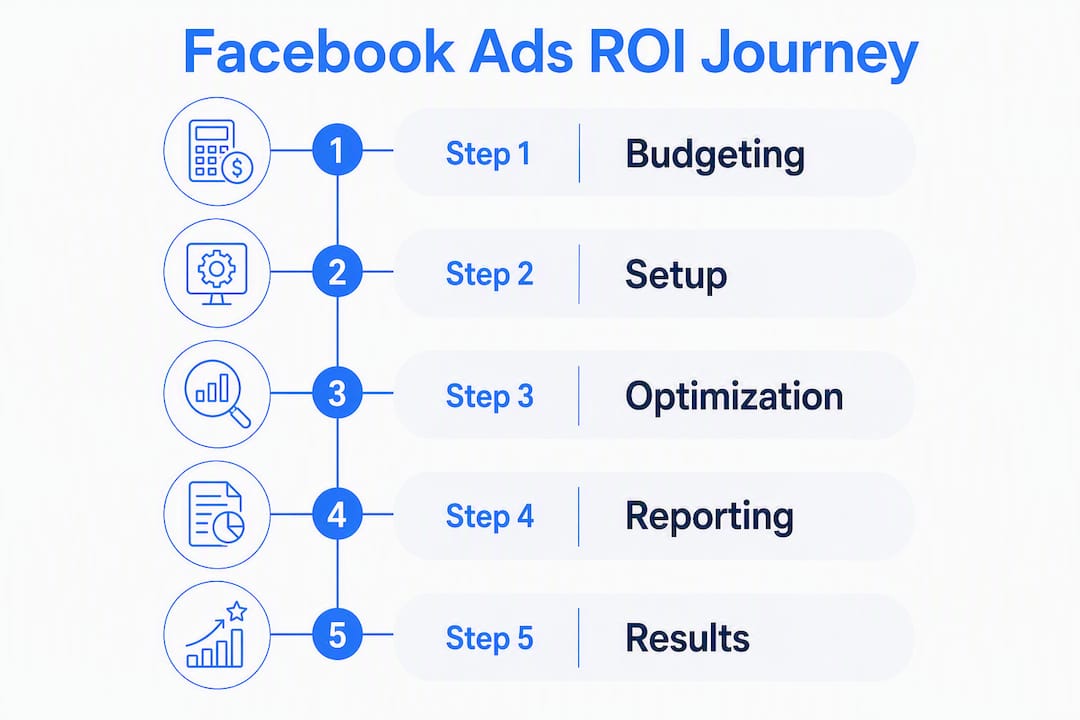
For NZ businesses, management fees typically follow one of three structures: a flat monthly retainer, a percentage of ad spend within a common range, or a hybrid of both. The right structure depends on your spend level and how actively the account needs to be managed.
Sample pricing shapes for NZ businesses (illustrative examples, not quotes):
- Small business or local service: $500–$1,500/month ad spend with a flat management fee in the $500–$800/month range.
- Mid-size business or growing e-commerce: $2,000–$5,000/month ad spend with percentage-based fees or a retainer in the $1,000–$2,000/month range.
- Established e-commerce or multi-location brand: $5,000+/month ad spend with a retainer or percentage model, often including dedicated creative production.
These are illustrative shapes only. Actual pricing varies by agency, scope, and campaign complexity.
Timeline reality check: NZ CPC data drawn from $3B in ad spend shows month-to-month volatility driven by seasonality and public holidays. Budget for higher CPCs around Waitangi Day, ANZAC Day, Matariki, and the late-year shopping period — and build that into your performance expectations from month one.
A realistic timeline from kick-off to meaningful results looks like this:
- Weeks 1–3: Account audit, tracking implementation, audience research, creative brief, and campaign structure.
- Weeks 4–8: Campaigns live, Meta’s algorithm in its learning phase. Expect variable results while the system gathers data.
- Months 3+: Optimisation phase begins in earnest. This is when A/B test results inform creative and targeting decisions, and ROAS starts to stabilise.
Pricing red flags to watch for:
- No clear separation between ad spend and management fees.
- Creative costs buried inside a flat fee with no itemisation.
- Vague KPIs like “increased brand awareness” with no measurable targets.
- Reporting locked behind a proprietary dashboard you cannot export or verify.
- No testing plan or optimisation schedule in the proposal.
Which ad formats and targeting options perform best for NZ audiences?
Format choice is where a lot of Auckland campaigns quietly underperform. The right format depends on the business objective, but a few patterns hold consistently across NZ markets.

Short vertical video for Stories and Reels tends to outperform static images for brand awareness and top-of-funnel reach, particularly on mobile. Carousel ads work well for product discovery, letting users swipe through multiple items or benefits in a single ad unit. Dynamic retargeting, which automatically serves product ads to people who have already viewed those items on your site, is the highest-leverage format for e-commerce. Lead forms built natively inside Facebook reduce friction for B2B advertisers by keeping the user on-platform rather than sending them to an external landing page.
Targeting tactics that matter specifically in the NZ context:
- Custom audiences built from your email list, website visitors, and video viewers give the algorithm a quality signal to work from.
- Lookalike audiences seeded with NZ conversions consistently outperform broad interest targeting for established businesses.
- Auckland suburb geo-targeting is particularly useful for service businesses and retailers, allowing spend to concentrate where your customers actually are. South Auckland and Manukau, for instance, have distinct demographic profiles that respond differently to creative and offer framing.
- Interest and behaviour layering works best as a refinement tool rather than a primary targeting method in a market as small as New Zealand.
For placements, request Facebook News Feed, Instagram Feed, and Reels as a baseline. Stories placements add reach at lower CPM but require vertical-format creative. Mobile-first creative is not optional in NZ: the majority of Meta ad impressions are served on mobile devices, so any creative not designed for a small screen is leaving performance on the table.
What should onboarding and reporting look like after you sign?
A well-run onboarding process sets the tone for the entire engagement. If an agency skips steps here, those gaps tend to compound over time.
Onboarding checklist (what a good agency will walk you through):
- Account audit of any existing Meta Business Manager, ad accounts, and Pixel data.
- Tracking implementation: Pixel verification, Conversions API setup, and Google Tag Manager or GA4 integration.
- Audience research: existing customer data review, competitor analysis, and audience segment mapping.
- Creative brief: brand guidelines, offer details, and first creative set for review.
- Campaign structure and test plan: ad set architecture, budget allocation, and A/B test hypotheses.
Access you will need to provide:
- Meta Business Manager admin access (or partner access via the agency’s Business Manager).
- Pixel and dataset access.
- Google Analytics 4 or Google Tag Manager access.
- CRM or e-commerce platform access if dynamic ads or lead nurturing are in scope.
For reporting, a clear cadence and a consistent template are what separate agencies that manage accounts from agencies that manage clients. The table below shows what a solid reporting structure looks like.
| Report type | Frequency | Key metrics to include |
|---|---|---|
| Performance snapshot | Weekly | Spend, impressions, CTR, CPC, conversions, ROAS |
| Insights and action plan | Monthly | ROAS trend, CPA by audience, creative performance, test results, next-month plan |
| Quarterly review | Quarterly | Goal progress, audience growth, budget recommendations, creative refresh plan |
ROAS, CPA, CTR, and conversion rate are the four metrics that map most directly to business outcomes. Any report that leads with reach and impressions without connecting them to revenue or leads is showing you vanity metrics first.
What results can you realistically expect from a Meta-certified agency?
Performance varies by industry, offer, creative quality, and how well the account is structured. That said, NZ benchmarks give a useful frame for calibrating expectations and stress-testing agency promises.
NZ Facebook Ads CTR benchmarks sit at a median level across industries, with significant monthly variation. An agency promising consistent 3–4% CTR from day one without a strong creative track record in your category is overpromising. Conversely, an agency that cannot explain how they plan to beat the median should be pressed on their testing methodology.
Beyondclix’s results page documents campaign outcomes including ROAS improvements, with the brand reporting up to 20x ROAS in rapid campaign results for certain clients. Results at that level depend on the offer, the audience, and the full-funnel setup, but they illustrate what is achievable when campaigns are built with integrated tracking and a clear conversion path.
When an agency presents case studies, ask for original account screenshots or GA4 event data rather than a slide with a number on it. Verifiable proof is the standard worth holding agencies to.
How do you choose the right Facebook ads agency in Auckland?
The decision comes down to evidence, process, and fit. Use the scorecard below to rate agencies during proposal reviews and discovery calls.
| Evaluation criterion | What to look for | Red flags |
|---|---|---|
| Meta certification | Official Meta Certified Partner badge | No certification, or certification claimed without a verifiable badge |
| NZ and Auckland experience | Local case studies with quantified results | Only global or Australian examples |
| Transparency | Clear fee structure, separate from ad spend | Bundled fees, no itemised scope |
| Reporting | Sample report provided upfront, metrics tied to goals | Proprietary dashboards with no data export |
| Testing and optimisation | Documented A/B testing plan and decision criteria | No testing plan, “we’ll optimise as we go” |
| Communication | Named campaign manager, defined escalation path | Rotating account teams, no direct contact |
| Creative ownership | Clear IP and asset ownership terms | Agency retains creative assets on contract end |
Interview questions worth asking on every discovery call:
- Who will manage my account day-to-day, and what is their experience with NZ campaigns?
- How do you handle the Meta learning phase, and what does your testing plan look like?
- Can you share a case study from a business in my industry or a comparable NZ market?
- What does your reporting template look like, and how often will we review performance?
- What happens to my ad account and creative assets if we end the engagement?
Once you have selected an agency, the practical next steps are straightforward: confirm Business Manager access, agree on a 30-day onboarding timeline, set first-month KPI targets in writing, and schedule a 30-day check-in before the first full monthly review.
Key takeaways
An Auckland-based Meta Certified Partner with a dedicated campaign manager, transparent pricing, and NZ-specific case studies is the clearest path to measurable Facebook and Instagram ad ROI for established businesses.
| Point | Details |
|---|---|
| Prioritise Meta certification | A Meta Certified Partner has verified technical skills, direct Meta support access, and beta feature access. |
| Budget for NZ seasonality | CPC spikes around Waitangi Day, ANZAC Day, Matariki, and late-year events — plan creative and budgets accordingly. |
| Insist on Conversions API | Server-side tracking via the Meta Conversions API is more accurate than Pixel alone for NZ e-commerce and lead gen. |
| Expect a 6–8 week learning phase | Meta’s algorithm needs time to optimise; meaningful ROAS data typically emerges after the first 6–8 weeks. |
| Beyondclix for Auckland campaigns | Beyondclix offers integrated Meta Ads management with local Auckland expertise, dedicated campaign managers, and cross-channel coordination. |
Why the “certified” label matters more than most Auckland businesses realise
Most businesses shopping for a Facebook ads agency in Auckland focus on price and portfolio. Those are reasonable starting points. But the question that separates a good hire from an expensive lesson is whether the agency’s process can actually be verified, not just described.
Meta certification is one of the few verifiable signals in an industry where anyone can claim expertise. An agency that has met Meta’s technical and spending thresholds has been tested in a way that a well-designed website cannot replicate. That does not guarantee results, but it does mean the fundamentals are in place: the team knows how the platform works, they have access to support when something breaks, and they are not learning on your budget.
The other underappreciated factor is integration. Auckland businesses that run Meta ads in isolation from their analytics, landing pages, and CRM are essentially flying blind on half the funnel. The ad might generate a click, but if the landing page is slow, the CRM is not capturing the lead, or the attribution is broken, the ROAS figure in the dashboard is fiction. Agencies that treat paid social as one channel in a connected system consistently outperform those that treat it as a standalone service.
The practical implication: when you are evaluating agencies, ask not just what they do with your Meta account, but how they connect it to everything else. The answer tells you more about their actual capability than any case study slide.
Beyondclix’s Meta ads service for Auckland businesses
Beyondclix delivers Meta Ads management as part of an integrated digital growth system, not as a standalone service bolted onto a generic retainer. For Auckland businesses, that means campaigns built with local market knowledge, connected to analytics and tracking from day one, and managed by a dedicated team that understands the NZ audience. The difference shows up in the numbers: campaigns coordinated across paid social, landing pages, and CRM consistently produce stronger ROAS than ads-only approaches.
The starting point is a campaign audit or discovery session to assess your current setup, identify tracking gaps, and define the right campaign structure for your goals. From there, Beyondclix builds the full campaign architecture, including creative, audience strategy, and conversion tracking, before anything goes live. You get a named campaign manager, a clear reporting cadence, and full access to your account data throughout.
To request an audit or get a proposal tailored to your Auckland business, visit the BeyondClix services page and submit your details. The team will follow up within one business day.
Useful sources
These resources are worth bookmarking before you brief an agency or review a proposal.
- Meta Ads | BeyondClix — Detail on Beyondclix’s Meta advertising services, including campaign management and integrated tracking.
- Results | BeyondClix — Campaign performance highlights and case outcomes from Beyondclix clients.
- How content marketing powers your paid strategy in NZ — Explains how integrated content and landing page work lifts paid ad performance in the NZ context.
- Digital Marketing in South Auckland | BeyondClix — Regional insights and campaign considerations for South Auckland businesses.
Use the benchmark sources to set realistic KPI targets before agency calls, and use the Beyondclix pages to understand what an integrated NZ campaign setup looks like in practice.
FAQ
What does a Facebook ads agency in Auckland typically charge?
Management fees vary by scope and agency model, but NZ businesses commonly see flat retainers or percentage-of-spend structures ranging from a few hundred to several thousand dollars per month, separate from the media budget paid directly to Meta. Always ask for an itemised fee structure before signing.
How long does it take to see results from Facebook advertising?
Meta’s learning phase typically runs 6–8 weeks after campaign launch, during which the algorithm gathers conversion data and optimises delivery. Meaningful ROAS trends usually emerge after the first 6–8 weeks, with more reliable optimisation data available from month three onwards.
Why does Meta Certified Partner status matter when choosing an agency?
A Meta Certified Partner has met Meta’s technical and spending benchmarks, completed advanced training, and has access to direct Meta support and beta features. For advertisers, it reduces the risk of paying for a team that is learning the platform on your budget.
What is the Facebook Pixel, and do I need the Meta Conversions API too?
The Facebook Pixel is a piece of code on your website that tracks user actions and feeds data back to Meta for optimisation and reporting. The Meta Conversions API sends the same event data server-side, bypassing browser-based tracking limitations caused by iOS privacy changes and ad blockers. For NZ e-commerce and lead generation, both are worth implementing together for accurate attribution.
Can Beyondclix manage Facebook ads for businesses outside central Auckland?
Yes. Beyondclix serves businesses across Auckland, including South Auckland, Manukau, and surrounding suburbs, with campaigns tailored to local audience profiles and geo-targeting strategies suited to each area.
Recommended
- LinkedIn ads agency Auckland: who to hire and what to expect – BeyondClix Blog
- Digital advertising formats for leads: your 2026 NZ guide – BeyondClix Blog
- Wezealor.com alternatives for NZ businesses in 2026 – BeyondClix Blog
- How content marketing powers your paid strategy in NZ – BeyondClix Blog
Want this run for your business?
Talk to our CEO. We will show you where the money is leaking and what we would do about it.