
Addressable advertising is the practice of delivering specific ads to identifiable audiences — known households, CRM contacts, or matched device profiles — rather than broadcasting to everyone watching or browsing at the same time. IAB New Zealand defines addressability as the ability to reach specific, identifiable audiences with relevant advertising, with first-party data and identity resolution replacing the third-party cookies that once made this possible at scale.
Three things make this particularly relevant for New Zealand marketers right now:
- The deprecation of third-party cookies has forced a shift to first-party data strategies, and NZ advertisers who haven’t started that transition are already behind.
- TVNZ and BVOD platforms are actively building addressable infrastructure, giving local buyers household-level precision that didn’t exist here a few years ago.
- The Advertising Standards Authority (ASA) and the NZ Privacy Act set clear guardrails on how personal data can be used in advertising, so compliance is not optional.
A practical example: a car dealer can serve one creative to households in-market for a SUV and a different creative to households browsing sedans, while both watch the same TVNZ programme. That’s addressable advertising in action.
Key takeaways
Addressable advertising works when your first-party data is clean, your privacy compliance is documented, and your measurement framework is set up before the campaign goes live, not after.
| Point | Details |
|---|---|
| Audit first-party data first | CRM quality, consent records, and identifier types determine what addressable methods are actually available to you. |
| Match method to your scale | Deterministic matching suits large, clean CRM lists; probabilistic modelling extends reach when list size is limited. |
| Comply with ASA and Privacy Act | All personalised ads must be clearly identified as advertising, and hashed data is still personal information under NZ law. |
| Use holdout groups for measurement | Conversion lift against a holdout is the only reliable way to separate addressable campaign impact from organic behaviour. |
| Start with a decisioned pilot | Test a PMP or clean room buy before scaling; IAB NZ evidence shows decisioned buys can outperform programmatic guaranteed on the same inventory. |
Table of Contents
- What is addressable advertising and how does it actually work?
- Which channels support addressable advertising?
- What are the real benefits of addressable advertising?
- What addressability methods should you use?
- Privacy, regulation, and NZ compliance for addressable campaigns
- How to run an addressable campaign in New Zealand: a practical sequence
- What does an agency-run addressable campaign look like?
- How do you measure addressable advertising results?
- Addressable advertising in New Zealand: three practical examples
- The part most NZ marketers get wrong about addressable advertising
- Sources
- FAQ
What is addressable advertising and how does it actually work?
Addressable advertising matches known audience identifiers to ad delivery systems so the right creative reaches the right person, not just the right context. The signal flow runs in a consistent sequence regardless of channel.
Data sources come first: your CRM list, first-party website data, loyalty programme records, or publisher login data. Those raw identifiers (email addresses, phone numbers) are hashed into anonymised tokens before they leave your environment. The hashed list is then passed to an identity resolution layer, which matches your records against a publisher’s or platform’s own identity graph.
Identity resolution works in two modes. Deterministic matching ties an ad impression to a confirmed identity — a logged-in user on Meta or a subscriber on TVNZ’s streaming platform. It’s precise but limited to people who’ve authenticated. Probabilistic matching infers identity from behavioural signals, device patterns, and location data, which scales further but carries more noise. Most real campaigns use both, leaning deterministic where match rates are strong and probabilistic to extend reach.
Once audiences are built, they’re activated through a demand-side platform (DSP), an ad server, or a publisher’s own stack. Measurement closes the loop by connecting impressions back to outcomes — purchases, form fills, store visits — using clean rooms or privacy-safe attribution tools.
Pro Tip: Refresh your identity graph at least quarterly. Stale CRM data (old email addresses, churned customers) drags down match rates and inflates frequency against the wrong people. A 90-day data hygiene cycle keeps false positives manageable and match rates honest.
Which channels support addressable advertising?
Addressability isn’t one channel. It’s a capability that different channels deliver with different levels of precision.
- Addressable TV and CTV (connected TV): ThinkTV describes addressable TV as technology that lets marketers show different ads to different households watching the exact same content, shifting TV buying from programme-level reach to household-level precision. In NZ, BVOD platforms are the primary access point for this capability.
- Digital display (web and app): Audience segments built from first-party or modelled data are pushed to a DSP and matched against publisher inventory. Identity tends to be probabilistic here unless the publisher has a strong logged-in user base.
- Social platforms (Meta, LinkedIn): These offer some of the strongest deterministic matching available. Upload a hashed CRM list to Meta Ads or LinkedIn Ads and the platform matches against its own authenticated user graph. Match rates on Meta typically run higher than open-web display because nearly every user is logged in.
- Programmatic private marketplaces (PMPs): A PMP deal gives you access to a specific publisher’s inventory with your own audience data applied. This sits between open auction (low control) and programmatic guaranteed (fixed volume, less flexibility). For NZ BVOD, PMPs are often the practical path to decisioned, data-driven buys.
The channel choice should follow your identity strength. If your CRM is rich and your audience is on social, start there. If you’re building brand reach across households, addressable TV or CTV through a BVOD PMP is worth the setup effort.
What are the real benefits of addressable advertising?
The core promise is efficiency: spend reaches people who are actually relevant, not everyone in a postcode or demographic band.
- Higher relevance: Ads matched to known intent or purchase history outperform generic creative because the message fits the moment.
- Frequency control: You can cap how many times a specific household or device sees an ad, which protects brand perception and reduces wasted spend.
- Connected measurement: Because you know who was exposed, you can measure conversion lift against a holdout group rather than relying on last-click attribution.
- Lower wasted impressions: Broad buys fund a lot of impressions that will never convert. Addressable buys concentrate spend on audiences with a demonstrated signal.
- Creative personalisation: Different creative variants can run to different audience segments within the same campaign, which ad creative research consistently links to improved conversion rates.
The trade-off is operational complexity. Building addressable campaigns requires clean data, privacy-compliant processes, and measurement infrastructure that broad buys don’t need. The return on that investment scales with audience size and campaign frequency — for a small, one-off campaign, the overhead may not be worth it.
What addressability methods should you use?
The right methodology depends on your data quality, campaign scale, and privacy obligations. Here’s how the main approaches compare:
| Method | Accuracy | Scale | Privacy risk | Operational effort |
|---|---|---|---|---|
| First-party identity matching (hashed CRM) | High | Limited to your list size | Low (anonymised) | Medium |
| Deterministic device matching | High | Moderate (logged-in users) | Low to medium | Medium |
| Probabilistic modelling | Medium | High | Medium | Medium to high |
| Contextual plus cohort targeting | Low to medium | Very high | Very low | Low |
| Data clean rooms | High | Depends on partner overlap | Very low | High |
First-party identity matching is the most defensible approach: your data, hashed, matched against a publisher’s graph. The ceiling is your list size, but the signal quality is strong.
Probabilistic modelling fills the gap when deterministic signals run thin. It scales well but introduces noise, and industry commentary points to modelling and measurement as increasingly central to sustaining addressable reach as deterministic signals fragment across platforms.
Data clean rooms let two parties analyse combined datasets without either side seeing the other’s raw records. TVNZ is already using AWS Clean Rooms and Amazon Personalize to activate first-party data in exactly this way, enabling advertisers to match audiences without exchanging raw customer lists.
Contextual and cohort targeting doesn’t rely on individual identity at all. It targets content environments or interest-based groups rather than named individuals, which makes it the lowest-risk approach from a privacy standpoint but the least precise for conversion-focused campaigns.
Pro Tip: If your CRM list has fewer than 10,000 records, probabilistic modelling will likely outperform deterministic matching on reach. Above that threshold, prioritise deterministic first and use modelling to extend to lookalike audiences.
Privacy, regulation, and NZ compliance for addressable campaigns
NZ advertisers running addressable campaigns must comply with two overlapping frameworks: the ASA’s Advertising Standards Code and the Privacy Act 2020. Neither is optional, and both have direct implications for how you collect, process, and use audience data.
The ASA requires that all advertiser-controlled messages be clearly identifiable as advertising and not disguised. This applies equally to personalised or dynamically inserted ads. A dynamically served creative that looks like editorial content is a compliance risk regardless of how it was targeted. The Advertising Standards Code also requires that advertising be truthful and not misleading — personalised messaging that overstates a claim doesn’t get a pass because it was well-targeted.
The Privacy Act 2020 governs how personal information is collected, stored, and used. Hashed email lists are still personal information under NZ law if they can be re-identified. Consent, purpose limitation, and data minimisation all apply.
Compliance checklist for NZ addressable campaigns:
- Obtain clear consent for data collection and specify advertising as a use purpose.
- Hash all identifiers before they leave your environment; never share raw customer lists with publishers.
- Document the legitimate purpose for each audience segment.
- Apply data minimisation: only pass the fields needed for matching, not full customer records.
- Review clean room agreements for data retention, access controls, and deletion rights.
- Ensure all personalised creatives carry clear ad identification (label, sponsor disclosure, or equivalent).
- Conduct an internal privacy review before activating any new audience data source.
Steps to get sign-off before launch:
- Brief your legal or privacy team on the data flows and matching methodology.
- Confirm your publisher or DSP partner has a current data processing agreement aligned with NZ law.
- Check that your consent records cover advertising use and are dated within your retention policy.
- Review creative assets against the ASA’s ad identification requirement.
- Document the sign-off in writing before the campaign goes live.
IAB New Zealand and ThinkTV both publish industry guidance on privacy-safe data activation. Consulting both before setting up a new addressable programme is worth the time, particularly if you’re entering clean room arrangements for the first time.
How to run an addressable campaign in New Zealand: a practical sequence
Follow this sequence to move from concept to live campaign without skipping the steps that cause problems later.
- Audit your first-party data. Assess what you have: CRM size, data recency, consent records, and identifier types (email, phone, device IDs). A list of 50,000 opted-in customers is a strong starting point; a list of 5,000 with patchy consent is not.
- Define your audience segments. Segment by purchase history, lifecycle stage, or intent signals. Be specific: “lapsed customers who bought in the last 18 months” outperforms “all customers” as a targeting brief.
- Select your partners and channels. For NZ, consider TVNZ’s BVOD stack for household-level CTV, Meta and Google Ads for deterministic social and search, and a DSP with NZ publisher relationships for open-web display. Ask each partner: What identity resolution method do you use? What’s a realistic match rate for my list? Do you support clean room collaboration?
- Set up privacy safeguards. Hash all identifiers. Sign data processing agreements. Confirm consent coverage. Brief your legal team.
- Build and personalise creative. Match creative variants to audience segments. A lapsed customer needs a different message than a prospect. Keep all creatives clearly labelled as advertising per ASA requirements.
- Run a decisioned pilot before scaling. IAB New Zealand’s case evidence on decisioned media buying in BVOD shows that data-driven decisioned buys can outperform programmatic guaranteed deals when tested against the same publisher inventory. Start with a PMP test buy before committing to a full programme.
- Measure and optimise. Set up holdout groups before launch. Track match rate, reach among exposed audiences, and conversion lift. Adjust frequency caps and creative rotation based on early results.
Questions to ask your publisher or DSP before signing:
- What identity resolution method do you use (deterministic, probabilistic, or both)?
- What match rate should I expect for a hashed email list of my size?
- Do you support clean room data collaboration, and which environment?
- What’s your data retention policy for matched audience segments?
- How often will you report on match rate and delivery performance?
What does an agency-run addressable campaign look like?
A well-run addressable programme follows a phased timeline that keeps privacy, measurement, and performance in balance from day one.
Weeks 0–2: Data audit and strategy. The agency reviews your CRM data quality, consent records, and existing audience segments. Identity resolution method is selected based on list size and channel mix. Clean room requirements are scoped if publisher collaboration is planned.
Weeks 3–4: Audience build and test setup. Hashed lists are prepared and uploaded to platforms. Holdout groups are defined. Creative variants are briefed and built against audience segments. A PMP deal or publisher partnership is confirmed.
Week 5 onwards: Live optimisation. Campaign goes live. Match rates are reviewed in the first 48 hours. Frequency caps, creative rotation, and bid strategies are adjusted weekly based on performance data.
Illustrative KPIs by phase:
- Data audit: CRM match rate (target above 40% on a quality list), consent coverage percentage.
- Audience build: Segment size after matching, reach among exposed vs unexposed.
- Optimisation: Conversion lift versus holdout, cost per incremental conversion, viewable impression rate.
Beyondclix is a comprehensive digital growth agency specialising in measurable, outcome-based campaigns for established NZ businesses. The approach covers the full addressable stack: analytics and tracking setup, audience strategy, platform activation across Meta, Google, and LinkedIn, and measurement frameworks that connect spend to real business outcomes. If you’re ready to scope a pilot, get in touch with Beyondclix to discuss what your data can support.
How do you measure addressable advertising results?
Measurement is where most addressable campaigns either prove their value or quietly disappoint. The key is separating exposed-audience performance from incremental impact.
- Match rate: The percentage of your audience list successfully matched to platform identifiers. Below 30% suggests data quality issues. Above 50% on a hashed email list is a healthy starting point.
- Reach among exposed audiences: How many unique matched individuals actually received an impression, and at what frequency.
- Conversion lift: The difference in conversion rate between your exposed group and a holdout group that saw no ads. This is the cleanest measure of whether the campaign drove behaviour.
- Cost per incremental conversion: Total spend divided by the number of conversions attributable to the campaign above the holdout baseline.
- View-through conversion: Conversions that occurred within a defined window after an ad impression, without a click. Useful for CTV and display where click-through rates are structurally low.
Geo-split tests work where inventory allows. Staggered campaign starts across publisher PMPs can also reveal lift when a true holdout isn’t feasible.
Experian frames addressable advertising as identity-first and AI-enabled, with identity resolution and privacy-first modelling separating guesswork from accuracy as signals fragment. That framing applies directly to measurement: the more precisely you can tie an impression to a known individual, the more reliable your lift calculation becomes.
Attribution windows should reflect your purchase cycle. A car dealer might use a 30-day view-through window; a FMCG brand might use seven days. Set the window before launch and don’t adjust it mid-campaign, as changing windows mid-flight invalidates your holdout comparison.
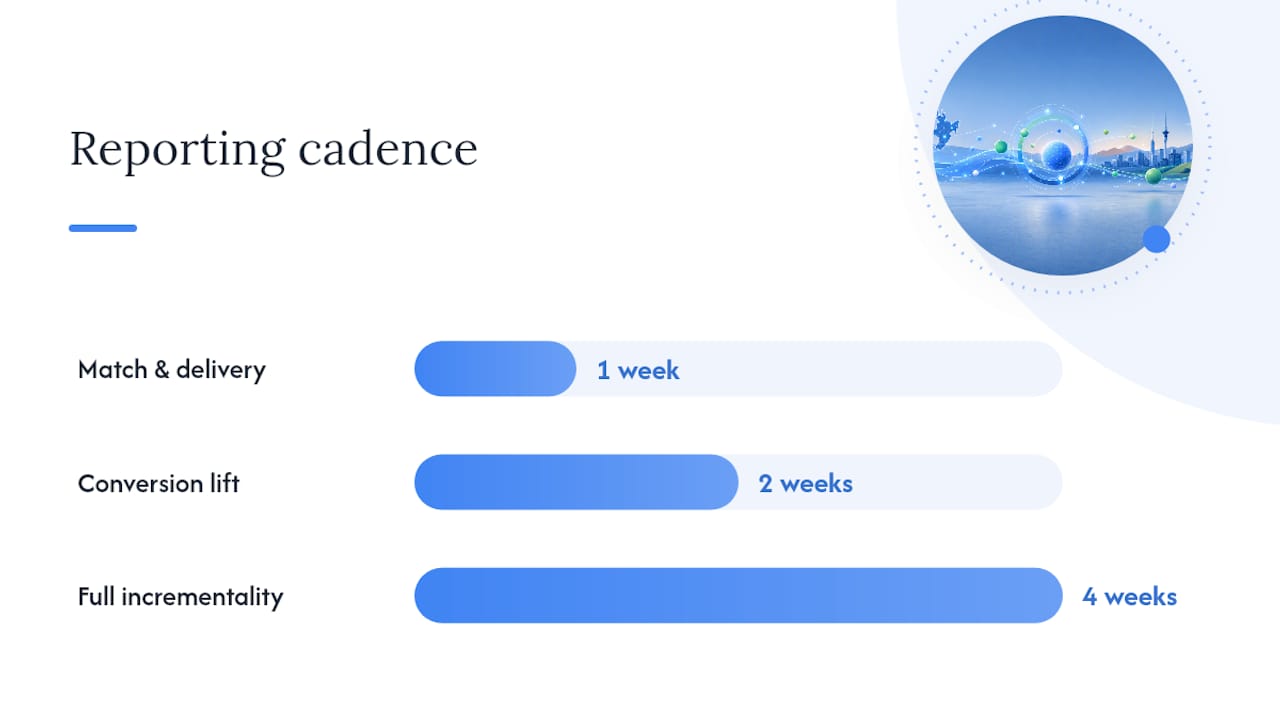
Reporting cadence matters too. Weekly check-ins on match rate and delivery, fortnightly on conversion lift, and a full incrementality read-out at the four-week mark gives you enough data to optimise without over-reacting to early noise.
Addressable advertising in New Zealand: three practical examples
TVNZ clean room collaboration for a national retailer. A national retailer uploads a hashed CRM list of loyalty programme members. TVNZ matches that list against its authenticated BVOD subscriber base using AWS Clean Rooms, without either party seeing the other’s raw records. The retailer serves different creative to lapsed members versus active ones during the same primetime programme, and measures conversion lift against a holdout group of unmatched subscribers.

A financial services brand using hashed CRM across social and CTV. A KiwiSaver provider uploads a hashed email list to Meta and a BVOD DSP simultaneously. On Meta, deterministic matching reaches existing members with retention messaging. On CTV, probabilistic extension reaches lookalike households with acquisition creative. The two channels are measured separately with different attribution windows, and the combined incremental result is reported against a unified holdout.
A decisioned BVOD buy for a challenger brand. Rather than taking a programmatic guaranteed deal on a BVOD platform, a challenger brand works with a DSP to set up a private marketplace deal with audience data applied at the impression level. As IAB New Zealand’s case evidence shows, this decisioned approach can outperform PG deals on the same inventory when the audience data is clean and the creative is matched to segment. ThinkTV’s guidance on addressable TV supports this model as the direction NZ broadcast buying is heading.
The part most NZ marketers get wrong about addressable advertising
Most conversations about addressable advertising in New Zealand focus on the technology: clean rooms, identity graphs, DSPs, match rates. That’s understandable — the infrastructure is genuinely new and the terminology is dense. But the technology is not where campaigns succeed or fail.
The real differentiator is data discipline before the campaign starts. Marketers who run addressable programmes on stale CRM lists, with patchy consent records, and without a holdout group in place are essentially paying a premium to reach an audience they can’t accurately identify and measuring results they can’t honestly attribute. The precision is illusory.
The second mistake is treating addressable advertising as a replacement for broad reach rather than a complement to it. Addressable buys are efficient for known audiences at the bottom and middle of the funnel. They’re not the right tool for building awareness among people who’ve never heard of your brand. A programme that cuts all broad reach in favour of addressable targeting often sees short-term efficiency gains followed by a slow erosion of the top-of-funnel pipeline that feeds future addressable audiences.
The third issue is compliance treated as a checkbox rather than a design principle. NZ’s Privacy Act and the ASA’s requirements aren’t obstacles to addressable advertising — they’re the framework that makes it sustainable. Campaigns built with consent and transparency at the centre tend to perform better over time because the audience data is cleaner and the brand relationship is intact.
The practical priority for most NZ marketers is straightforward: audit your first-party data, document your consent, run a small decisioned pilot with a holdout group, and measure honestly. That sequence, done well, will tell you more about what addressable advertising can actually do for your business than any technology demo.
Sources
- IAB New Zealand Glossary
- ThinkTV: TV language / addressable TV explanation
- Addressable advertising in the age of AI | Experian Marketing
- Definition of Advertising and Advertisement – Advertising Standards Authority
FAQ
What is addressable advertising in simple terms?
Addressable advertising delivers specific ads to identifiable audiences — known households, CRM contacts, or matched devices — rather than broadcasting to everyone in a channel. IAB New Zealand defines it as the ability to reach specific, identifiable audiences with relevant advertising using first-party data and identity resolution.
Can you give an example of addressable advertising in New Zealand?
A national retailer uploads a hashed loyalty programme list to TVNZ’s BVOD platform via a clean room. Loyalty members see a retention offer while non-members watching the same programme see an acquisition creative. Neither party shares raw customer data.
How is addressable advertising different from programmatic advertising?
Programmatic advertising automates the buying and selling of ad inventory, often using contextual or demographic signals. Addressable advertising goes further by matching ads to specific, identifiable individuals or households using first-party data and identity resolution. Addressable can run through programmatic pipes (via a DSP or PMP), but not all programmatic buying is addressable.
What are the main types of addressable advertising channels?
The four main channels are addressable TV and CTV (household-level precision via BVOD), digital display (web and app, typically probabilistic), social platforms like Meta and LinkedIn (strong deterministic matching via logged-in users), and programmatic private marketplaces (publisher-specific inventory with audience data applied).
Does addressable advertising comply with NZ privacy law?
It can, but compliance requires deliberate design. Hashed identifiers are still personal information under the NZ Privacy Act 2020, so consent, purpose limitation, and data minimisation all apply. The ASA also requires that all personalised ads be clearly identifiable as advertising and not misleading under the Advertising Standards Code.
Recommended
- Digital advertising formats for leads: your 2026 NZ guide – BeyondClix Blog
- Facebook ads agency Auckland: drive real ROI in 2026 – BeyondClix Blog
- How content marketing powers your paid strategy in NZ – BeyondClix Blog
- LinkedIn ads agency Auckland: who to hire and what to expect – BeyondClix Blog
Want this run for your business?
Talk to our CEO. We will show you where the money is leaking and what we would do about it.