

You’ve had a bad week. A customer left a one-star Google review about a late delivery, and it’s now the first thing people see when they search your business name. Someone suggests an easy fix: only ask your happy customers for reviews, and send the unhappy ones to a private feedback form. Nobody gets hurt, and your rating goes up.
It sounds like smart marketing. In New Zealand it can be a breach of the Fair Trading Act, and Google’s own rules ban it too. This guide covers what the law and Google actually say, what a recent million-dollar penalty tells you, and what you can safely do to build a strong review profile.
The case every NZ business owner should know about
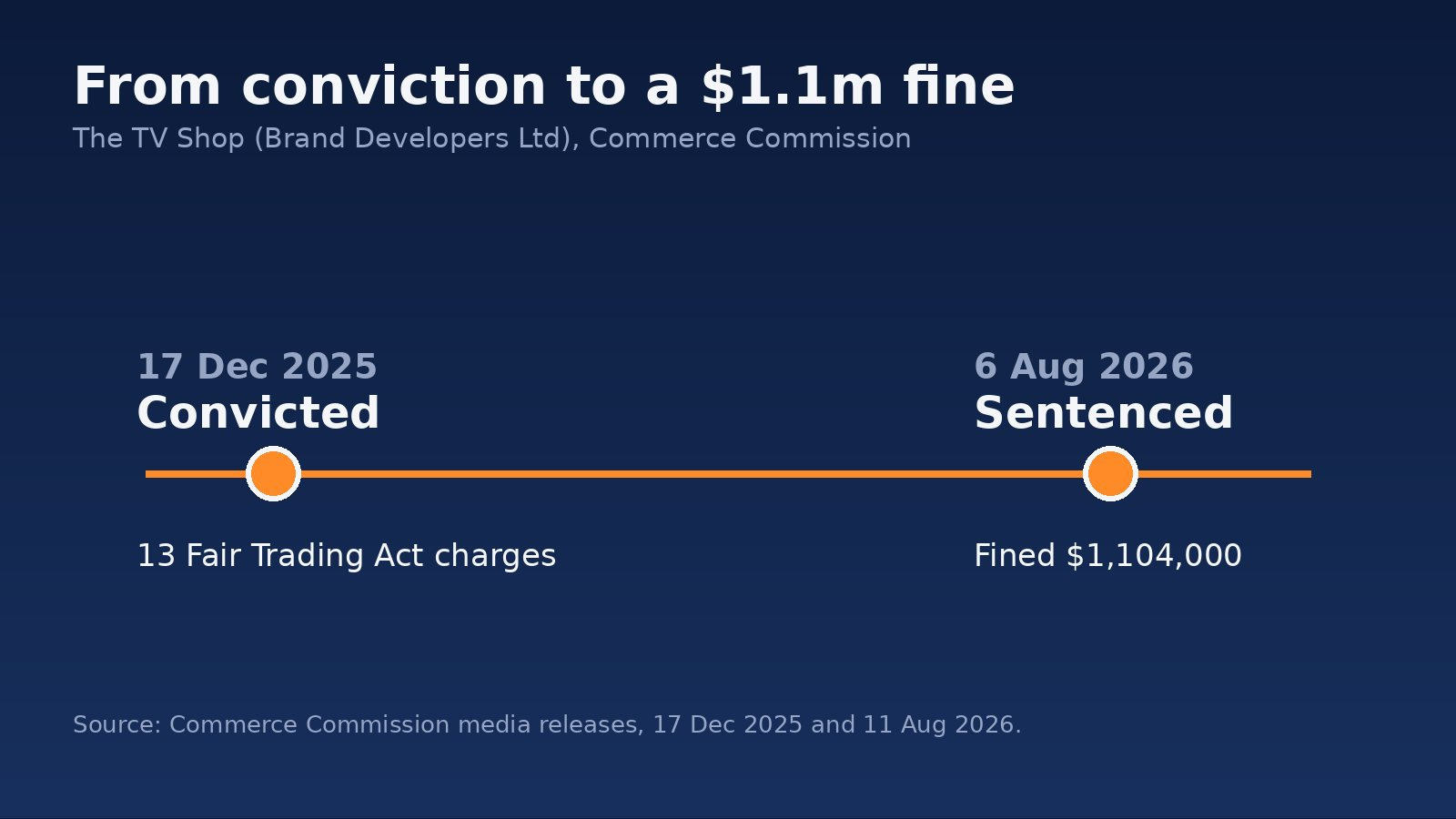
On 17 December 2025 the District Court convicted The TV Shop (Brand Developers Ltd) on 13 Fair Trading Act charges. The Commerce Commission said staff had posted positive customer reviews without disclosing who they were, and that the company only published one-to-three-star reviews if the customer replied to a follow-up email. Commerce Commission general manager Anne Callinan put it plainly: “The law is very clear – businesses must not mislead consumers through reviews that are not what they seem.” (Commerce Commission, 17 December 2025).
The penalty followed. The company was sentenced on 6 August 2026 and ordered to pay $1,104,000. The Commission said that “Kiwis should be able to trust online reviews are genuine and free of manipulation.” (Commerce Commission, 11 August 2026). Law firm Simpson Grierson’s August update counts at least 473 staff-posted reviews in the case (Simpson Grierson, August 2026), and Hesketh Henry’s summary describes the conduct as deliberate and systematic (Hesketh Henry, 4 September 2026).
Most small businesses are nowhere near that scale. The point is the principle: a review page that shows only part of the picture can mislead customers, and the regulator treats that as a real offence.
Two separate things went wrong, and you can make either one by accident
The TV Shop case involved two different problems, and it helps to keep them apart.
1. Reviews that weren’t what they seemed
Staff wrote reviews as if they were ordinary customers. For a small business the equivalent is a staff member, a family member or a supplier “helping out” with a few five-star reviews. It feels harmless. It is exactly the thing the Commission prosecuted.
2. Hiding the bad reviews
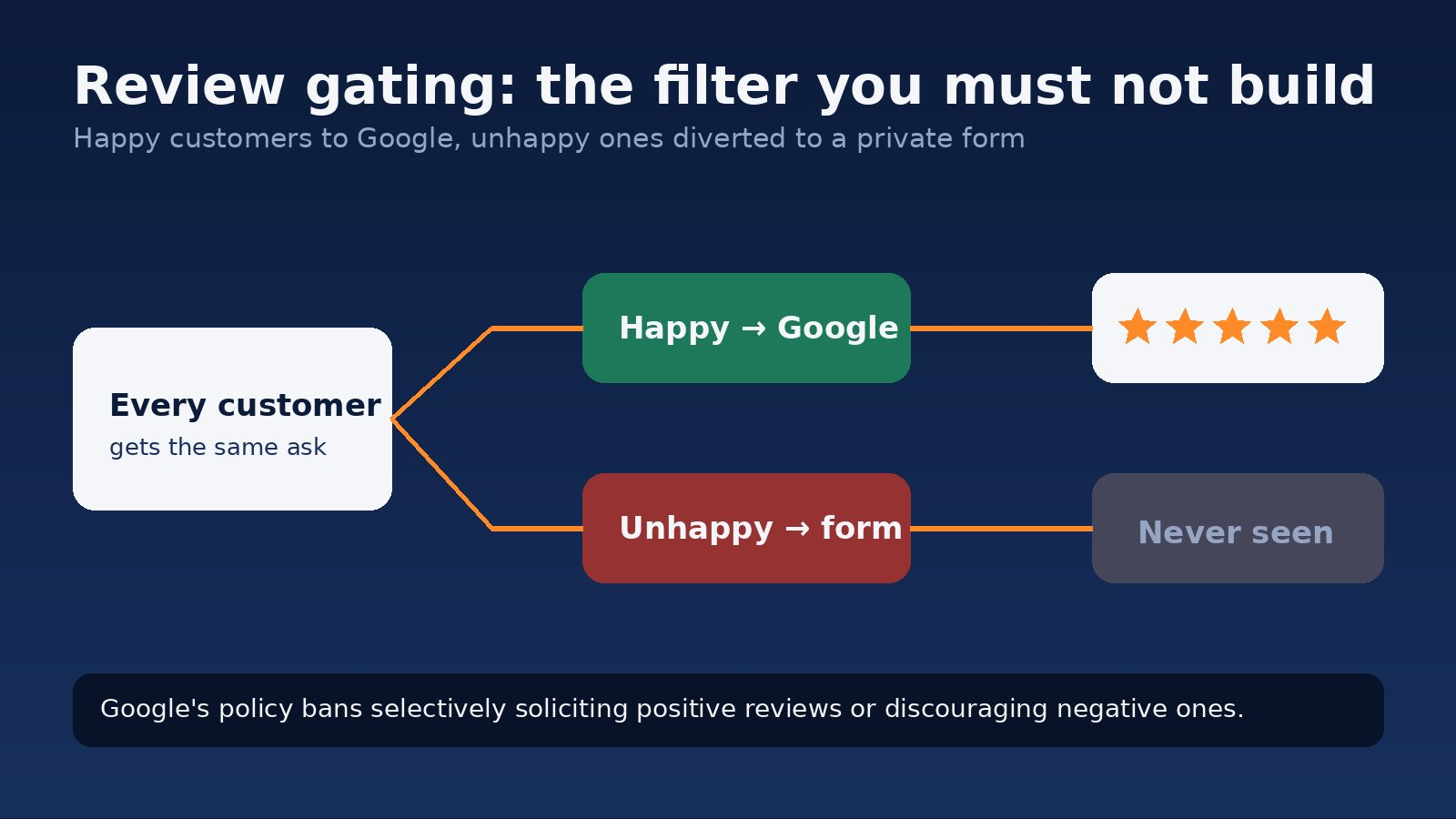
The second problem is the one most owners don’t realise is risky. Publishing the one-to-three-star reviews only when the customer did something extra meant the public saw a flattering sample. That is the same idea as review gating, where unhappy customers are steered away from the public page. An explainer from IT Brief NZ, written by marketing firm Storm IMC (so treat it as one vendor’s view), also points to a 2019 case where Bachcare was ordered to pay $117,000 over review practices (IT Brief NZ, 22 April 2026).
What Google’s rules say
Even if you ignored the law, Google’s policy would catch you. Its Business Profile review policy says merchants may not “Discourage or prohibit negative reviews, or selectively solicit positive reviews”. It also bans offering incentives for reviews, and bans requiring staff to leave a set number of reviews or asking them for specific content (Google Business Profile Help: prohibited and restricted content).
That is Google’s own policy for its own product, so it describes what Google may remove or penalise on your profile, not New Zealand law. But the two point the same direction: ask everyone, and let the results stand.
What you can do instead
None of this means you have to leave your reputation to chance. There is plenty you can do honestly, and it works better over time than any shortcut.
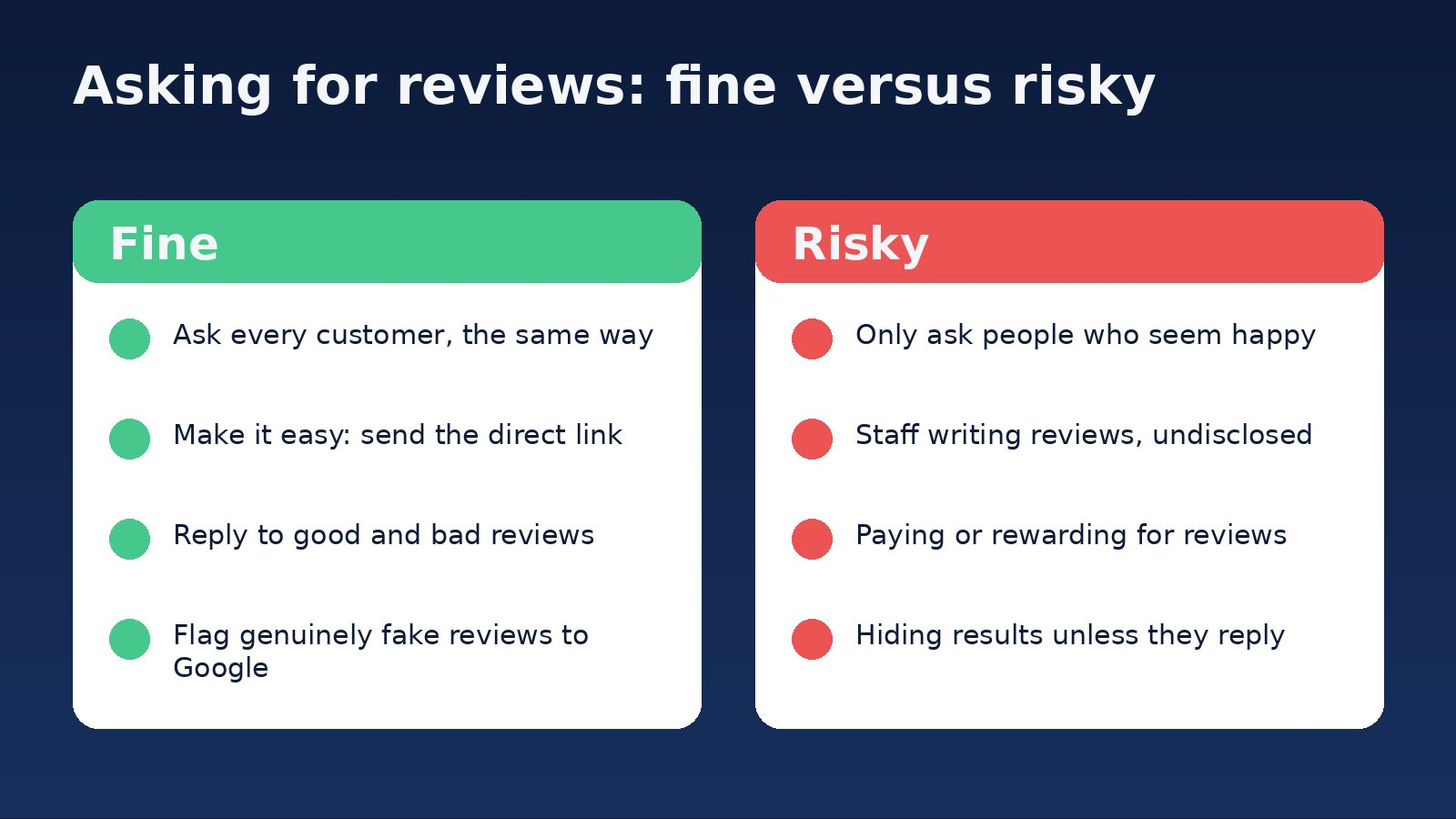
- Ask every customer, the same way. Send the direct review link to everyone you served, not a hand-picked group.
- Make it easy. A text message with one tap to the review page beats a request buried in an email footer.
- Reply to every review. A calm, specific reply to a one-star review often does more for a prospect reading it than the review itself did harm.
- Fix the cause. If three customers mention the same late delivery, the review is telling you something worth knowing.
- Report fakes. If a competitor or stranger leaves a review about a job you never did, flag it to Google through your Business Profile.
How to tell whether your agency is playing it safe
If someone else manages your reputation, the legal risk still lands on your business. Ask these four questions before you sign, and again at each quarterly review.
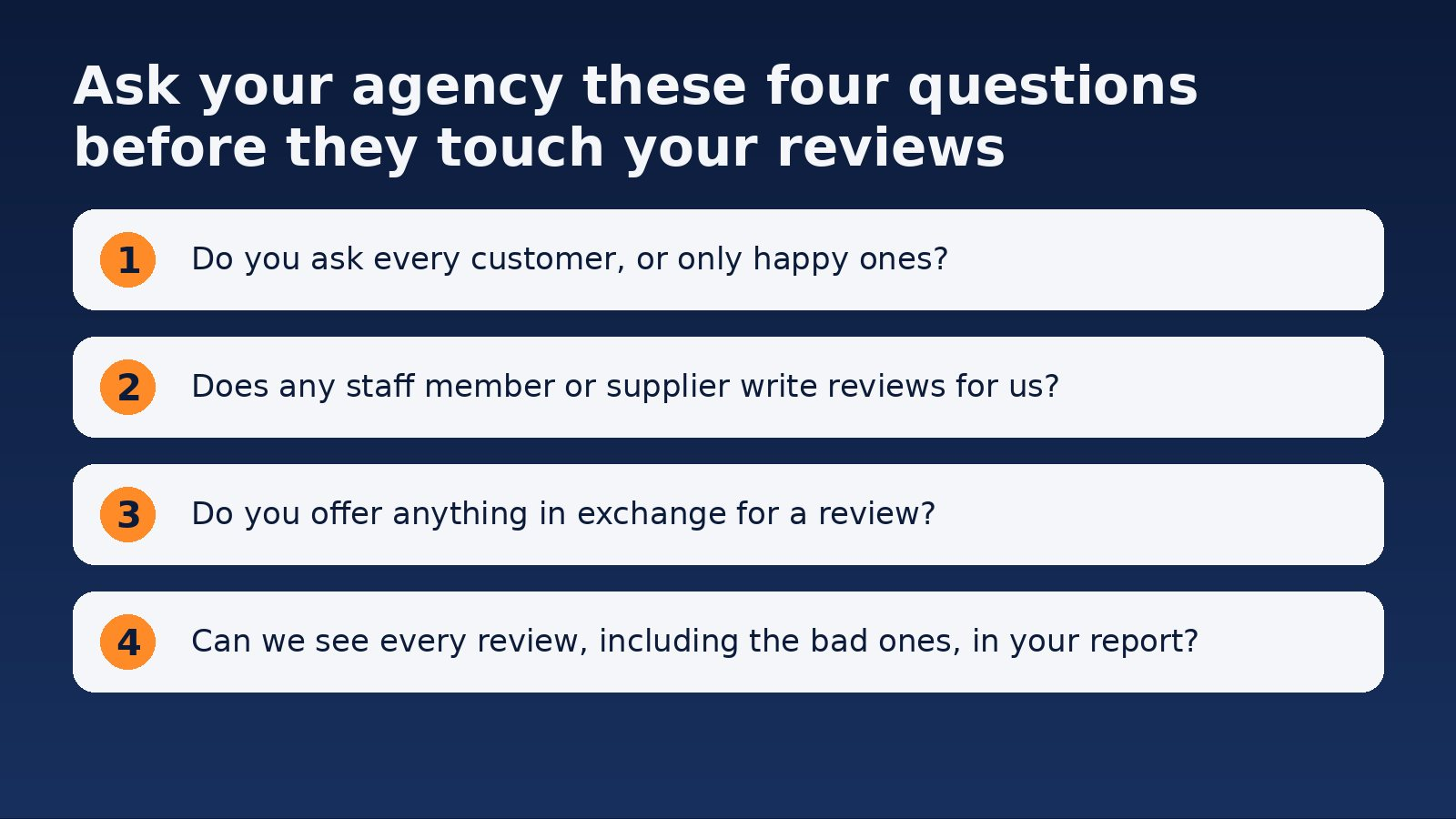
A good agency will answer all four without hesitating. If you hear “we only target happy customers” or “we handle the negative ones privately”, walk away.
The honest case for leaving the bad reviews up
One more reason to resist the filter, and it’s a commercial one. A profile made up entirely of five-star reviews looks suspicious to a careful buyer. A handful of lower ratings, each with a polite and sensible reply from you, tells a prospect that real customers are being served by a real business. The occasional bad review isn’t the threat. A review page nobody believes is.
That’s also the cheapest reputation work there is. It costs a few minutes a week and no software, and it isn’t going to end up in front of the Commerce Commission.

Where BeyondClix fits
We help NZ businesses build reputation the straightforward way: a consistent review request process, fast and professional replies, and honest reporting on what customers are saying. See our online reputation management services, or get in touch if you’d like a second opinion on how your current review process holds up.
This article is general information, not legal advice. If you’re unsure whether a specific review practice complies with the Fair Trading Act, speak to a lawyer.
Frequently asked questions
Is it illegal to ask only happy customers for reviews in New Zealand?
It carries real risk. The Commerce Commission has prosecuted a business over the way it published reviews, and Google’s policy prohibits selectively soliciting positive reviews. The safe approach is to ask every customer.
Can I delete a bad Google review?
Not directly. You can reply to it, and you can flag it to Google if it breaks Google’s content policy, for example if it’s fake or about a job you never did. A review that is merely unflattering stays.
Can my staff leave reviews for the business?
No. Google’s policy bans staff review quotas and requests for specific review content, and undisclosed staff reviews were central to the Commerce Commission’s case against The TV Shop.
Can I offer a discount in return for a review?
Don’t. Google’s policy prohibits offering incentives for reviews.
How should I respond to a negative review?
Reply quickly, politely and specifically. Acknowledge the problem, say what you’re doing about it, and offer to continue the conversation offline. Prospects read your reply as closely as the review.
Sources
- Commerce Commission: District Court finds The TV Shop staff wrote positive customer reviews (17 December 2025)
- Commerce Commission: The TV Shop to pay $1.104m (11 August 2026)
- Simpson Grierson: Competition and Consumer Law Update, August 2026
- Hesketh Henry: Genuine reviews only (4 September 2026)
- Google Business Profile Help: prohibited and restricted content (vendor documentation)
- IT Brief NZ: NZ businesses warned over illegal review gating (22 April 2026) (vendor opinion piece by Storm IMC)
Want this run for your business?
Talk to our team. We will show you where the money is leaking and what we would do about it.