

You run a clinic, a massage studio or a wellness practice. A happy client writes “best massage I’ve ever had, my back pain is gone”, and you put it on your website. Until this year that was normal marketing. Under New Zealand’s updated health advertising code, that sentence is exactly the kind of testimonial that can get an ad pulled.
The Advertising Standards Authority (ASA) rolled out a new Therapeutic and Health Advertising Code that applied to new advertising from 1 April 2026 and to all advertising, including campaigns already running, from 1 July 2026. If your marketing was written before then and nobody has re-read it, it is worth doing this week.
Does this apply to a small wellness business?
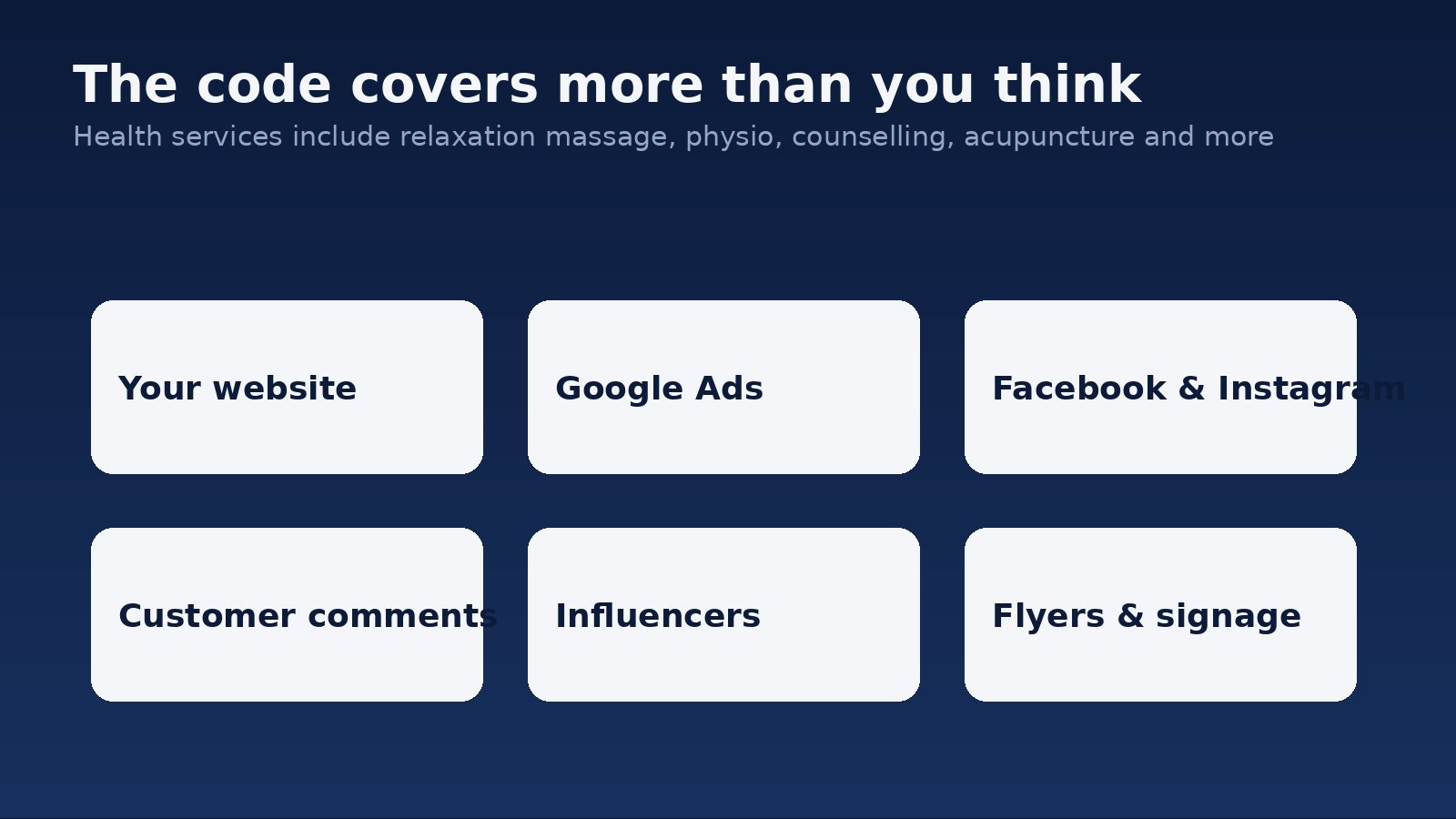
Almost certainly yes. The code defines a “health service” as one that offers a method of treatment for one or more medical conditions, or support for normal healthy body functions. Its own list of examples includes physiotherapy, counselling, relaxation massage, chiropractic, acupuncture, naturopathy and hypnotherapy. It says providers may or may not be registered health professionals, per the code itself.
It also reaches further than paid ads. The code covers advertising in any media, including the advertiser’s own channels, social media, user-generated content, influencers, videos, apps and signage. And it judges “conveyed context”, meaning what your material implies, not just what it literally says.
Law firm Bell Gully, in its July 2026 briefing, notes that advertisers, agencies and media organisations share responsibility, and that each may need to respond to a complaint. If the ASA upholds a complaint it can ask the advertiser, agency and/or media company to remove the advertisement. In practice, the cost to you is a pulled campaign, lost momentum and a bad week, not a fine.
The testimonial problem
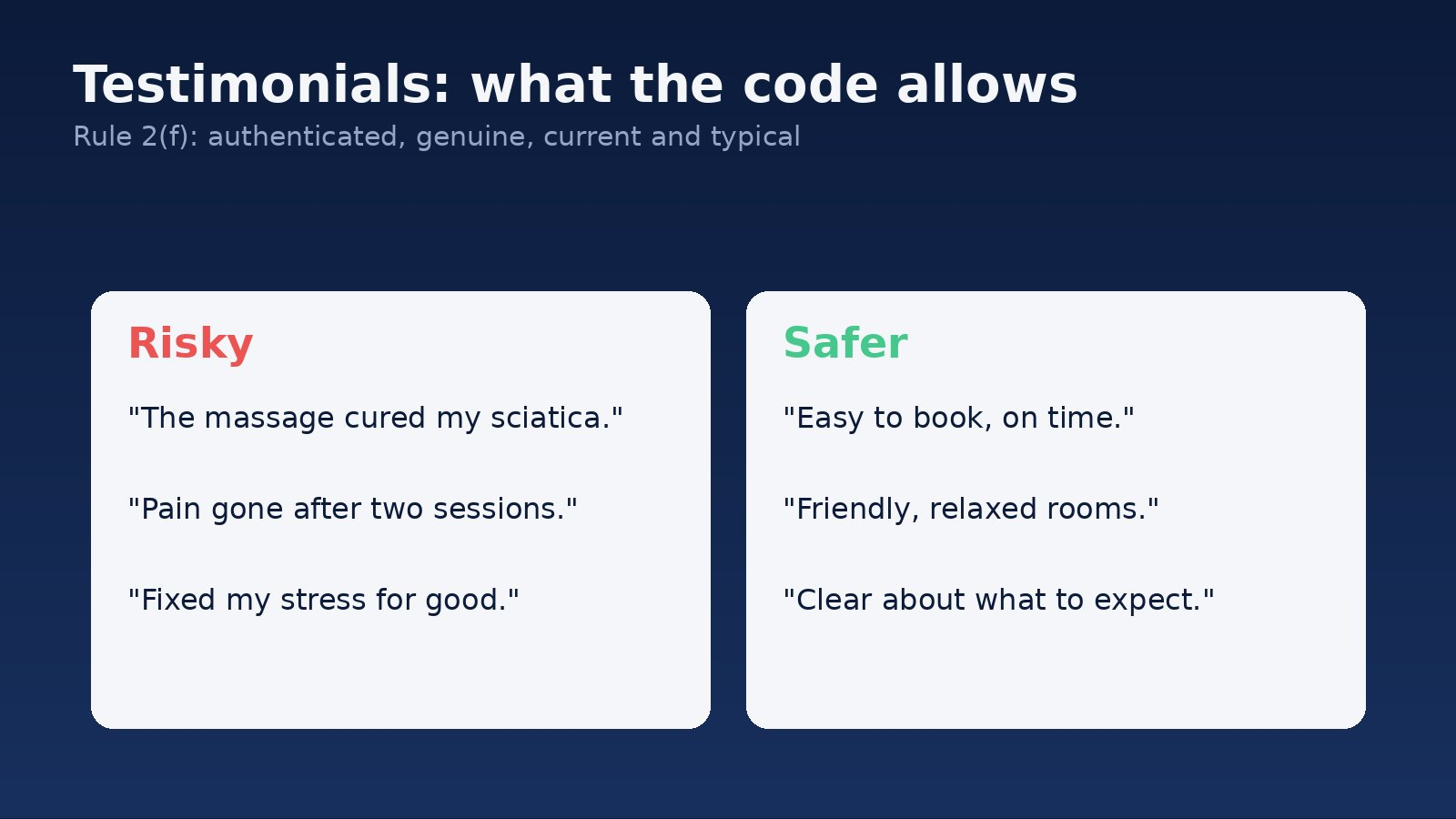
This is the change most likely to catch a good, honest business out. Rule 2(f) says testimonials for health services must be authenticated, genuine, current and typical, and that any payment or exchange of value must be acknowledged. The guidelines go further: a testimonial for a health service must not make a therapeutic purpose claim and must not suggest, directly or by implication, that the service has beneficially affected the health of an individual.
Read that against the reviews on your site. “My sciatica is gone” breaks it. “Cured my headaches” breaks it. The guidelines say testimony that does not imply a therapeutic purpose or reference personal use or benefit is still permitted, with examples like how helpful the team were or how quickly an order arrived. For a clinic, that means feedback about the booking process, the welcome, the clean rooms and the clear explanation of what to expect.
The user-generated content rules matter too. The code lists customer comments on platforms you control, and comments under your own social posts, as examples that can cause issues. Even an emoji reply that implies you agree with a client’s claim about their health can be read as endorsing it. Bell Gully’s advice is that non-compliant content tagged to your brand should be untagged or removed.
That does not mean you stop collecting reviews. Google reviews on your Business Profile are written on Google’s platform, and the sensible approach is a review request that asks about the experience, not the cure. If you also want the legal side of reviews, our guide to what NZ law says about filtering Google reviews covers it.

Claims on your service pages
Your own wording is covered by the same code. Under Rule 1(b), advertisements must not claim or imply that services are effective in all cases, are infallible, magical or miraculous, or are a “certain, guaranteed or sure cure”. They must not claim a service is safe or has no risks. And claims must be substantiated before they are made, a point Bell Gully stresses.
Practical rewrites for a typical wellness page:
- Instead of “relieves back pain”, describe the session. What happens, how long it lasts, who it suits.
- Instead of “guaranteed results”, say what a first appointment involves and what you will discuss.
- Drop urgency pressure. The code treats vulnerable audiences, including people with health issues, as needing protection from inappropriate urgency, according to Bell Gully’s summary. “Book now before your pain gets worse” is the wrong tone and a compliance risk.
None of this makes a good wellness site dull. A page that clearly shows the practitioner, the rooms, the process, the pricing and how to book will often convert better than one stuffed with promises. People choosing a practitioner want to feel safe and informed before they ring.
What Google adds on top
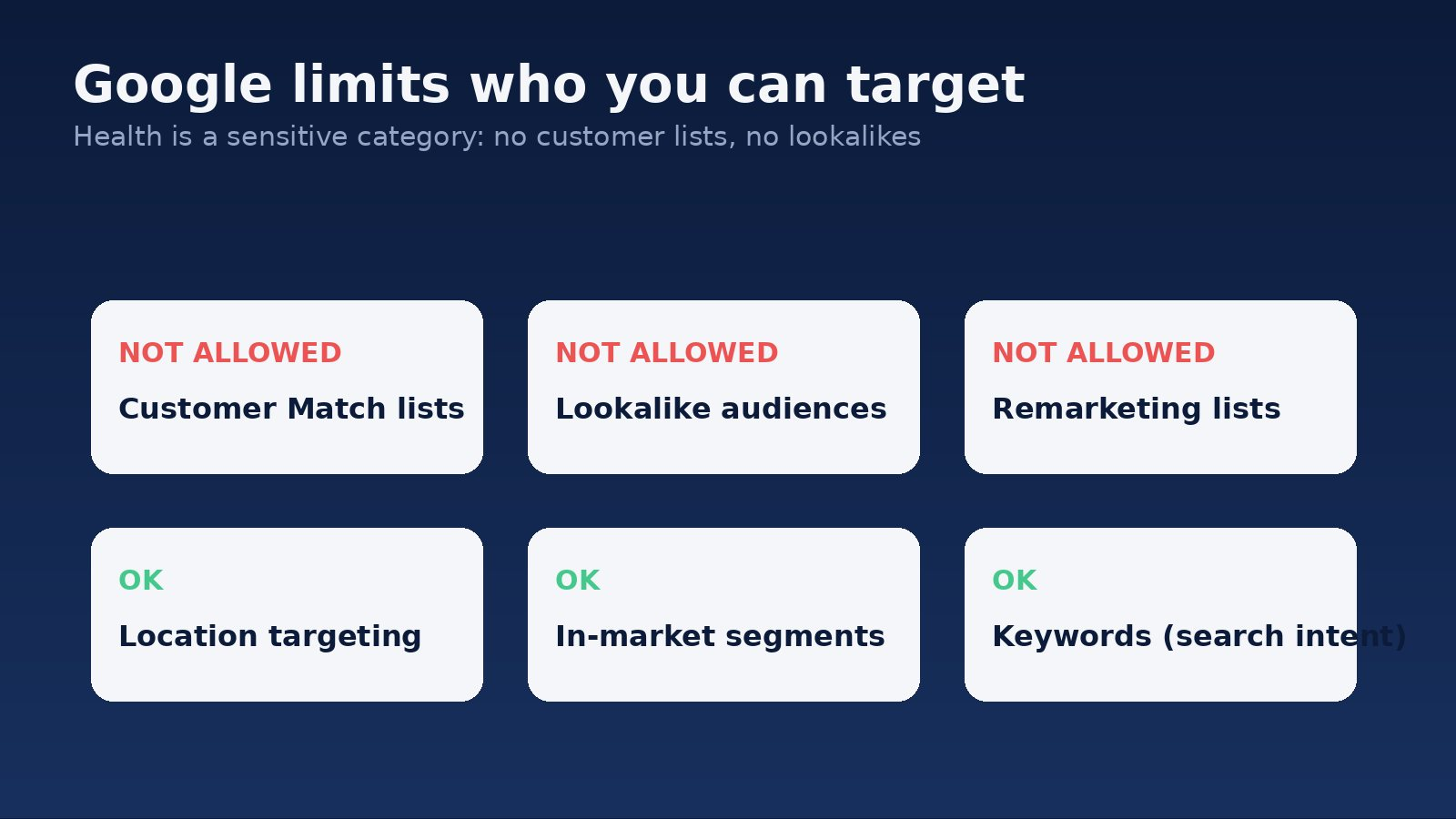
The ASA code is the New Zealand layer. Google runs its own rules, and for health they limit who you can aim ads at. Per Google’s restricted targeting policy (vendor documentation), health is a sensitive category. Advertiser-curated audiences cannot be used, which includes Customer Match, your own data segments, audience expansion and lookalikes. Predefined Google audiences, location targeting and in-market segments are still supported.
For a local clinic, this is less painful than it sounds. Most of the enquiries come from people searching “massage near me” or “physio Howick”, and that intent-based search targeting is unaffected. What it rules out is the shortcut of uploading your client list and finding more people like them. Meaning: a wellness business that depends on remarketing to past clients through Google needs a different plan, such as email to people who have opted in.
Where wellness customers actually are
The audience is online. DataReportal’s Digital 2026: New Zealand reports 5.06 million internet users in October 2025, 96.2% of the population, and 4.24 million social media user identities, equal to 80.6% of the population. Almost every potential client already has a phone in hand when they decide who to book.
So the channels that suit a health or wellness business are the ones where a person is already looking:
- Google Search and Google Business Profile. The “near me” moment is where bookings start, and a complete, current Profile with real opening hours, photos and a booking link does more than most ads.
- A website that answers the first-visit questions. Who you are, what the first session is like, what it costs, where to park.
- Email to existing clients. Appointment reminders and seasonal offers to people who have given permission sit outside Google’s audience restrictions.
- SEO. A well-built page for each treatment and each suburb you serve brings steady enquiries without paying per click.
That mix is also the cheapest way to start. Expect to see early movement in local search within a few months, while paid search can generate enquiries within weeks once approved. What matters is that you can tell which source produced each booking, so you can stop paying for the ones that do not.

A five-step check before you spend another dollar
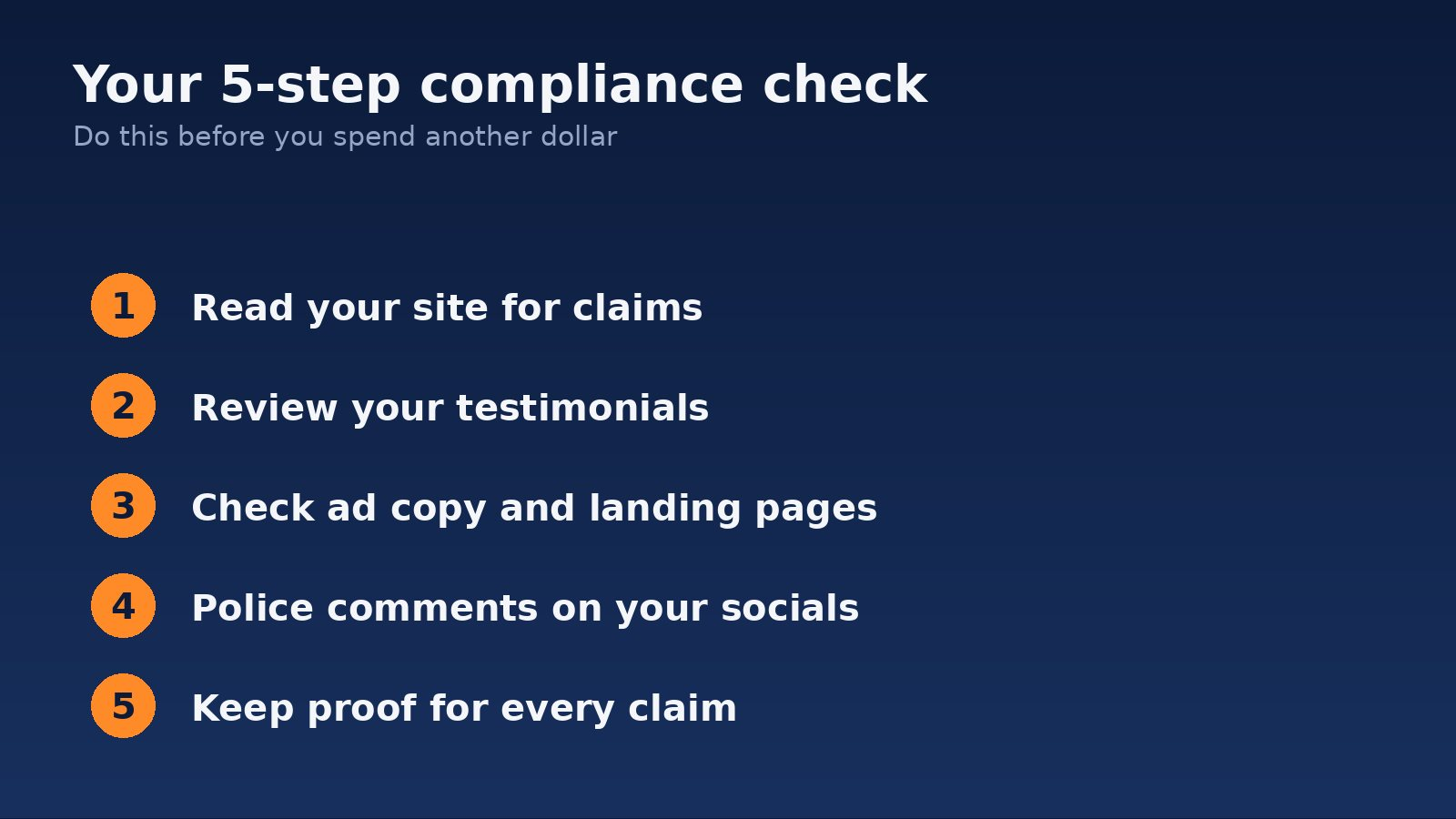
- Read your own site as a stranger would. Highlight every sentence that promises or implies a health outcome.
- Review your testimonials. Keep the ones about service and experience. Rewrite your request process so new ones focus on that.
- Check ad copy and landing pages together. The ad and the page it leads to are judged as one message.
- Look at your social comments. Hide or remove comments making health claims about your service, and avoid replies that agree with them.
- Keep evidence for every factual claim you make. If you cannot substantiate it, take it out.
Working with an agency on this
If you hire help, ask them how they handle the health advertising code, and ask to see the checks they apply to ad copy and landing pages. Because agencies share responsibility under the code, a good one will already have a process. Be wary of anyone promising guaranteed bookings or “cure” language in your ads.
BeyondClix works with New Zealand service businesses across Google Ads, SEO, websites and tracking, and we build campaigns around what each channel is allowed to say. If you want a second pair of eyes on your site and ads against the new code, see our services, or get in touch and we will tell you plainly what is worth changing first. This article is general information, not legal advice. For a specific claim, check with a lawyer or the ASA’s own guidance.
Frequently asked questions
Does the health advertising code apply to massage therapists?
Yes. The code’s definition of health services names relaxation massage among its examples, and it applies whether or not the provider is a registered health professional.
Can I still show client reviews on my website?
Yes, but not reviews that claim a health outcome. Testimonials for health services must be authenticated, genuine, current and typical, and must not suggest the service beneficially affected someone’s health.
When did the new rules start?
They applied to new advertising from 1 April 2026 and to all advertising, including existing campaigns, from 1 July 2026.
Can I use Google Ads for a health or wellness business?
Generally yes, with limits. Google restricts health-related targeting, so you cannot use Customer Match, lookalike or similar advertiser-curated audiences, but keyword and location targeting remain available.
What happens if someone complains about my ad?
The ASA can ask the advertiser, agency and/or media company to remove the advertisement. Where the code overlaps with legislation such as the Medicines Act 1981, regulatory action may also follow.
Do comments on my Facebook page count as advertising?
They can. The code treats user comments on platforms you control, and replies that imply agreement with an unsubstantiated claim, as content that may cause issues.
Sources
- ASA media release: Updated ASA Code delivers clear rules for therapeutic and health advertising (4 December 2025)
- ASA Therapeutic and Health Advertising Code 2025
- Bell Gully: New Therapeutic and Health Advertising Code now applies to all New Zealand advertisements (3 July 2026)
- Google Ads Help: Restricted targeting in personalized advertising (vendor documentation)
- DataReportal: Digital 2026: New Zealand (8 November 2025)
Want this run for your business?
Talk to our team. We will show you where the money is leaking and what we would do about it.