

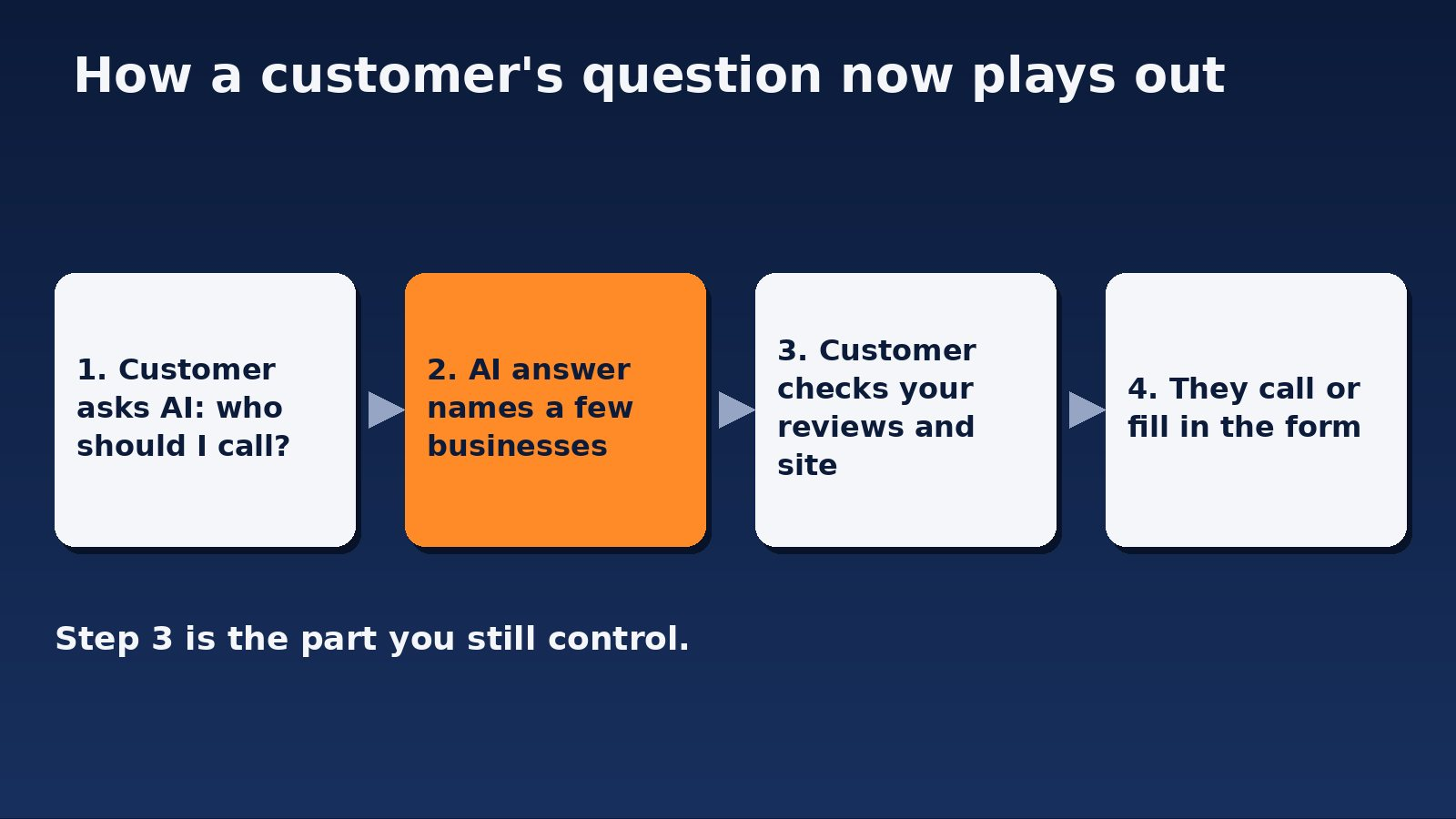
A homeowner in Howick needs an electrician. Instead of scrolling through ten blue links, they type the question into ChatGPT or read the AI summary at the top of Google. They get a short answer that names a few businesses. If yours is one of them, the phone rings. If it is not, you never find out you were in the race.
That is the question behind “AI search”, and it is why business owners keep asking whether they need to do something new. This week there is fresh news worth acting on: Google now reports how often your site appears inside its AI answers, and as of 31 August 2026 that report is available to every website worldwide. Here is what it means for a New Zealand business, what is hype, and what to do first.
What is actually happening to your enquiries
Google’s AI summaries, called AI Overviews, are already live in New Zealand, according to the Marketing Association of New Zealand’s March 2026 article on AI search. The same article notes that most of the hard data on how people behave comes from the US, global studies and Australia, not from New Zealand. That is worth keeping in mind with every number below.
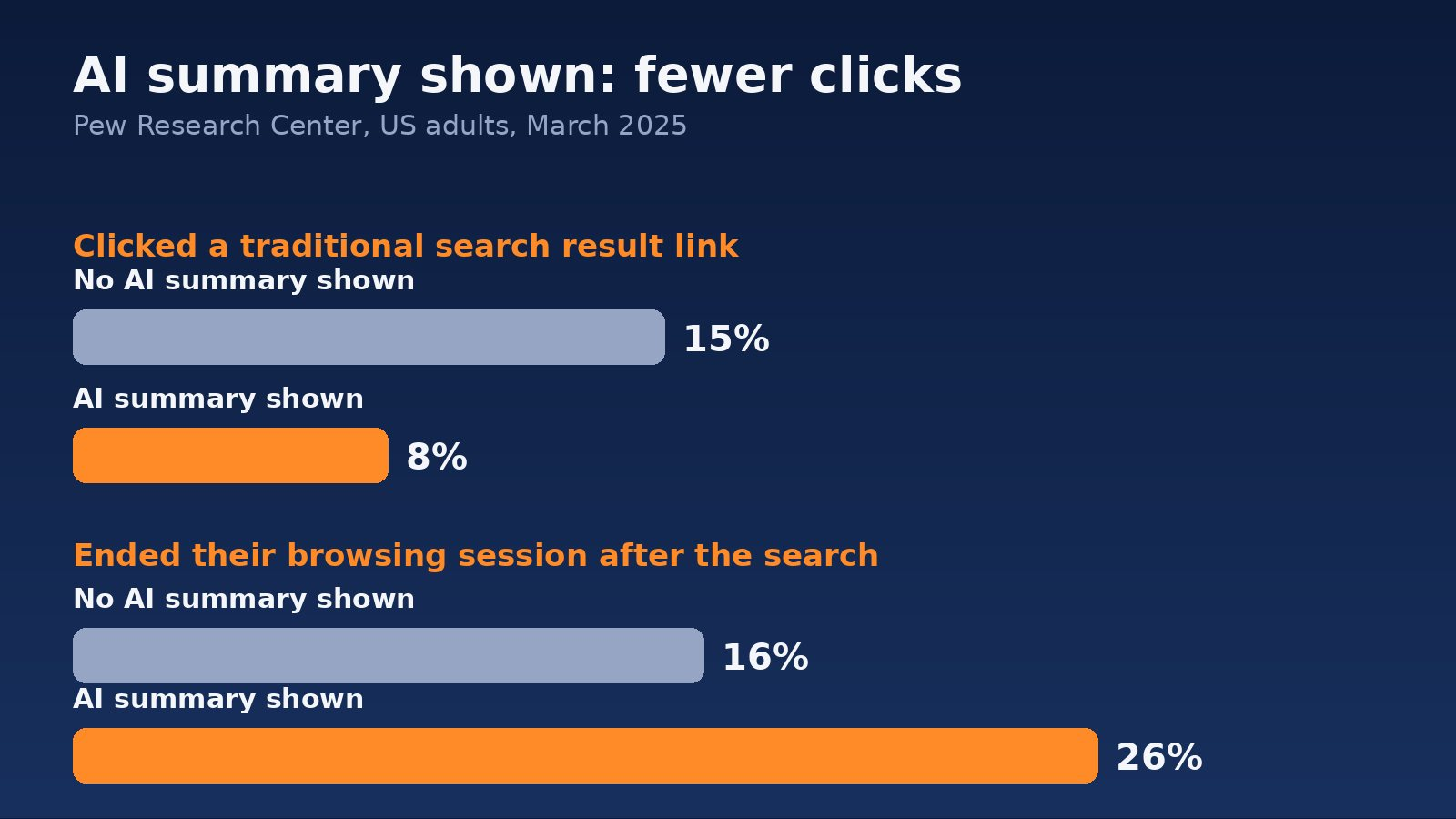
The best-known study is from Pew Research Center, which tracked the real Google searches of 900 US adults in March 2025. It found people clicked a traditional search result in 8% of visits when an AI summary appeared, against 15% when it did not. Clicks on the links inside the AI summary itself were rarer still, at about 1% of visits. And 26% of visits with an AI summary ended the person’s browsing session, against 16% without one, per Pew’s analysis.
Read that carefully. It is US data from one month, and it covers all kinds of searches, not “electrician near me”. It does not say your enquiries fall by half. It does say the way customers reach you is changing, and that you cannot assume a first-page ranking delivers the clicks it used to.
Are customers really asking AI who to call?
Some are, and the number is climbing fast overseas. BrightLocal’s 2026 Local Consumer Review Survey, which polled 1,002 US adults, found that 45% of consumers had used AI tools for local business recommendations, up from 6% the year before. ChatGPT was the most used tool, followed by Google’s AI Mode. The details are in BrightLocal’s analysis. This is a US survey from a company that sells local SEO software, so treat the size of the jump with some caution.
The most useful finding for a small business is what people do after the AI answers. Among people who use AI for recommendations, 97% sometimes double-check against real reviews, and 88% check the sources AI cites. The AI gets you onto the shortlist. Your reviews and your website decide whether you stay on it.
The news: Google now shows you how often it names you
On 3 June 2026 Google announced Search Generative AI performance reports in Search Console, the free tool every website owner can connect to their site. The post says that, as of 31 August 2026, the reports have been rolled out to all websites worldwide.
The reports show how often pages from your site appeared in AI Overviews and AI Mode, which pages, in which countries, on which devices, and how that has moved over time. For a business owner that is the first official answer to “are we showing up in AI answers at all?”
Two honest limits. The report counts impressions, meaning appearances, not enquiries. And it only covers Google’s own AI features, not ChatGPT or other tools. So it tells you part of the story. Use it as a baseline: ask whoever looks after your website to check it now, screenshot it, and compare in three months.

What Google says you need to do
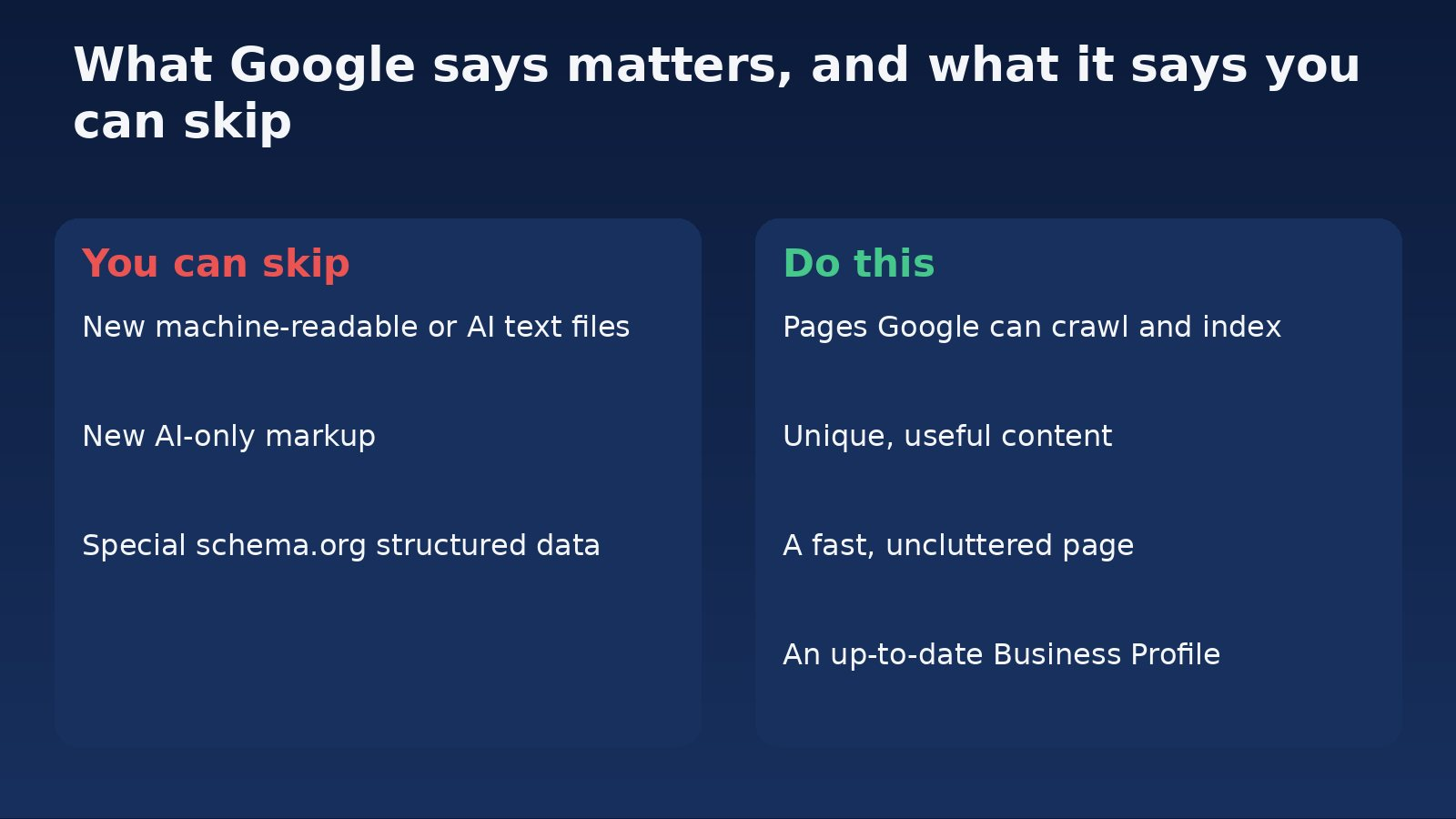
Here is the part that surprises people. Google’s own guidance says there is no secret. Its documentation on AI features and your website says a page must be indexed and eligible to appear in Google Search with a snippet, and that “there are no additional requirements to appear in AI Overviews or AI Mode, nor other special optimizations necessary.” It adds that you do not need to create new machine-readable files, AI text files or markup, and no special schema.org structured data is required.
That is a vendor statement about Google’s own product, and Google has an interest in keeping things simple. But it is also the clearest official position there is, and it lines up with the basics. Google’s May 2025 advice to site owners lists:
- Unique, valuable content that fulfils what a visitor actually needs, not commodity text that says what every competitor says.
- A good page experience: works on a phone, loads quickly, and makes the main information easy to find.
- Access for Google: the page is not blocked, loads properly and can be indexed.
- Preview settings that do not hide you: tags such as
nosnippetlimit how your content appears in AI features. - Accurate business information: Google specifically mentions keeping Business Profile information up to date.
Notice what is missing: any trick. If an agency tells you that you need a special file or a new technical layer to be “AI ready”, ask them to show you where Google or anyone else says so.
What to do first, in plain terms
Google’s guidance covers Google. ChatGPT and other tools do not publish equivalent rules, and nobody outside those companies can say exactly which sources they favour. So the sensible plan is to be the kind of business that is easy to recommend and easy to verify, which is also what wins customers who never touch AI.
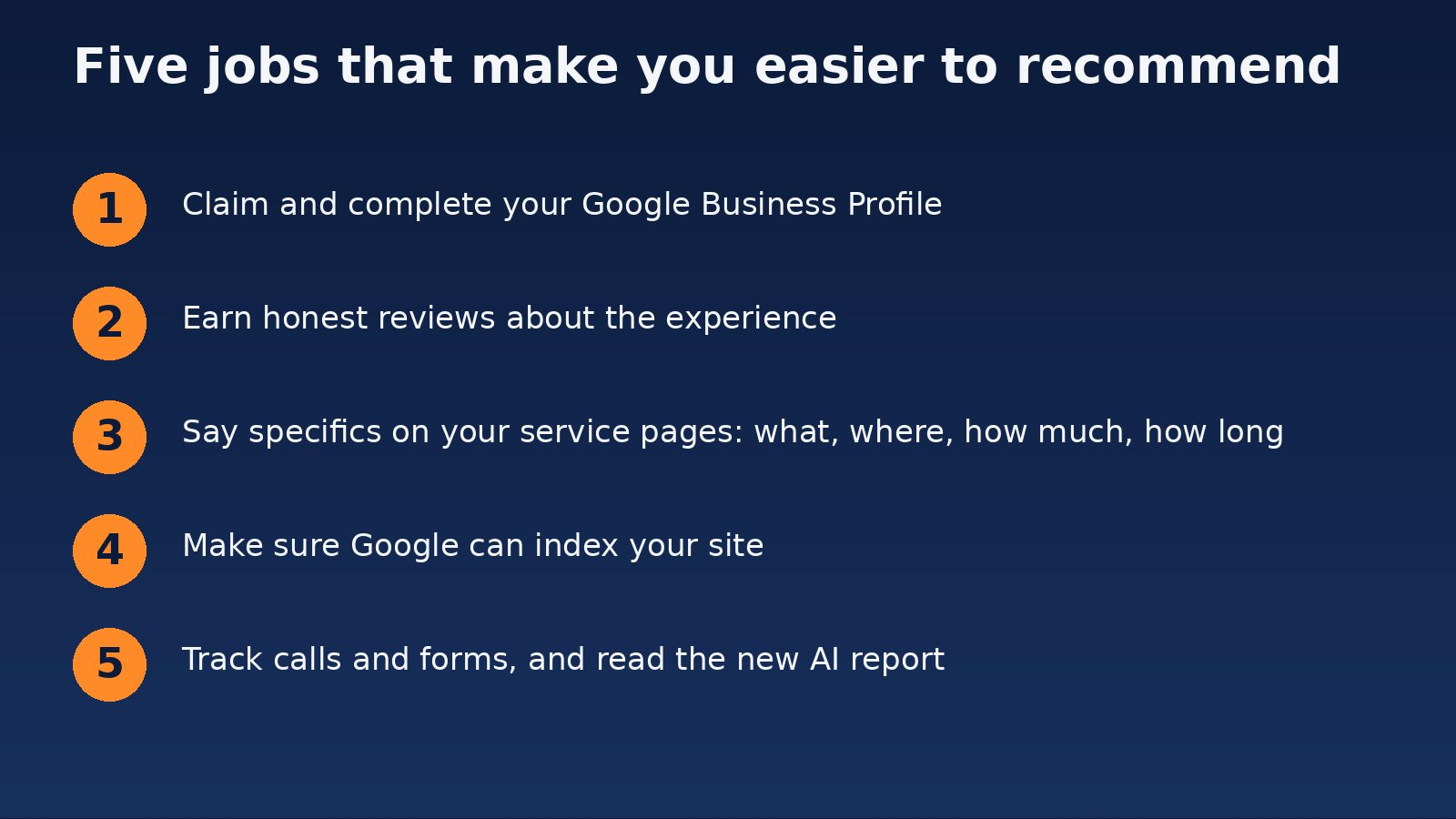
- Fix your Google Business Profile. Correct hours, services, service areas, photos and phone number. It is free, and Google names it directly.
- Build an honest review profile. Customers check reviews after the AI answer. Ask every happy customer, reply to every review, and never filter or fake them. Our guide to what NZ law says about fake reviews explains the risk.
- Make your service pages specific. Say what you do, which suburbs you cover, how long jobs take and what they typically cost, in plain words. A page that says what every competitor says gives an AI nothing to pick you for.
- Check Google can read your site. A developer or agency can confirm in minutes that nothing is blocking indexing and that your pages return properly.
- Track what arrives. Count calls and form fills by source so you know what is working. We cover how in how to tell which ads made the phone ring.
How long does it take, and what does it cost?
The first three jobs are mostly your own time or a few hours of an agency’s. The effect shows up as better local visibility and more reviews over months, not days, and nobody can honestly promise a position in an AI answer. Be most wary of any quote that bundles “AI optimisation” as a separate monthly line item with a guaranteed result. This work belongs inside ordinary SEO and local search work, and for a wider view see our earlier post on SEO and AI search in Auckland.
Questions worth putting to any agency before you sign:
- Which AI features do you check, and how do you report on them?
- Can you show me our Search Console AI report today?
- What are you changing on the site, and why would that make us easier to recommend?
- How will we know a call came from search rather than somewhere else?

Where BeyondClix fits
BeyondClix is an Auckland digital marketing agency working with New Zealand service businesses on Google Ads, SEO, websites and tracking. If you want to know whether your business appears when customers ask AI, we will check your Search Console data, Business Profile and service pages, and tell you plainly what is worth fixing first. See our services or get in touch.
Frequently asked questions
Do I need to optimise my website for ChatGPT differently from Google?
There is no published rulebook for ChatGPT. The reliable approach is accurate business details, specific helpful pages and honest reviews, which also serve Google, where Google says no special AI optimisation is required.
Are Google AI Overviews available in New Zealand?
The Marketing Association of New Zealand reported in March 2026 that Google AI Overviews are already live in New Zealand.
Will AI summaries cut my website traffic?
Possibly. Pew Research found US users clicked a traditional result in 8% of visits with an AI summary versus 15% without. That is US data, and no NZ equivalent has been published.
How can I see whether my business appears in Google’s AI answers?
Google has added Search Generative AI performance reports to Search Console, showing impressions, pages, countries and devices for AI features, and says they reached all websites worldwide by 31 August 2026.
Do I need special schema or an AI text file?
Google says no. It states you do not need new machine-readable files, AI text files, markup or special schema.org data to appear in AI Overviews or AI Mode.
Can anyone guarantee my business will be named by AI?
No. Be sceptical of any guarantee, because AI answers are generated and the sources they favour are not published.
Sources
- Google Search Central Blog: Introducing Search Generative AI performance reports in Search Console (3 June 2026) (vendor documentation)
- Google Search Central: AI features and your website (vendor documentation)
- Google Search Central Blog: Top ways to ensure your content performs well in Google’s AI experiences on Search (21 May 2025) (vendor documentation)
- Pew Research Center: Google users are less likely to click on links when an AI summary appears in the results (22 July 2025)
- BrightLocal: Local Consumer Review Survey 2026, AI trust analysis (10 March 2026) (US survey, vendor research)
- Marketing Association of New Zealand: Why NZ Marketers Can’t Afford to Ignore The Rise of GEO & AEO (27 March 2026)
Want this run for your business?
Talk to our team. We will show you where the money is leaking and what we would do about it.