

A physio in Newmarket types her own clinic’s name into Google and sees it first. She types “physio Auckland” and doesn’t see it at all. Her receptionist says new patients “just aren’t finding us”. She is right, and the reason has little to do with how good the clinic is.
Central Auckland is the hardest part of the city to be found in. It’s crowded, the competition is serious, and the people searching are different from suburb to suburb. This guide explains how SEO (getting your business to show up in free Google results) works for a Central Auckland business, what it costs you in time, and how you’d know it’s working.
Who actually searches in Central Auckland
Start with the people. The 2023 Census counted 81,546 usual residents in the Waitematā Local Board area, which covers the city centre and inner-city suburbs. That was a fall of 1.6% since 2018, while Auckland as a whole grew 5.4%. 81.2% of residents were aged 15 to 64 (67.5% across Auckland), and the median age was 33.3 years against 35.9 for Auckland (Auckland Council, Waitematā 2023 Census summary).
Renting is the other defining number. 60.6% of dwellings in Waitematā were mainly rented, which the council reports as the highest proportion of any local board (Auckland-wide, home ownership sits at 59.5%). 31.5% of residents identified with an Asian ethnicity, and 4.8% with the Middle Eastern, Latin American and African group, against 2.7% across Auckland.
What that means for you: your customers skew young, work-age and mobile. Renters move often, so they keep needing a new dentist, a new gym, a new accountant. They search on their phones, and they search the moment they need something. Plenty of them are also not local at all. Workers and visitors come into the CBD and Newmarket every day, and they search for “near me” while standing there.
Why a Central Auckland business can’t just “do SEO”
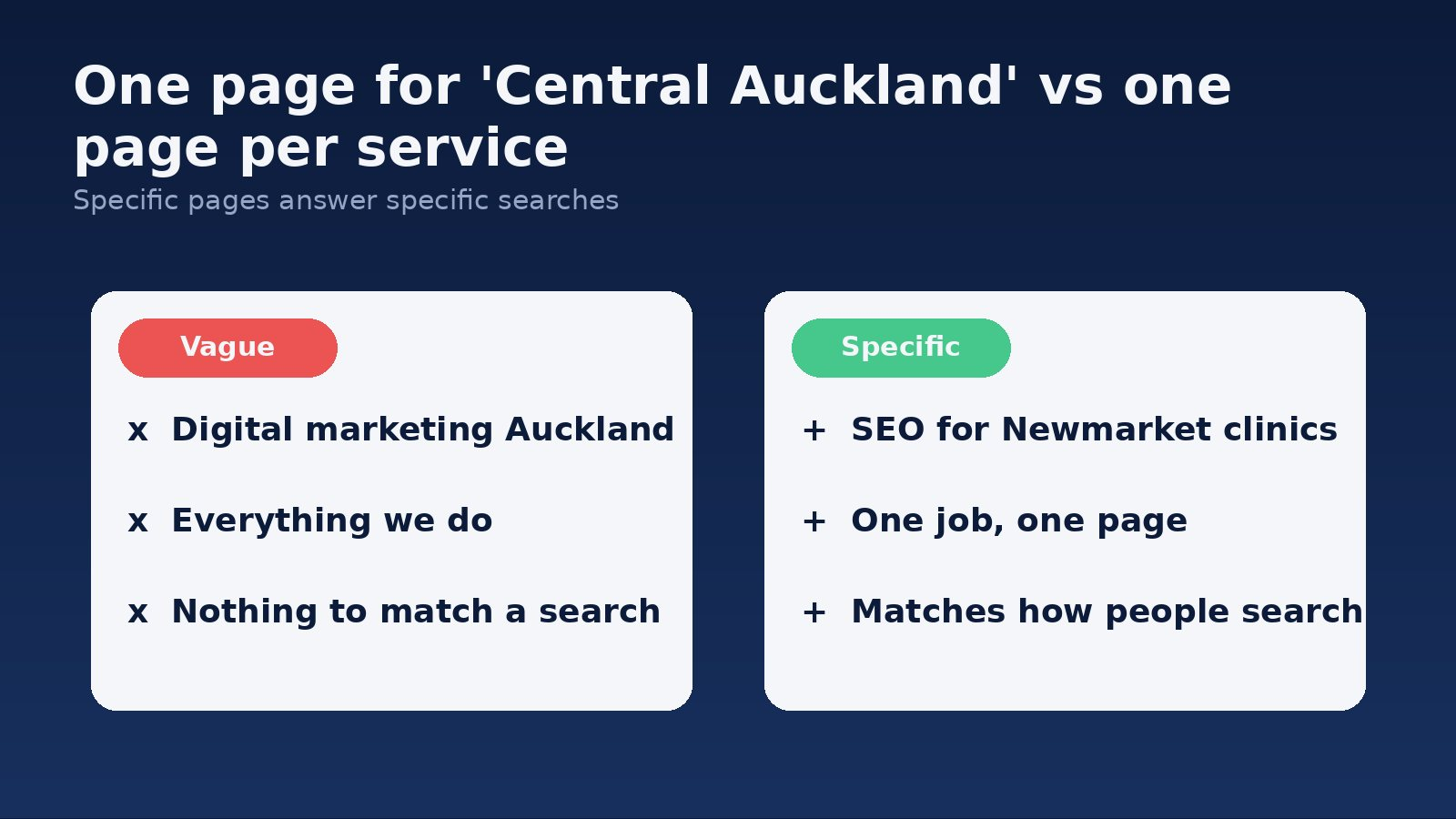
An SEO campaign aimed at “Auckland” treats the city as one market. Central Auckland is a cluster of tiny ones. Someone looking for a lunch spot in the CBD, a specialist in Newmarket and a boutique in Ponsonby has three different needs, three sets of competitors and three different phrases.
The fix is to be specific. A page that says “digital marketing” tells Google nothing it can match to a search. A page that says “SEO for Newmarket clinics” matches exactly what a clinic owner types. One job, one page, with the area named where it genuinely applies.
What Google says it uses for local results
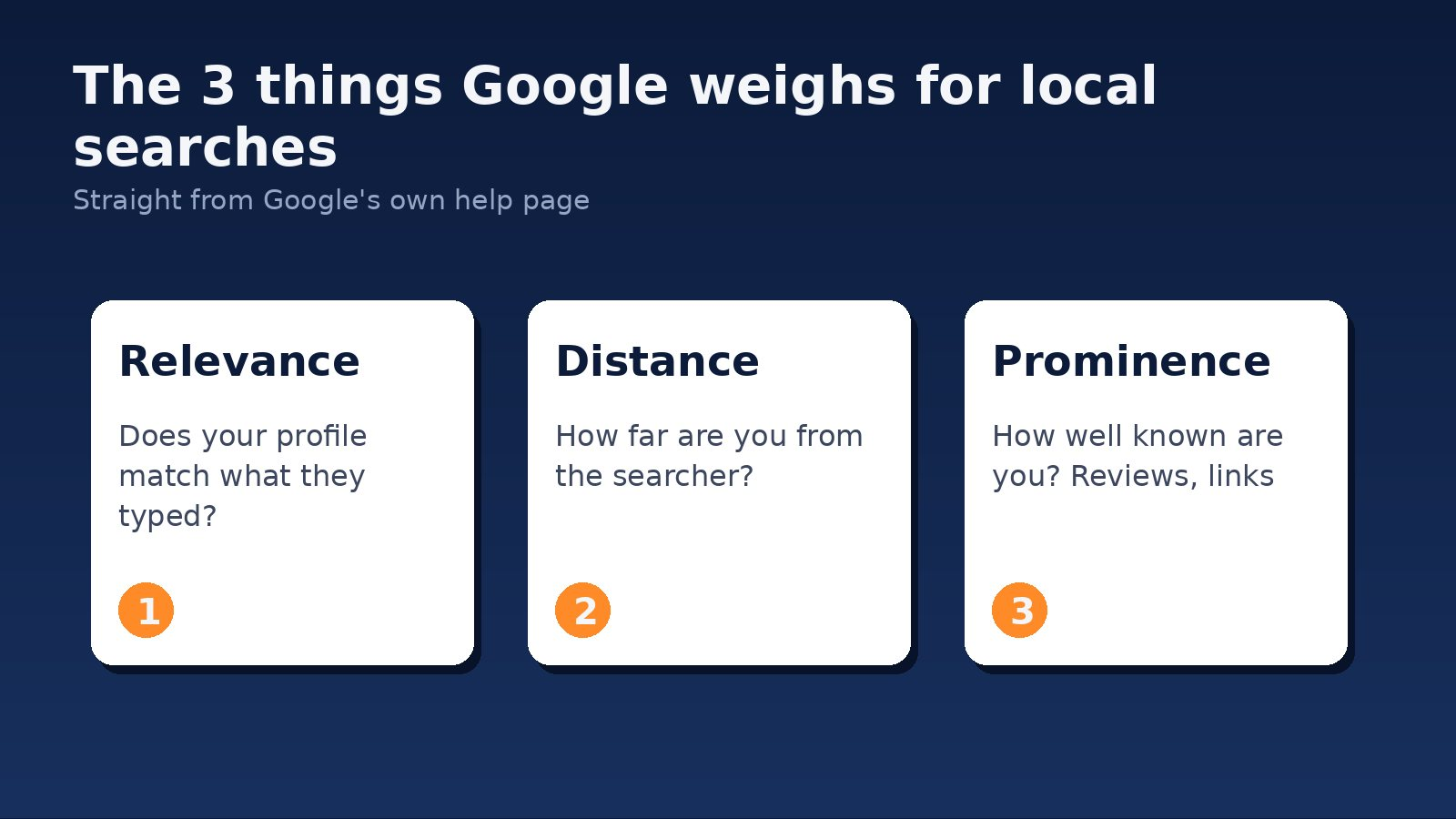
You don’t need to guess here, because Google publishes its own answer. For local results it says it weighs three things. Relevance is “how well a Business Profile matches what someone is searching for”. Distance is “how far each business is from the customer who’s searching”. Prominence is “how well-known a business is”, which Google says is based partly on how many websites link to you and how many reviews you have (Google Business Profile Help, Tips to improve your local ranking).
Two of those you can influence. You can’t move your premises to be closer to the searcher, so distance is mostly fixed. But relevance and prominence are work you can do. Google says “businesses with complete and accurate info are more likely to show up in local search results” and that “more reviews and positive ratings can help your business’s local ranking”. It also says plainly that “there’s no way to request or pay for a better local ranking on Google.”
That last line matters when an agency calls you with a guarantee. Nobody can buy a local ranking, so be wary of anyone promising one.
Step one: get your Business Profile right
For most Central Auckland businesses the quickest win is the free Google Business Profile, the listing that appears on the map and beside your name. Fill in every field: your address, opening hours, business category and a description that says what you do and for whom. Keep it accurate. Inaccurate details can stop your listing from appearing in nearby searches.
Then reviews. Ask recent customers for honest ones, and reply to the ones you get. Don’t buy reviews or write your own: see our guide to the NZ fake-review law, and Google can remove them anyway. A steady trickle of genuine reviews is worth more than a burst.
Step two: tell Google about your business on your own site
Your website should state the same name, address and phone number as your profile, on a page Google can read. Google also publishes a way to label this information in your site’s code, called LocalBusiness structured data. Google lists a business name and address as required, and recommends details such as telephone, url and openingHoursSpecification (Google Search Central, Local business structured data). Your web developer or agency can add it in an afternoon. It’s a way of removing ambiguity, not a ranking trick.

Step three: one page per service, written for the area
This is where most Central Auckland sites fall down. A single “Services” page lists everything in one paragraph. Instead, build a page for each service you want customers for, and make each one useful: what the service is, who it suits, what it costs or how pricing works, how to get to you, and how to book. Name the area where it’s true, such as “near Newmarket station” or “a short walk from Ponsonby Road”. Don’t paste a different suburb name into the same text. Google and your customers both notice.
If you serve all of Auckland from a Central address, say so honestly. If you really operate in one area, say that. Trying to look local everywhere usually ends up looking local nowhere.
What does SEO cost, and how long does it take?
Be sceptical of anyone who quotes a result before they’ve looked at your market. Central Auckland competition varies hugely by industry. A dentist competes with dozens of clinics; a niche supplier may compete with three.
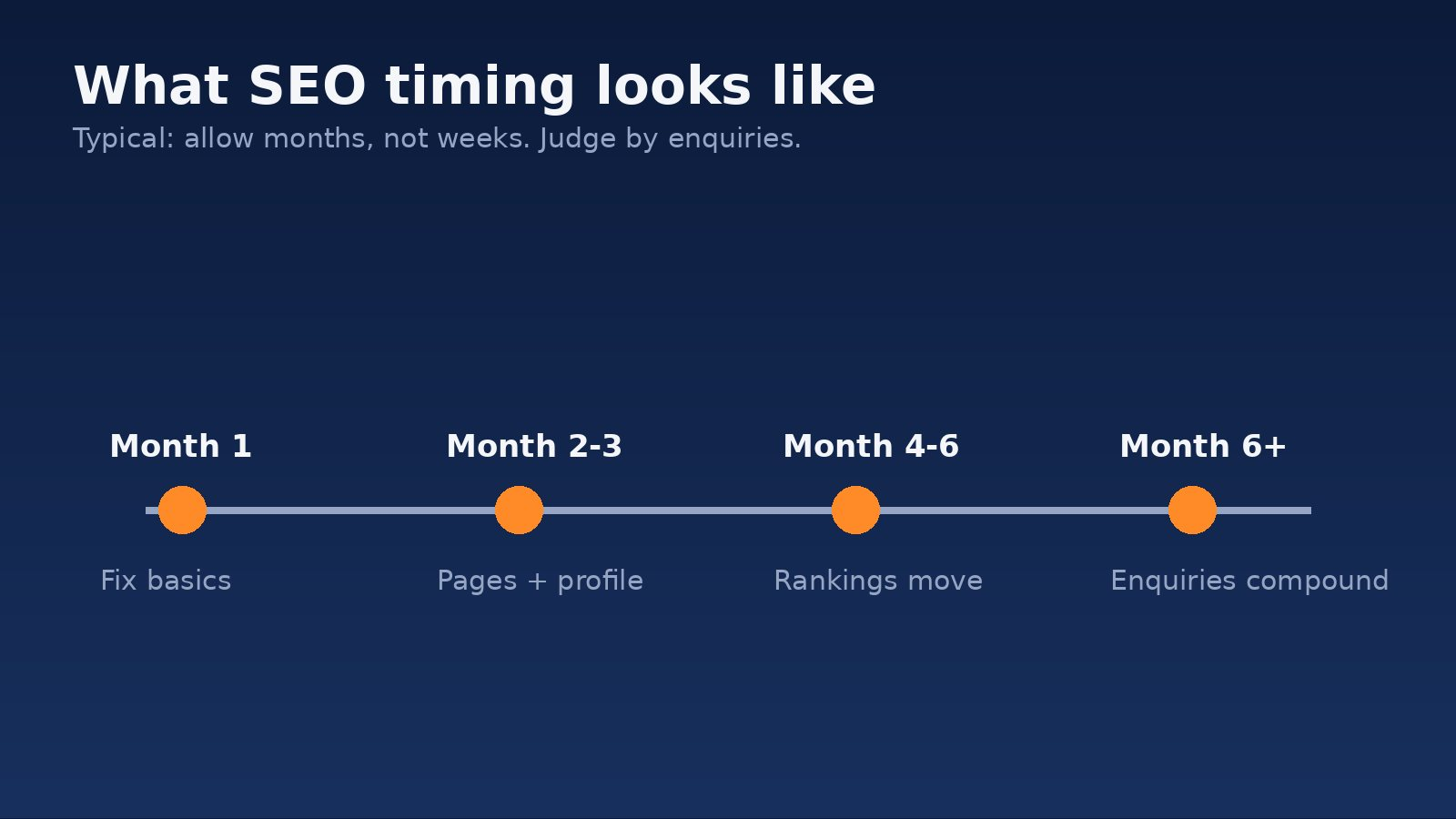
On time, SEO isn’t an ad. You aren’t buying clicks that start tomorrow. Allow several months before judging whether it’s working, and expect the first changes to show up in your Business Profile views and phone calls before they show up in rankings. Our published plans are on the pricing page.
How you’d know it’s working
Ignore reports built around rankings alone. Ask for three numbers: phone calls from Google, website enquiries from search, and Business Profile actions (calls, direction requests, website clicks). If those rise over a few months, it’s working. If your agency can’t show them, you can’t tell either way.
Where to start
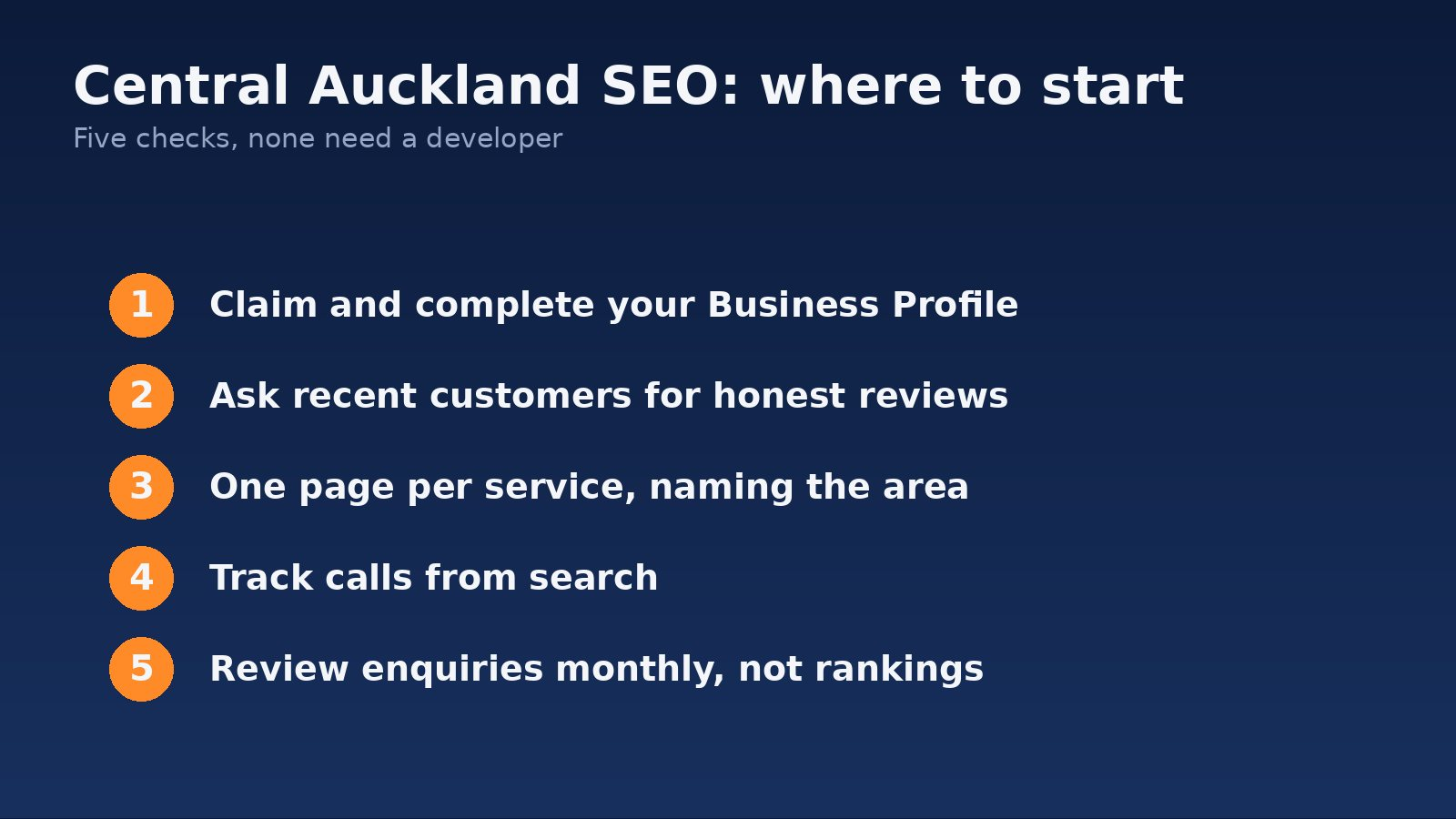
- Claim and complete your Business Profile. Every field, accurate.
- Ask recent customers for honest reviews. Reply to all of them.
- Build one page per service, naming the area where it’s true.
- Make sure calls from search are tracked.
- Review enquiries monthly, not rankings.
If you want a second pair of eyes, BeyondClix is an Auckland agency that works with local service businesses. See our SEO and digital marketing services or get in touch and we’ll tell you plainly what’s worth fixing first.
Frequently asked questions
How long does SEO take for a Central Auckland business?
Allow several months. Business Profile fixes can show up first, while website pages usually take longer. Judge it by calls and enquiries rather than rankings.
Is SEO or Google Ads better in the CBD?
They do different jobs. Ads bring enquiries quickly and cost you per click. SEO builds free visibility more slowly. Many businesses use ads now and SEO alongside them.
Can I pay Google for a better local ranking?
No. Google’s own help page says there is no way to request or pay for a better local ranking. Ads are a separate product and appear separately.
Do I need a Google Business Profile?
If customers search for you or visit you, yes. It is free, and Google says complete and accurate profiles are more likely to appear in local results.
Does mentioning Newmarket or Ponsonby on my pages help?
Only where it’s true and useful, such as how to reach you. Repeating suburb names in otherwise identical text doesn’t help customers, and we wouldn’t rely on it to help rankings.
Sources
- Auckland Council: Waitematā Local Board, 2023 Census results
- Google Business Profile Help: Tips to improve your local ranking (vendor documentation)
- Google Search Central: Local business structured data (vendor documentation)
Want this run for your business?
Talk to our team. We will show you where the money is leaking and what we would do about it.