

You run an electrical business out of Glenfield. Your Google Ads are live, the clicks are coming in, and the phone does ring. But a fair share of the calls are from Grey Lynn and Ponsonby, a quote you’d rather not drive the bridge for at 4.30pm. Meanwhile a new homeowner in Hobsonville or Albany searches for an electrician and finds someone else.
That’s the North Shore problem in a sentence. It looks like one market on a map, but it is four quite different ones with a harbour along the bottom edge. A Google Ads campaign set up for “North Shore” without thinking about either pays for the wrong clicks and misses the right ones. This guide explains how Google Ads works for a North Shore business, where the money leaks, what changed in September 2026, and how you’d know it’s working.
The North Shore is four markets, not one
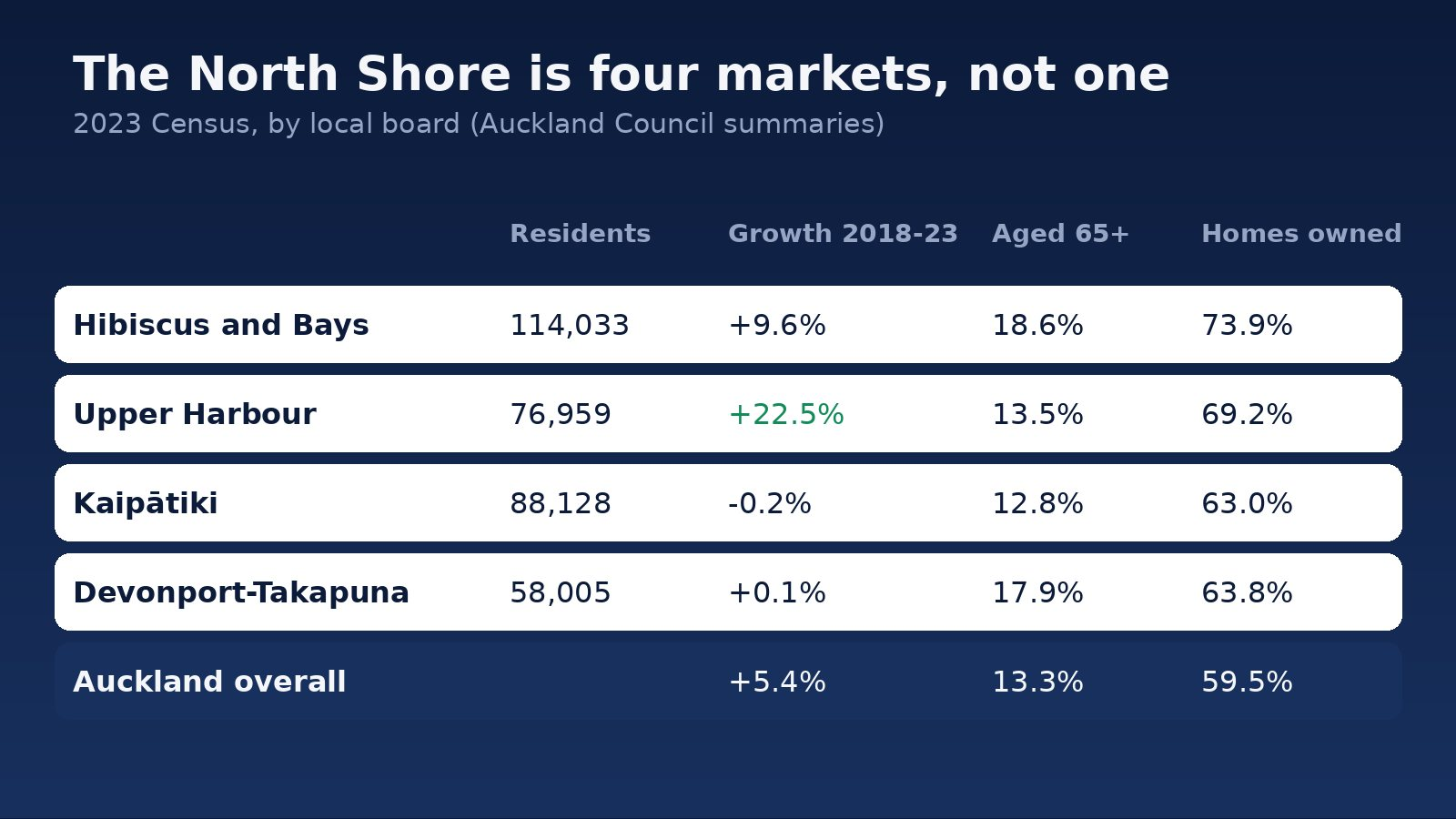
Auckland Council splits the Shore into four local boards, and the 2023 Census shows how differently they’re moving. Together they held about 337,000 usual residents.
- Upper Harbour (Albany, Hobsonville, Whenuapai) is the growth story. It had 76,959 residents, up 22.5% since 2018, the second-highest increase of any local board. Its occupied dwellings rose 27.1%, the highest increase of all the boards. 45.5% of residents identified with an Asian ethnicity, against 31.3% across Auckland (Auckland Council, Upper Harbour 2023 Census summary).
- Hibiscus and Bays (Browns Bay, Ōrewa, Whangaparāoa) is the biggest, with 114,033 residents, up 9.6%. It is older and owner-occupied: 18.6% aged 65 or over and 73.9% of homes owned, against 13.3% and 59.5% for Auckland (Auckland Council, Hibiscus and Bays 2023 Census summary).
- Kaipātiki (Glenfield, Birkenhead, Northcote) held steady at 88,128 residents, a 0.2% dip. 37.0% of homes were mainly rented and 34.8% of residents identified with an Asian ethnicity (Auckland Council, Kaipātiki 2023 Census summary).
- Devonport-Takapuna barely moved: 58,005 residents, up just 30 people. 17.9% were 65 or older (Auckland Council, Devonport-Takapuna 2023 Census summary).
What this means for your ads: Upper Harbour is full of new households that haven’t chosen a plumber, dentist, accountant or cleaner yet. They are the best customers a search ad can find, because they search the moment they need something and have no one to ring by habit. Hibiscus and Bays and Devonport-Takapuna are settled, older and mostly owner-occupied, which suits renovation, financial, health and home-services businesses. Kaipātiki sits in the middle. One headline and one landing page can’t speak to all four well.
What Google Ads actually does for you
Google Ads puts your business at the top of the results when someone types what they want, such as “electrician Albany” or “bathroom renovation Takapuna”. You pay when someone clicks, not when your ad is shown. There’s no waiting for rankings to build, which is why it suits a business that needs the phone to ring this month.
Your cost has two parts: what you pay Google for clicks, and what you pay someone to run the account. Our published plans are on the pricing page, and your ad spend goes straight to Google. If a quote doesn’t separate those two numbers, ask why.
Leak one: a circle doesn’t know where the bridge is
The quickest way to target “near my business” is a radius: pick your address and draw a circle. Google’s own setup guide walks you through it, and tells you to “check the map to make sure that you’re targeting the correct area” before you save (Google Ads Help, How do I set up location targeting).
That advice matters more here than almost anywhere in Auckland. Draw a circle around Takapuna or Northcote big enough to reach Albany, and it also reaches across the harbour into the city fringe. On a map the distance is short. In a van at the end of the day it isn’t. Every click from the wrong side of the water costs the same as a click from your best suburb.
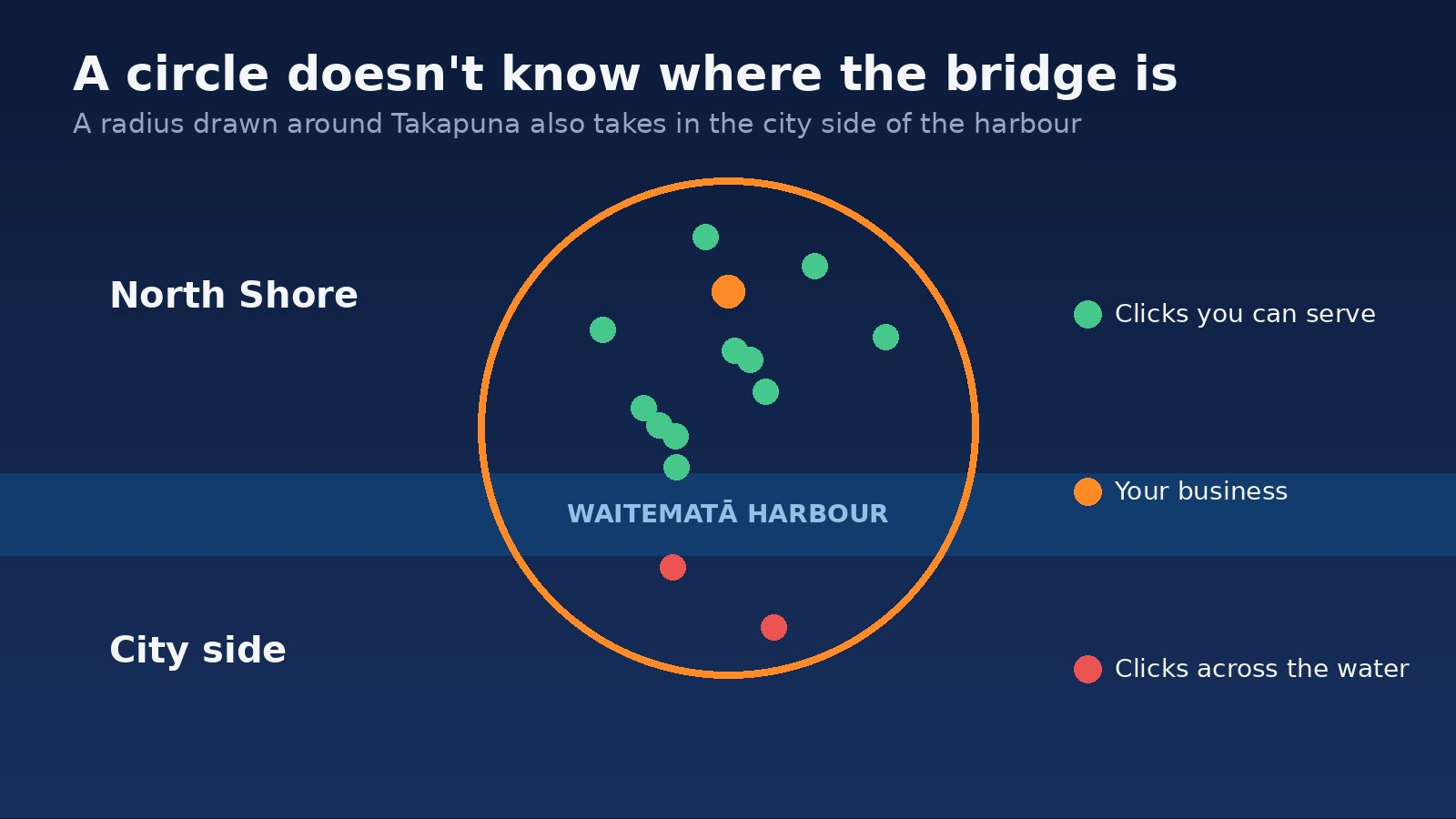
The fix is to target the suburbs you’ll actually travel to, by name, rather than a circle. Don’t go too narrow, though. Google warns that selecting a small location “could mean that your ads might only show intermittently or not at all” (same source). For most Shore businesses, the right list is a handful of suburbs or the boards you genuinely serve.
There’s a second setting to check too. By default, Google can show your ads to people who have shown interest in your area as well as people who are in it. We covered that one in detail in our South Auckland Google Ads guide, and it applies on the Shore just the same.
Leak two: one campaign for four markets
“North Shore” is a label, not a customer. A Browns Bay retiree weighing up a kitchen renovation and a young family who just moved into Hobsonville are buying differently, at different times, for different reasons. Put them in one campaign with one headline and the results average out. You can’t see that Upper Harbour is producing cheap enquiries while Devonport-Takapuna isn’t, or the other way round.

The fix is structure. Separate the areas that behave differently, give each its own ads, and send each to a page that names the suburb and the service. A searcher in Albany should land on a page about Albany. Then the reports tell you where your best customers come from, and you can move budget towards them instead of guessing.
What changed in September 2026: the language of your ad
Here’s the news part. Google has changed how it decides which language your Search ads are shown in. Its help page says: “Starting in September 2026, the way language targeting works is changing” for Search campaigns. “The campaign-level language targeting setting will be removed,” and “Search ads will automatically match based on the language of your ads.” Google says no action is required by advertisers (Google Ads Help, About language targeting).
Google also says it uses “search term language, the user’s language settings, and preferences” to work out which language a person knows, and tries to serve an ad they understand (same source). In plain words: the tick-box in your settings no longer decides it. The words in your ad do.
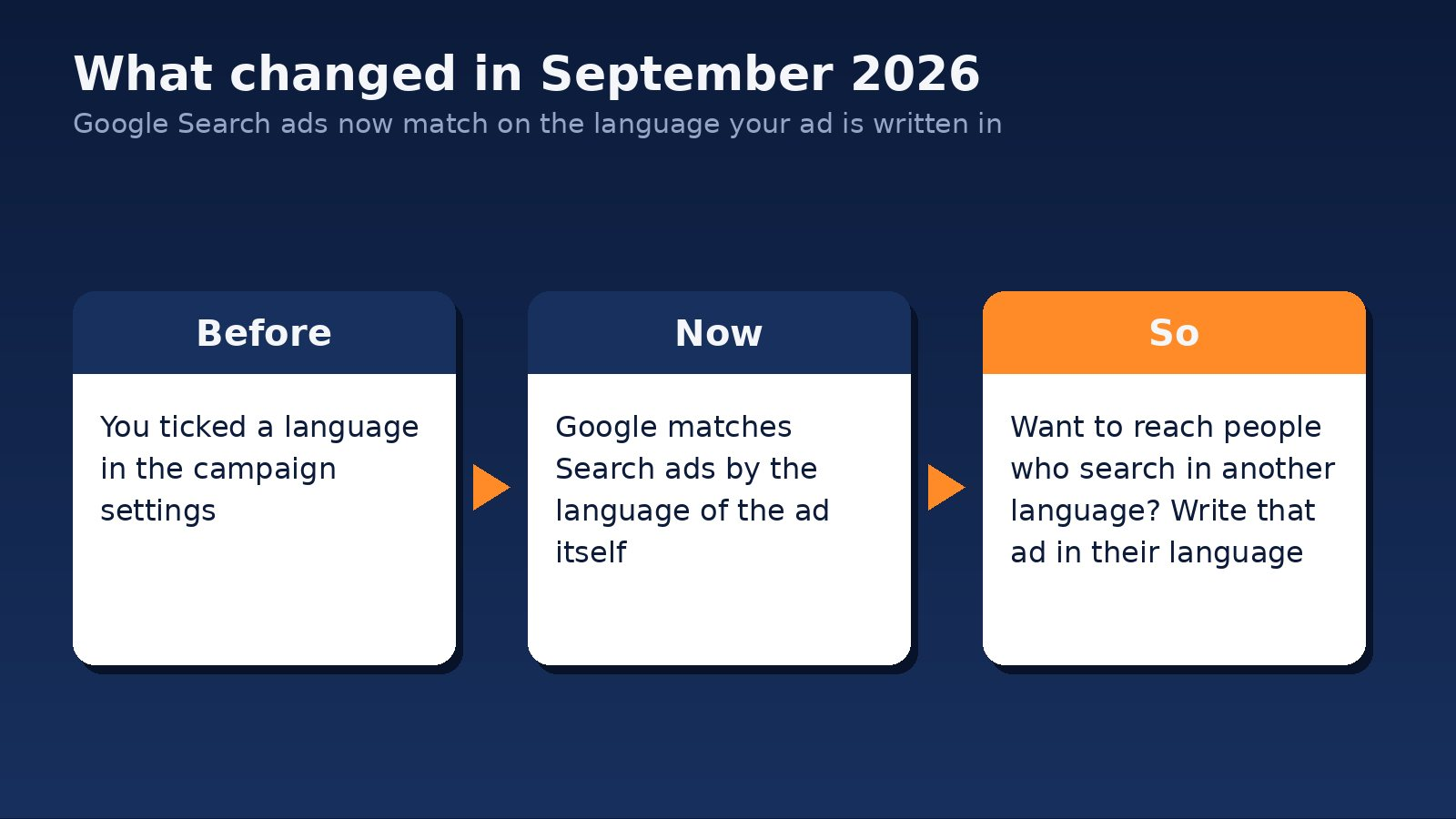
Why this matters more on the North Shore than in most of New Zealand: in Upper Harbour almost half of residents, and in Kaipātiki more than a third, identified with an Asian ethnicity. The Census summaries don’t tell you which language anyone searches in, so don’t assume. But if you already know some of your customers would rather read an ad in Mandarin, Cantonese or Korean, the way to reach them on Search is now simply to write that ad, and a landing page to match, in that language. Ask your agency whether your account has any ads in a second language. If the answer is no and your customers are multilingual, that’s a test worth running.
Leak three: ads running when nobody answers
Google’s help page is plain about the default: “By default, your Google Ads campaigns are set to show ads ‘All day'” (Google Ads Help, About ad scheduling). If your ad’s main button is “Call now” and nobody picks up after 5pm, the evening clicks often go to waste.
That doesn’t mean switch off at 5pm. Plenty of homeowners search after dinner, and a form enquiry at 9pm is still a lead if you ring back at 8am. It means decide on purpose. Run call-focused ads when someone is there to answer, and send after-hours clicks to a short form you follow up first thing.
How you’d know it’s working
A click isn’t a customer. For most Shore service businesses the real result is a phone call or a form enquiry, so ask for calls, enquiries and cost per enquiry, not impressions and clicks.
Google Ads also has two reports built for exactly the bridge problem. The Matched locations view “shows your performance based on the locations that matched your ads,” and the distance report “reports the distance between the location that triggered your ad and your closest business location” (Google Ads Help, View matched locations and distance reports). Together they show whether your spend is landing on the Shore or leaking across the water.
Ask whoever runs your account three questions:
- How many calls and enquiries did the ads produce last month, and what did each cost?
- Which suburbs did they come from, according to the Matched locations report?
- How much did we spend on clicks from areas we don’t serve?
If they can’t answer within a day, the tracking probably isn’t set up properly. Our guide to knowing which ads made the phone ring shows how to check.
How long, and what to expect
Google Ads can produce enquiries within days of launch, but the first month is a learning period. The account needs data on which searches and suburbs turn into enquiries before it settles. Allow two to three months before you judge the cost per enquiry fairly. Stopping after four weeks throws away the learning you paid for.
Where to start
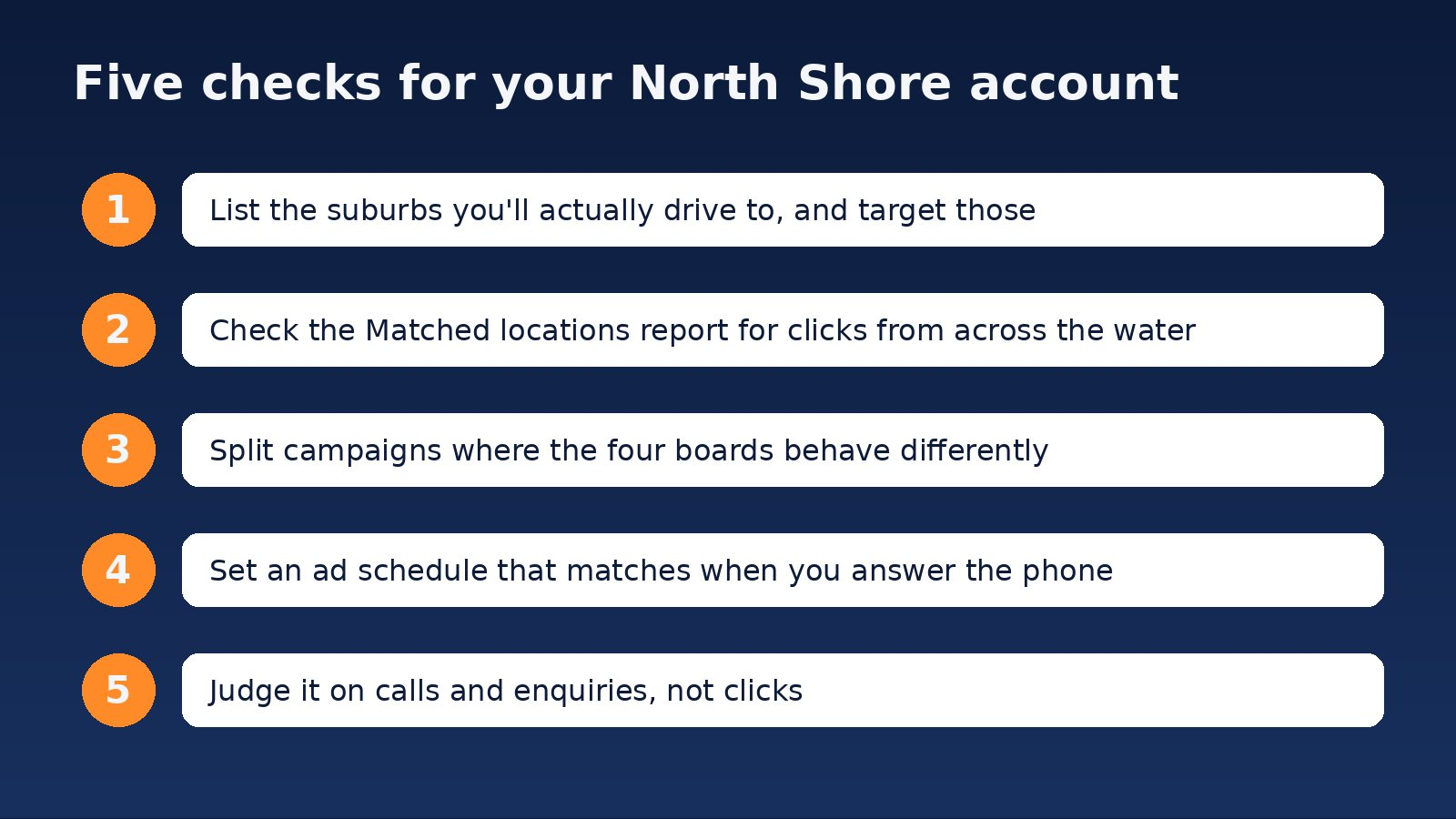
- Write down the suburbs you’ll actually drive to. Target those by name instead of a circle that crosses the harbour.
- Open the Matched locations report. See how much of last month’s spend came from places you don’t serve.
- Split the campaign where the boards behave differently, and send each to a page that names the suburb.
- Decide your ad schedule on purpose, based on when someone answers the phone.
- Review monthly on calls, enquiries and cost per enquiry, not clicks.
If you’d like a second pair of eyes on your account, or a campaign built around the North Shore suburbs you actually serve, see our Google Ads services or get in touch for a free review.
Frequently asked questions
Should I target the whole North Shore or specific suburbs?
Target the suburbs you’ll genuinely travel to. A radius around your address is quick but can cross the harbour. Don’t go so narrow that Google can’t show your ads; Google warns that very small areas may show ads only intermittently.
Do I need to change anything because of Google’s September 2026 language change?
Google says no action is required. Search ads now match on the language your ad is written in. If you want to reach customers who search in another language, write ads and a landing page in that language.
How do I know if I’m paying for clicks from outside my area?
Check the Matched locations report in Google Ads. It shows performance by the locations that matched your ads. The distance report shows how far those people were from your business.
How much does Google Ads cost on the North Shore?
You pay Google for clicks, plus a management fee if someone runs the account for you. Our plans are on our pricing page. Judge the result on cost per enquiry, not cost per click.
How long before Google Ads works?
Enquiries can start within days, but allow two to three months for the account to learn which searches and suburbs convert before judging the cost per enquiry.
Sources
- Auckland Council: Upper Harbour Local Board, 2023 Census results
- Auckland Council: Hibiscus and Bays Local Board, 2023 Census results
- Auckland Council: Kaipātiki Local Board, 2023 Census results
- Auckland Council: Devonport-Takapuna Local Board, 2023 Census results
- Google Ads Help: About language targeting (vendor documentation)
- Google Ads Help: How do I set up location targeting (vendor documentation)
- Google Ads Help: About ad scheduling (vendor documentation)
- Google Ads Help: View matched locations and distance reports (vendor documentation)
Want this run for your business?
Talk to our team. We will show you where the money is leaking and what we would do about it.