

You’ve probably had a month like this. The phone goes quiet, the website traffic looks about the same, and you can’t tell whether customers have gone elsewhere, stopped looking, or are still out there and just not finding you. Most business owners answer that question with a gut feel. There’s a better way, because new data on how New Zealanders use the internet came out this month.
On 5 November 2026, DataReportal published its Digital 2027: New Zealand report, the annual snapshot of how many Kiwis are online, which platforms they use, and how that’s changing. Put it alongside NZ Post’s latest research on what shoppers check before they buy, InternetNZ’s survey on AI use, and last summer’s spending data, and you get a clear picture of how people choose who to buy from. This post pulls those numbers together and turns them into plain decisions for your marketing, with Black Friday (27 November) and the summer run-in only weeks away.
Almost everyone is online, so “being online” isn’t an advantage any more
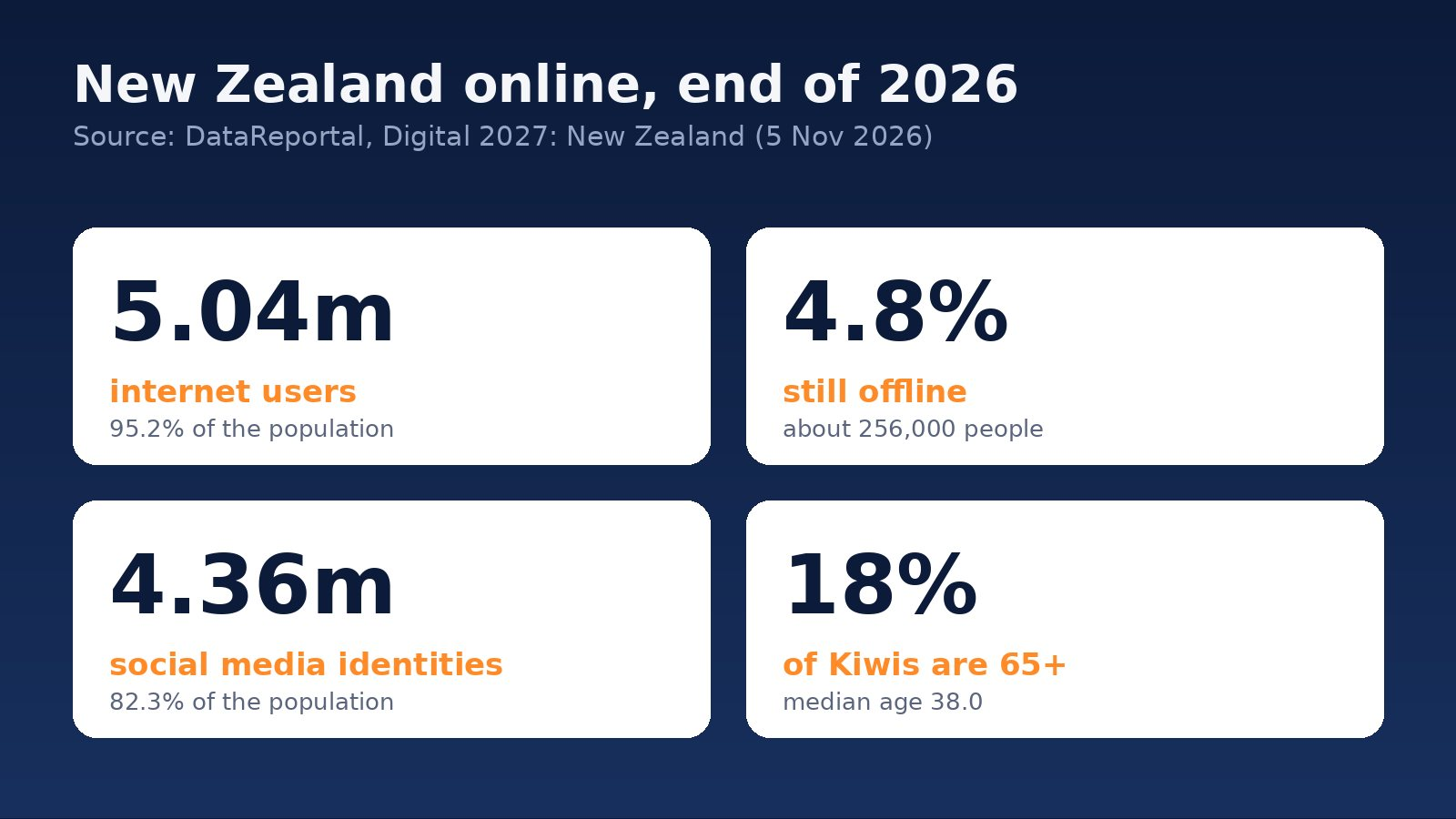
DataReportal puts New Zealand at 5.04 million internet users at the end of 2026, or 95.2% of the population. About 256,000 people, 4.8%, remain offline (DataReportal, Digital 2027: New Zealand).
Two things follow from that.
First, your older customers are online too. The same report notes the median age in New Zealand is 38.0, and 18% of the population is 65 or older. If your business sells to retirees, homeowners or established professionals, “our customers aren’t really online” no longer holds up. They’re searching, reading reviews and comparing quotes like everyone else.
Second, simply having a website and a Facebook page doesn’t set you apart. Every competitor has them. The difference now is whether you show up at the moment someone is ready to buy, and whether what they find convinces them.
Slow internet is no longer anyone’s excuse
Figures from Ookla, quoted in the same report, put the median mobile download speed in New Zealand at 145.45 Mbps and the median fixed broadband speed at 215.22 Mbps at the end of 2026. Mobile speeds rose 19.7% in the twelve months to August 2026. When a page takes eight seconds to load, the customer’s connection isn’t the problem. Your site is.
Search still starts the journey, and in New Zealand search means Google
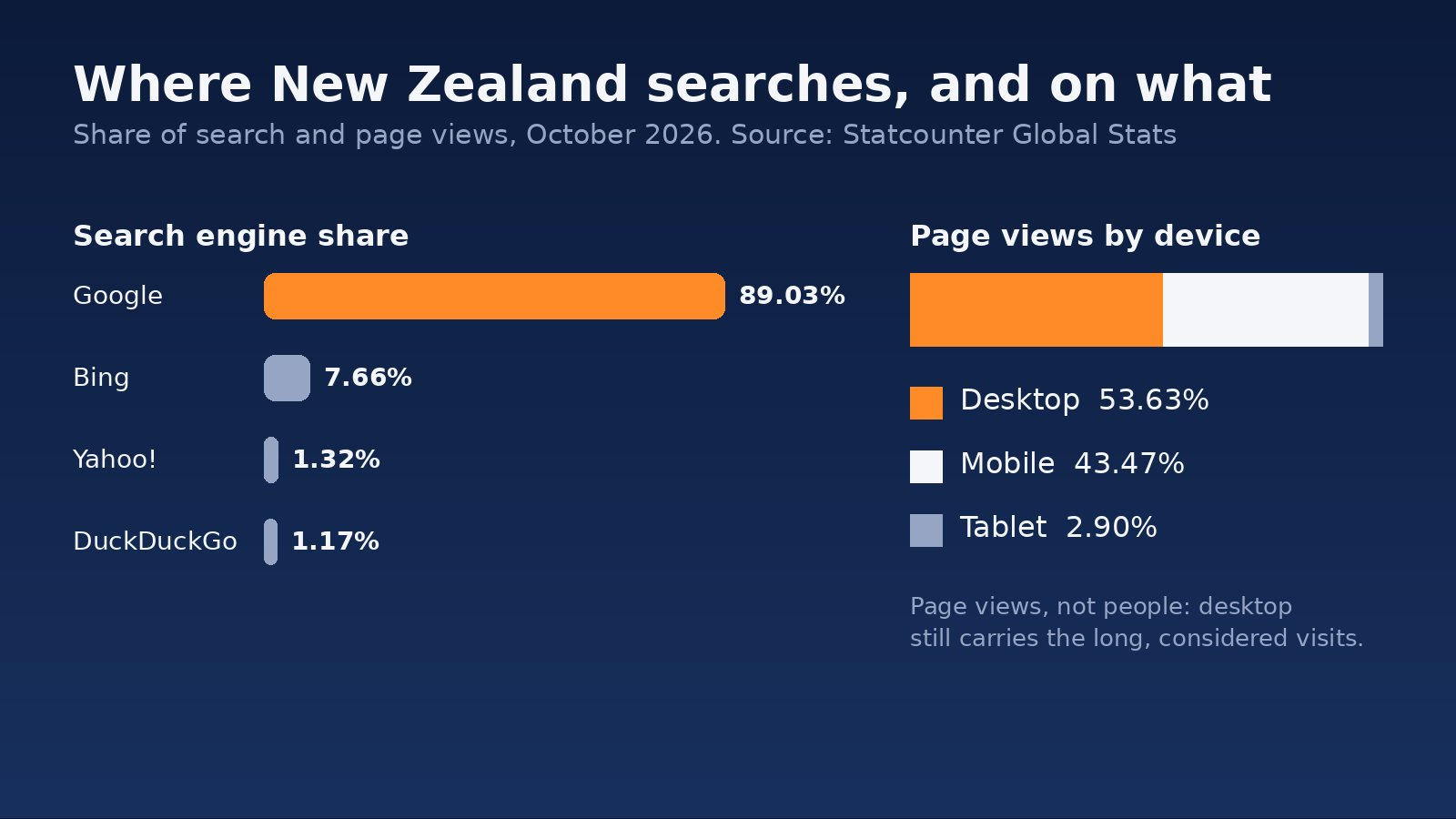
When someone needs a plumber, an accountant or a new couch, most of them still start by typing into a search box. Statcounter, which tracks billions of page views a month, puts Google at 89.03% of search engine use in New Zealand in October 2026, with Bing at 7.66% and everything else under 2% (Statcounter: Search engine market share, New Zealand).
That’s the single most useful number in this post for most business owners. If you only fix one thing, fix how you appear on Google: your Google Business Profile, your reviews, and whether your website answers the questions people actually type.
Bing’s 7.66% is small, but it isn’t nothing. If you sell to other businesses, where a lot of searching happens on work computers, it can be worth covering once Google is working well.
Mobile matters, but don’t forget the desktop
Statcounter’s device data for the same month may surprise you: desktop computers produced 53.63% of web page views in New Zealand, mobile 43.47% and tablets 2.9% (Statcounter: Desktop vs mobile vs tablet, New Zealand).
Those are page views, not people. Someone checking your opening hours on their phone views one page. Someone comparing three quotes on a laptop at night views fifteen. For bigger purchases, such as a renovation, a legal matter or a new supplier, the long research visit often happens on a bigger screen. Your site needs to work properly on both. A mobile-first design that looks bare on a laptop costs you the most considered buyers.
Where New Zealanders’ attention actually is
Beyond search, the question every owner asks is “which platform should I be on?” DataReportal pulls ad-reach figures from each platform’s own advertising tools. These show how many people you could reach with ads, not how many log in every day, so treat them as a rough guide rather than a census.
- YouTube: 4.36 million people, or 86.5% of New Zealand’s internet users, up 2.8% in a year.
- LinkedIn: 3.60 million registered members, up 9.1%. LinkedIn counts members rather than active users, so this figure isn’t directly comparable with the others.
- Facebook: 3.40 million, down 1.4% in a year. DataReportal cautions that Meta regularly revises its figures, so a small dip may be a correction rather than people leaving.
- Instagram: 2.70 million.
- TikTok: 2.19 million adults (18+), up 7.2% in a year.
All figures: DataReportal, Digital 2027: New Zealand.
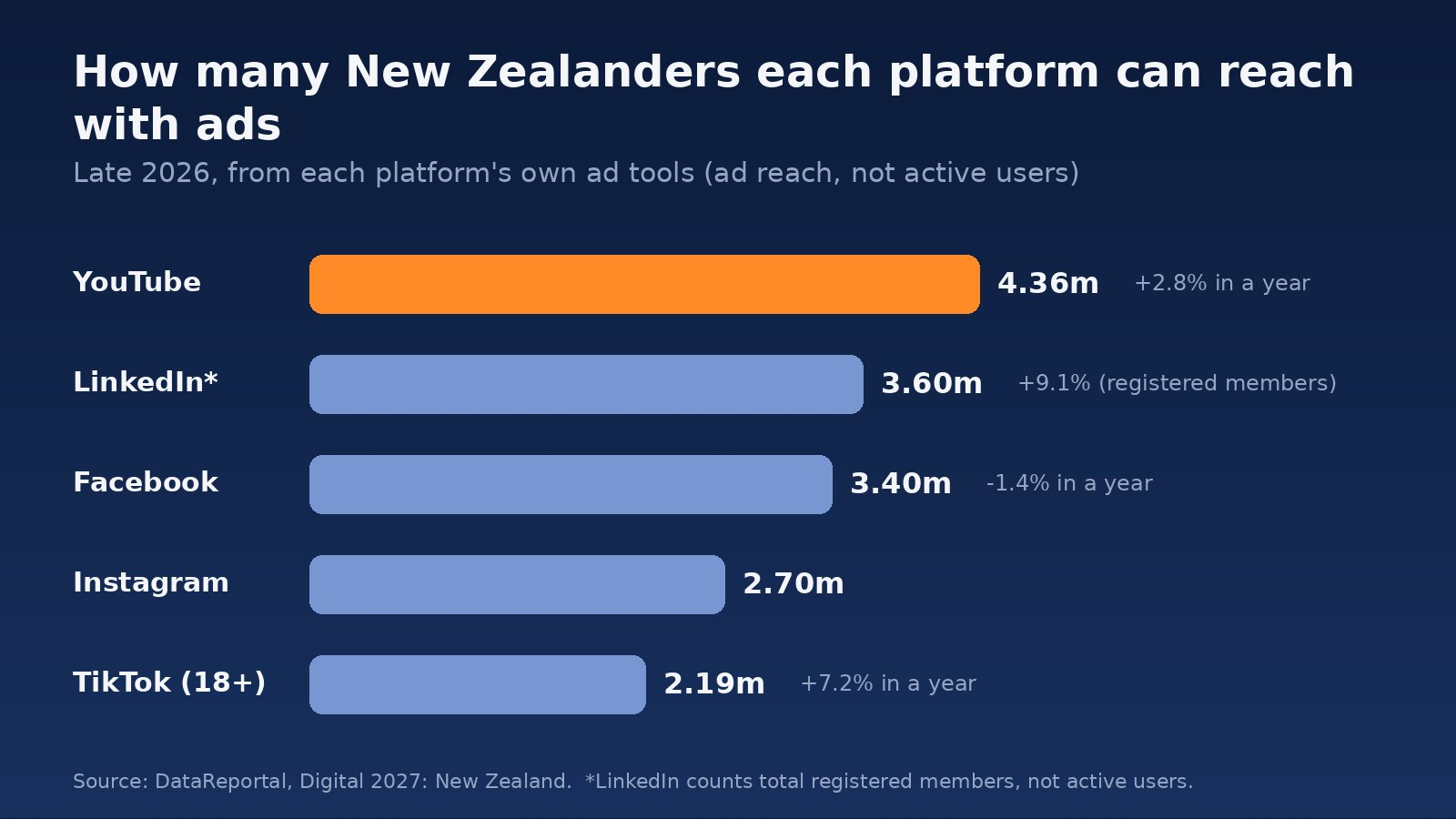
What does that mean for your budget? Reach isn’t the same as buying intent. A huge audience is worth little if nobody in it is looking for what you sell this week. For most local service businesses the order of priority is still the same: be found on Google when people search, look trustworthy when they check you out, then use social and video to stay in front of the people who’ve already shown interest. If you sell to other businesses, LinkedIn’s growth makes it worth a closer look. Our guide to LinkedIn Ads in NZ covers what that costs.
Before they buy, they check you out
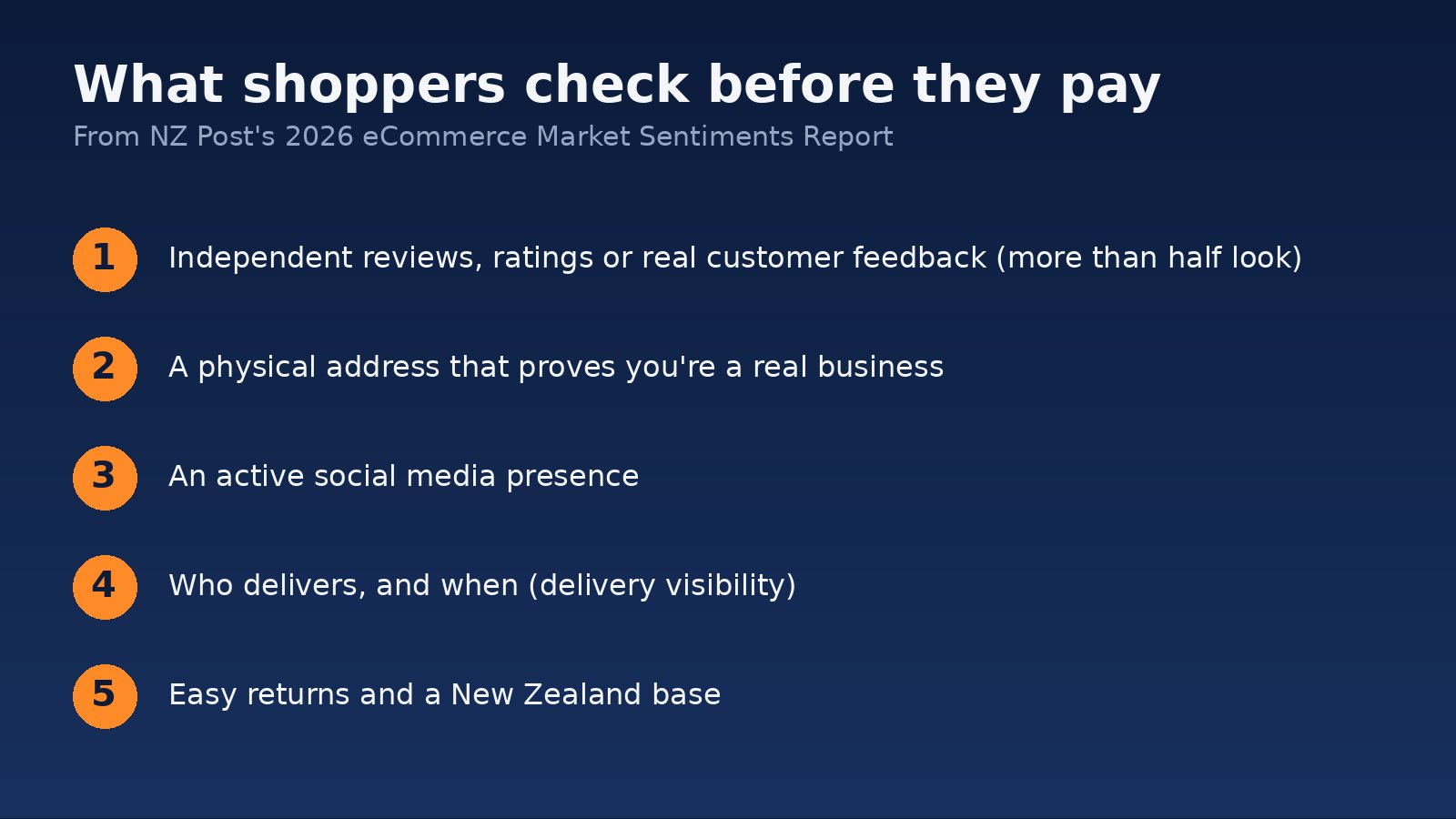
This is the part most businesses underestimate. NZ Post’s ninth annual eCommerce Market Sentiments Report, released in July 2026, found that more than half of shoppers search for independent reviews, external ratings or real shopper feedback before purchasing. They also look for signs of a legitimate business, including a physical address, a social media presence and the delivery partner (NZ Post media release, 11 July 2026).
NZ Post’s General Manager Business, Chris Wong, put it plainly: searching for value is “now the starting point for almost every purchase decision”, but shoppers “are increasingly looking for signs of legitimacy and reassurance before hitting ‘pay now’.” With scams, offshore sellers and AI-generated content everywhere, people have become cautious.

NZ Post’s research is about online shopping, but the same habit shows up in service businesses. Before anyone books a builder, an accountant or a cleaner, they look up the reviews, check that there’s a real address, and scroll the Facebook page to see whether it’s been active since 2021. If your ads are good but your reviews are thin or stale, you’re paying for clicks that leave unconvinced.
There’s good news for local businesses in the same report. Spending with New Zealand-based online retailers grew at more than double the rate of international online spending. NZ retailers accounted for 79.6% of all online spending, and their average basket was more than $50 bigger than offshore sellers’. Over a quarter of shoppers named an NZ-based store, delivery visibility and easy returns as key reasons for choosing a retailer. Being local is a selling point, so say so clearly.
AI is now part of how people shortlist
InternetNZ’s latest Internet Insights research, released in March 2026, found that 60% of New Zealanders use AI weekly. The same study found 68% are “very or extremely concerned” about AI being used to produce harmful content, and only 72% now think the internet’s positives outweigh its negatives, down from 90% in 2019 (RNZ, 2 March 2026).
NZ Post saw the same pattern among shoppers, who are “leveraging generative AI to search, compare and decide where to buy.” In practice, someone might ask ChatGPT or Google’s AI answers for “the best-rated heat pump installers in Hamilton” before they ever reach your website.
Taken together, that means people use AI heavily but don’t fully trust it, so they double-check. AI tools tend to recommend businesses that are described clearly and consistently across the web and have a solid base of genuine reviews. The work that wins the AI shortlist is mostly the same work that wins the human one. We covered how to check whether AI tools mention your business in getting your business mentioned when customers ask AI.
Black Friday now beats Boxing Day, but don’t bet the summer on it
Payment network Worldline’s figures show Black Friday overtook Boxing Day as New Zealand’s biggest retail spending day last year. Non-food spending through its systems reached $55.6 million on Black Friday (28 November 2025), against $51.2 million on Boxing Day, which fell 12.4% on the year before. But Black Friday’s own non-food spend was down 6.2% on 2024 (Newstalk ZB / NZ Herald, 12 January 2026).
So the big day is bigger than Boxing Day, but it isn’t growing, and shoppers are hunting for value. If you’re a retailer, plan your Black Friday offer now and have your ads and emails ready by mid-November. If you’re a service business, don’t feel you have to discount. A clear “book before Christmas” message to people who’ve already enquired usually earns more than a sitewide sale.
What this means for your marketing, in five decisions
- Get Google right first. With 89% of searches, it’s where buying intent lives. That means a complete Google Business Profile, a site that loads fast, and ads or SEO aimed at the searches that lead to sales.
- Make trust visible. More than half of shoppers look for reviews before they buy. Ask every happy customer for a review, show your address, and keep your social pages active.
- Design for laptops as well as phones. More than half of page views in October came from desktops, and the long research visits often do.
- Pick platforms by intent, not size. YouTube and Facebook reach the most people. Google reaches people who are ready to buy. LinkedIn suits business buyers. Spend in that order unless you have a reason not to.
- Measure enquiries, not clicks. None of this is worth much if you can’t tell which channel made the phone ring. Our post on which ads actually made the phone ring explains how to set that up.
Where to start
You don’t need to act on every number here. Start with the two that cost the most when ignored: how you appear on Google, and what people find when they check you out. If you’d like a second pair of eyes on either, see our services or our published pricing plans. We’ll tell you where your money is best spent before summer, even if the answer is “not with us yet.”
Frequently asked questions
How many New Zealanders use the internet in 2026?
DataReportal’s Digital 2027: New Zealand report puts it at 5.04 million people at the end of 2026, or 95.2% of the population. About 256,000 people (4.8%) remain offline.
Which search engine do most New Zealanders use?
Google, by a wide margin. Statcounter recorded Google at 89.03% of search engine use in New Zealand in October 2026, with Bing at 7.66%.
Do New Zealanders mostly browse on mobile or desktop?
Both. In October 2026, Statcounter recorded 53.63% of New Zealand page views on desktop and 43.47% on mobile. That counts page views rather than people, so it reflects how much longer research sessions tend to run on a computer.
Which social media platform reaches the most New Zealanders?
YouTube, with an ad reach of 4.36 million people in late 2026, according to DataReportal. Facebook reached 3.40 million, Instagram 2.70 million and TikTok 2.19 million adults. These are advertising reach figures, not daily active users.
Do reviews really affect whether people buy?
Yes. NZ Post’s 2026 eCommerce Market Sentiments Report found that more than half of shoppers search for independent reviews, ratings or real feedback before purchasing, and many also look for a physical address and an active social media presence.
When is Black Friday in New Zealand in 2026?
Friday 27 November 2026. Last year Black Friday overtook Boxing Day as New Zealand’s biggest non-food spending day, according to Worldline, although Black Friday spending itself was down 6.2% on 2024.
Sources
- DataReportal (Kepios): Digital 2027: New Zealand (published 5 November 2026; includes Ookla speed data and platform ad-reach figures)
- Statcounter Global Stats: Search engine market share, New Zealand (October 2026)
- Statcounter Global Stats: Desktop vs mobile vs tablet market share, New Zealand (October 2026)
- NZ Post: Almost one in four dollars of total retail spend is now online (eCommerce Market Sentiments Report, 11 July 2026)
- RNZ: ‘Ens-ification’ blamed as Kiwis feel down about internet (InternetNZ Internet Insights findings, 2 March 2026)
- Newstalk ZB / NZ Herald: Boxing Day shopping falls 12.4% in 2025 (Worldline data, 12 January 2026)
Want this run for your business?
Talk to our team. We will show you where the money is leaking and what we would do about it.