
Beyondclix is the strongest NZ-ready alternative to ecomconversion.com — it offers integrated Google Ads, Meta Ads, SEO, CRO, and analytics under one roof, with a local New Zealand presence and a documented track record of up to 20x ROAS. If Beyondclix isn’t the right fit for your situation, the other viable options fall into three categories: local full-service agencies, specialist CRO vendors, and fractional consultants.
- Recommended pick: Beyondclix (NZ-based, integrated, measurable outcomes)
- Other options: Local full-service agencies, specialist CRO shops, independent fractional consultants
- Next step: Contact Beyondclix or use the onboarding checklist in Section 9 below.
Table of Contents
- How do ecomconversion.com alternatives compare side by side?
- Why do NZ ecommerce brands look for a local alternative?
- How was this shortlist evaluated?
- What does Beyondclix offer NZ ecommerce brands?
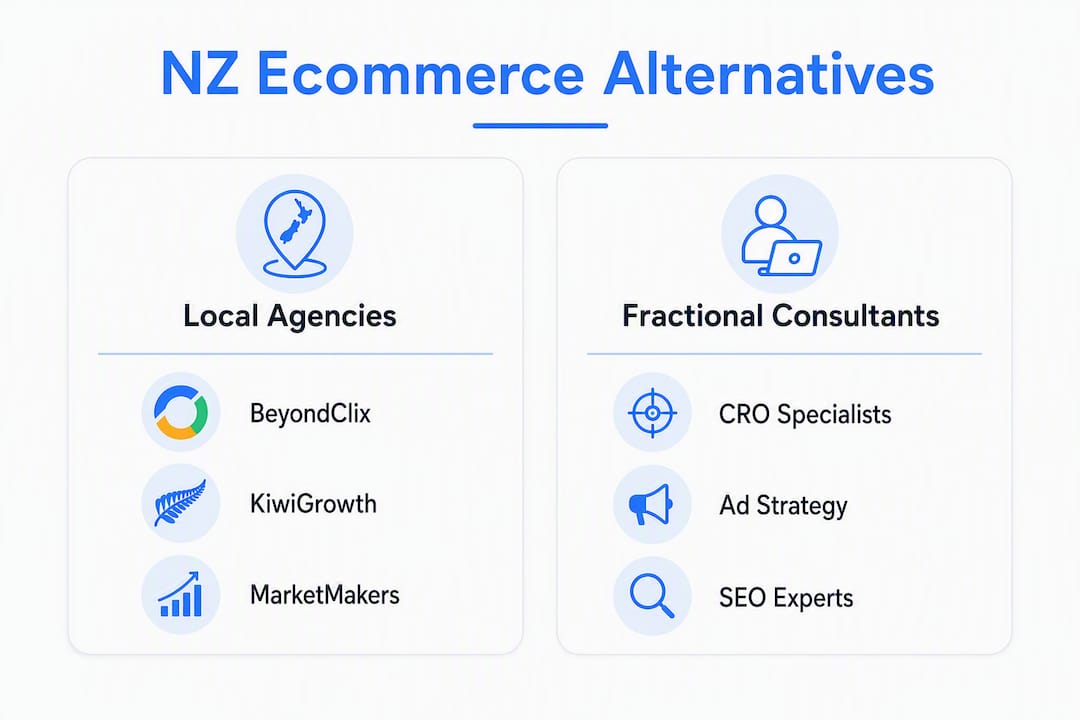
- What other alternatives should you consider?
- How do you choose between Beyondclix and other options?
- What mobile and friction fixes move the needle fastest in New Zealand?
- What does switching agencies actually look like in practice?
- Key takeaways
- Ad creative and CRO: what most agencies get backwards
- Beyondclix: NZ ecommerce growth without the offshore gap
- Useful sources
- FAQ
How do ecomconversion.com alternatives compare side by side?
| Dimension | Beyondclix | Offshore performance agency (e.g. eCom Conversion) | Local CRO specialist | Fractional consultant |
|---|---|---|---|---|
| Services offered | Google/Meta/LinkedIn Ads, SEO, CRO, analytics, email, CRM, web design | Facebook Ads, Google Ads, Shopify dev | CRO, UX audits, A/B testing | Strategy, audits, coaching |
| Best for | Established NZ stores seeking integrated growth | Brands needing low-cost ad management | Stores with traffic but poor conversion | Brands needing short-term strategic direction |
| Pricing model | Retainer or project-based | Typically percentage-of-spend or fixed retainer | Project or day-rate | Day-rate or short retainer |
| Proven results | Up to 20x ROAS (published brand claim) | Varies; limited NZ case studies | Conversion rate lifts on existing traffic | Depends on individual |
| NZ availability | Local presence | Offshore (Noida, India) | Some NZ-based providers | Variable |
| Onboarding time | Structured 90-day programme | Typically 2–4 weeks | 1–3 weeks | 1–2 weeks |
| Methodology | Friction audit + integrated channels | Ad-channel focused | CRO-first | Advisory |
A few nuances worth noting:
- eCom Conversion is listed as a Noida-based performance marketing agency, which creates timezone and accountability gaps for NZ brands.
- Offshore agencies often focus on ad channels alone without integrating CRO or analytics, so conversion leaks go unfixed while ad spend climbs.
- Fractional consultants suit brands that need a short diagnostic sprint, not ongoing execution.
Why do NZ ecommerce brands look for a local alternative?
The core issue isn’t price. It’s fit. Over 65.7% of NZ ecommerce sales were completed on smartphones in 2025, which means an agency that optimises primarily for desktop is already behind. Offshore providers often miss this because their own market benchmarks look different.
GST display is another friction point unique to New Zealand. Showing GST-exclusive prices and adding tax at checkout is one of the most common causes of cart abandonment for Kiwi shoppers. An agency unfamiliar with NZ consumer expectations may not flag this during an audit.
Beyond the technical gaps, there’s the practical matter of timezone alignment. A 5.5-hour offset between Auckland and India means real-time campaign adjustments during NZ peak hours often happen the next business day. For brands running time-sensitive promotions, that lag costs money.
Pro Tip: Before you migrate your ad budget to any new agency, run a friction audit on your current checkout. Paying to scale traffic into a leaky funnel is one of the fastest ways to burn budget without moving ROAS.
How was this shortlist evaluated?
The evaluation used six weighted criteria, applied consistently across all provider types:
- Demonstrable results (30%) — Published ROAS figures, case studies, or documented conversion lifts with named outcomes.
- NZ availability and local presence (20%) — Physical or operational presence in New Zealand, timezone alignment, and familiarity with NZ consumer behaviour.
- CRO capability (20%) — Ability to run friction audits, session analysis, A/B testing, and checkout optimisation, not just traffic acquisition.
- Cross-channel integration (15%) — Whether ads, SEO, email, and analytics are managed as a single system or sold as separate silos.
- Onboarding speed and pricing transparency (15%) — Clear timelines, upfront pricing structures, and no ambiguous contract terms.
Sources used include NZ ecommerce benchmarks, published company profiles, and practitioner guidance from Sanjay Dey’s UX/UI revenue research and the Baymard Institute’s CRO resources.
What does Beyondclix offer NZ ecommerce brands?
Beyondclix’s full services suite covers every channel an established NZ store needs:
- Paid advertising: Google Ads, Meta Ads, LinkedIn Ads
- Organic growth: Technical and on-site SEO
- Conversion: CRO audits, friction analysis, checkout optimisation
- Data: Analytics and tracking dashboards, GA4 setup, purchase funnel validation
- Retention: Email remarketing, CRM integration, lead nurturing automations
- Brand: Website design and build, online reputation management
The integrated approach is the differentiator. Rather than running ads in isolation, Beyondclix aligns every channel so that a Meta campaign feeds the same funnel the SEO programme is building, and the analytics dashboard shows the full picture.
Beyondclix’s published brand claim documents strong ROAS in rapid campaign results — a figure that reflects integrated channel management rather than single-channel ad buying.
Pro Tip: When you first contact Beyondclix, prepare your current ROAS by channel, your top three traffic sources, and your checkout abandonment rate. That data cuts the discovery phase from weeks to days.
What other alternatives should you consider?
Three provider types cover the realistic alternatives to a full-service integrated agency.

Local full-service agencies offer NZ presence and broad channel coverage, but quality varies. The benefit is accountability and timezone alignment. The trade-off is that some local agencies still operate in channel silos, so ask directly whether CRO is included or quoted separately.
Specialist CRO vendors are the right call when your traffic is healthy but your conversion rate sits below the NZ benchmark of 1.4–3%. Local commentary recommends 2% as a healthy target. They run session recordings via tools like Hotjar or Microsoft Clarity, build A/B test programmes, and redesign checkout flows. The limitation: they don’t manage your ad spend, so you’ll still need a separate media partner.
- Pros: deep conversion expertise, fast diagnostic turnaround
- Cons: no channel management, requires a separate agency relationship
Fractional CRO consultants suit brands in transition, particularly those between agencies or preparing for a platform migration. They’re cost-effective for a 4–8 week diagnostic sprint but rarely the right long-term partner for a brand that needs ongoing execution.
Pro Tip: If your conversion rate is already above 2% but ROAS is flat, the problem is likely audience targeting or creative quality, not checkout friction. A full-service agency is a better fit than a pure CRO specialist in that scenario.
How do you choose between Beyondclix and other options?
Work through these criteria before you commit to any agency:
- Store size and revenue stage — Integrated agencies like Beyondclix suit established stores with existing traffic. Early-stage stores may be better served by a focused specialist first.
- Channel coverage needed — If you need Google, Meta, SEO, and email working together, a siloed provider will cost you more in coordination overhead than a single integrated partner.
- CRO depth — Ask every agency: “Can you show me a sample friction audit?” If they can’t, CRO is a line item on a proposal, not a real capability.
- Reporting cadence — Weekly dashboards with named KPIs, or monthly PDFs? The former lets you course-correct fast.
- Tech stack compatibility — Confirm the agency works natively with your platform (Shopify, WooCommerce, etc.) and your existing analytics setup.
Questions to ask during discovery calls:
- “Show me a specific ROAS case study from a NZ ecommerce client.”
- “Walk me through your friction audit process.”
- “What’s your minimum term and how is pricing structured?”
- “How do you handle GST display audits for NZ stores?”
Red flags to watch for:
- Opaque reporting with no named KPIs
- No NZ-specific case studies or local client references
- Lengthy onboarding with no upfront diagnostic
- Ambiguous GST handling or no mention of NZ-specific checkout practices
NZ agency retainers typically range from a few thousand dollars per month for specialist work to higher fees for full-service integrated programmes. Percentage-of-spend pricing is common for pure media buying; project fees suit one-off audits or builds.
What mobile and friction fixes move the needle fastest in New Zealand?
65.7% of NZ ecommerce sales happen on smartphones, so mobile performance is where most brands find their quickest wins.
Mobile-first audit priorities:
- Convert images to WebP or AVIF and lazy-load below-the-fold assets
- Reduce form fields at checkout to the absolute minimum
- Enable Apple Pay and Google Pay as primary payment options
- Test thumb-friendly tap targets on product and cart pages
Price transparency fixes:
- Display GST-inclusive prices from the product page, not just at checkout
- Add a postcode-based shipping estimator to the cart
- Remove any late-stage cost surprises that inflate the final total
Friction audit checklist:
- Run session recordings (Hotjar, Microsoft Clarity) on mobile checkout
- Segment analytics by device and identify where mobile drop-off exceeds desktop
- Review checkout step completion rates and flag the highest-exit step
- Test error messages and form validation for clarity
Stat: 65.7% of NZ ecommerce sales were finalised on smartphones in 2025. If your checkout isn’t built for a thumb, you’re losing sales on the majority of your traffic.
Pro Tip: Use Baymard’s CRO resources as a free benchmark against your checkout flow before briefing any agency. It gives you a credible baseline to measure agency recommendations against.
What does switching agencies actually look like in practice?
A structured 90-day transition reduces revenue disruption significantly.
- Days 0–7 (Discovery and access): Transfer admin access to ad accounts, GA4, Google Search Console, and your product feed. Export historical campaign data. Document current ROAS by channel.
- Days 7–21 (Audit and quick fixes): Run the friction audit. Fix GST display, image weight, and checkout form issues. Validate tracking and purchase funnel events.
- Days 21–45 (Test campaigns and initial optimisation): Launch test campaigns on one or two channels. Confirm pixel and conversion tracking is firing correctly. Run a sample order to verify taxes and shipping at checkout.
- Days 45–90 (Scale and refinement): Expand to full channel mix. Begin A/B testing creative and landing pages. Establish reporting cadence and KPI baselines.
Onboarding checklist:
- Ad account and pixel access transferred
- Historical data exported and documented
- Analytics goals and events validated
- Product feed reviewed for errors
- CRO priorities ranked by estimated impact
- Sample order placed to confirm checkout accuracy
Expect quick wins in weeks 2–4 from friction fixes. Meaningful ROAS lift typically becomes measurable after 45–60 days of live campaign data.
Key takeaways
Beyondclix is the recommended NZ-ready alternative to ecomconversion.com because it combines local presence, integrated channel management, and a documented ROAS track record in a single engagement.
| Point | Details |
|---|---|
| Top recommended pick | Beyondclix offers integrated ads, SEO, CRO, and analytics with NZ local presence and up to 20x ROAS. |
| Mobile is the priority | 65.7% of NZ ecommerce sales happen on smartphones; mobile fixes deliver the fastest conversion gains. |
| GST display matters | Showing GST-inclusive prices from the product page reduces cart abandonment for Kiwi shoppers. |
| Evaluate on results, not promises | Ask every agency for a specific NZ ROAS case study and a sample friction audit before signing. |
| Beyondclix next step | Contact Beyondclix or use the 90-day onboarding checklist to switch with minimal disruption. |
Ad creative and CRO: what most agencies get backwards
Most agencies pitch creative as a branding exercise. The data tells a different story. Once checkout friction is resolved, ad creative becomes the primary lever for conversion lift, not just click volume. Brands that fix their funnel first and then invest in creative testing see compounding returns because the traffic they’re paying for actually converts.
The mistake Kiwi brands make most often is running creative tests while the checkout is still broken. Session recordings consistently show users clicking through a compelling ad, landing on a well-designed product page, and then abandoning at a payment step that doesn’t support Apple Pay or shows a GST-exclusive price that jumps at checkout. The creative did its job. The funnel didn’t.
The sequence matters: friction audit first, creative optimisation second, scale third. Agencies that reverse this order are spending your budget to find out your checkout doesn’t work.
For brands considering a switch, asking a prospective agency how they sequence CRO and creative work is one of the most revealing questions you can ask. The answer tells you whether they think in channels or in funnels.
Beyondclix: NZ ecommerce growth without the offshore gap
If you’ve been comparing ecomconversion.com alternatives and want an agency that actually knows the NZ market, Beyondclix is built for exactly this. The offshore model creates real gaps: timezone delays, no NZ-specific checkout expertise, and ad management that runs in isolation from your conversion rate.
Beyondclix covers Google Ads, Meta Ads, SEO, CRO, analytics, email remarketing, and CRM integration as a single connected programme, not a menu of separate services. The friction audit is part of onboarding, not an optional add-on. And because the team is NZ-based, campaign adjustments happen during your business hours, not the next morning.
Get in touch with Beyondclix to request an initial audit and find out what your current funnel is leaving on the table.
Useful sources
The figures and recommendations in this article draw on the following sources:
- NZ Apps — ecommerce web design: source for the 65.7% NZ mobile ecommerce share (2025) and mobile-first CRO guidance.
- U.S. Department of Commerce — New Zealand ecommerce country commercial guide: NZ-specific checkout friction, GST display practices, and cart abandonment drivers.
- Baymard Institute — ecommerce CRO resources: checkout optimisation benchmarks and CRO best practices.
- Enterprise League — eCom Conversion company page: directory listing of eCom Conversion’s service coverage.
Published NZ statistics (mobile share, conversion benchmarks) are cited directly from their sources. Practitioner benchmarks translated from non-NZ markets are noted as such in the relevant sections.
FAQ
What is the best NZ alternative to ecomconversion.com?
Beyondclix is the strongest NZ-ready alternative, offering integrated Google Ads, Meta Ads, SEO, CRO, and analytics with a local presence and a documented ROAS track record of up to 20x.
How can I increase my ecommerce conversion rate in New Zealand?
Start with a mobile friction audit, since 65.7% of NZ ecommerce sales happen on smartphones. Fix GST display, reduce checkout form fields, and enable digital wallet payments before increasing ad spend.
What should I ask a performance marketing agency before signing?
Ask for a specific NZ ROAS case study, a sample friction audit, and a clear breakdown of pricing and minimum contract terms. Opaque reporting and no local case studies are the two most common red flags.
What is a realistic conversion rate for a NZ ecommerce store?
NZ DTC benchmarks place conversion rates at 1.4–3% depending on device and sector, with 2% considered a healthy target for most stores.
How long does it take to see results after switching agencies?
Friction fixes typically show results within 2–4 weeks. Meaningful ROAS lift from new campaigns becomes measurable after 45–60 days of live data, based on a structured 90-day onboarding programme.
Recommended
- Wezealor.com alternatives for NZ businesses in 2026 – BeyondClix Blog
- Best ph.digital alternatives for NZ businesses in 2026 – BeyondClix Blog
- Ecommerce marketing East Auckland: local agency guide – BeyondClix Blog
- Digital growth strategy components for NZ businesses in 2026 – BeyondClix Blog
Want this run for your business?
Talk to our CEO. We will show you where the money is leaking and what we would do about it.