
For an established New Zealand business that needs measurable leads and sales now, the fastest path is an integrated growth team combining a strategy/account lead, PPC/paid-media specialist, SEO specialist, content/social manager, email/CRM specialist, and analytics/CRO specialist. Hiring these roles piecemeal, without a coordinating strategy lead, consistently produces slower results because channels optimise in isolation rather than compounding each other’s gains.
Your minimum viable specialist mix to start generating measurable results:
- Strategy/account lead — sets KPIs, owns the media plan, aligns all channels
- PPC/paid-media specialist — Google Ads and LinkedIn Ads for fast lead volume
- SEO specialist — technical and on-site SEO for sustainable organic traffic
- Paid social manager — Meta and TikTok Ads for audience building and retargeting
- Content/social marketer — feeds creative assets to paid and organic channels
- Email/CRM specialist — Klaviyo or equivalent for nurture and retention
- Analytics/CRO specialist — GA4, attribution, conversion rate improvement
- E-commerce specialist/developer — Shopify storefront, technical integrations (e-commerce businesses)
An integrated agency retainer covering all of these roles typically produces the first measurable KPI movement within 30–90 days, compared to 3–6 months when roles are onboarded sequentially as separate hires.
Table of Contents
- What KPI does each type of digital marketing specialist own?
- When should you hire each specialist for your NZ business?
- How should your specialists work together as an integrated team?
- What do engagement models and NZ pricing ranges look like?
- What should you ask candidates or agencies, and what are the red flags?
- How does an integrated approach deliver measurable ROI?
- Key takeaways
- Why integrated teams consistently outperform channel-by-channel hiring
- Beyondclix delivers the full specialist mix for NZ businesses
- Useful sources
- FAQ
What KPI does each type of digital marketing specialist own?
| Specialist | Primary KPI | Best for | Time to impact | Cost model | Integration |
|---|---|---|---|---|---|
| Strategy/account lead | CAC, LTV, overall ROAS | All business sizes | Immediate | Retainer | Coordinates all channels |
| PPC/paid-media | ROAS, CPA, lead volume | Businesses with ad budget | 2–4 weeks | Retainer + % of spend | Feeds data to CRO and content |
| SEO specialist | Organic traffic, keyword rankings | Established sites with content | 3–6 months | Retainer or project | Informs content and tech roadmap |
| Paid social manager | CPL, ROAS, reach | Brand awareness + retargeting | 2–6 weeks | Retainer + % of spend | Shares creative briefs with content |
| Content/social marketer | Engagement, organic reach, MQLs | Content-led brands | 4–8 weeks | Retainer or project | Supplies assets to paid and SEO |
| Email/CRM specialist | Open rate, revenue per email, churn | E-commerce, subscription | 4–8 weeks | Retainer or project | Connects to paid audiences and Shopify |
| Analytics/CRO specialist | Conversion rate, attribution accuracy | Any business with traffic | 4–8 weeks | Retainer or project | Validates every other channel’s ROI |
| E-commerce/developer | Revenue per session, AOV | Shopify-based e-commerce | 4 weeks | Project or retainer | Integrates GA4, Klaviyo, paid channels |
| Creative/design | CTR, ad quality score | Any channel running creative | Ongoing | Retainer or hourly | Supports paid, social and content |
NZ e-commerce lead roles now routinely list Shopify, GA4, and Klaviyo as combined requirements rather than separate specialisations, which means a single hire often needs to cover what was previously three distinct digital marketing roles.
When should you hire each specialist for your NZ business?
The sequencing decision comes down to your primary growth constraint. If you need leads within 30 days, start with a PPC specialist and a strategy lead. If organic visibility is the problem, an SEO specialist is the priority. If you have traffic but poor conversion, analytics/CRO comes first.
Signals that tell you it’s time to hire:
- Monthly ad spend above NZ$3,000 with no dedicated paid-media owner: budget is leaking
- Organic traffic flat or declining for two consecutive quarters: SEO specialist needed
- Email list above 1,000 contacts with no automation in place: CRM/email specialist overdue
- Cart abandonment rate above 70% on a Shopify store: CRO and e-commerce developer required
- No attribution model in place despite running multiple paid channels: analytics specialist urgent
Recommended hire sequence by objective:
- Lead generation focus: Strategy lead → PPC specialist → analytics/CRO (days 1–30), then content/social and email/CRM (days 30–60)
- E-commerce growth: Strategy lead → paid social + PPC → e-commerce developer + analytics (days 1–45), then email/CRM with Klaviyo (days 45–90)
- Retention and lifetime value: Email/CRM specialist → analytics/CRO → content marketer (days 1–60)
Sequencing hires by immediate impact means starting with a strategy lead and PPC specialist for fast paid leads, then adding analytics/CRO and a developer within 30–60 days to capture and scale those results.
How should your specialists work together as an integrated team?
The strategy or account lead is the linchpin. Without one person accountable for CAC, LTV, conversion rate, and ROAS across all channels, each specialist optimises their own metric and the business ends up with a collection of channel reports rather than a revenue picture.

A practical week-to-week rhythm looks like this: the paid-media specialist shares performance data every Monday; the content team delivers creative assets by Wednesday; landing page updates from the developer go live by Thursday; and the analytics specialist closes the loop on Friday with a conversion attribution review. Monthly, the strategy lead runs a full attribution review, adjusts budget allocation, and sets the next test plan.
Minimum weekly dashboard for leadership:
- Total ad spend vs. budget
- Cost per lead (CPL) by channel
- Conversion rate by landing page
- MQLs and SQLs generated
- Revenue attributed to digital channels
Monthly additions: ROAS by campaign, email revenue contribution, organic traffic trend, and CAC vs. LTV ratio.
A digital media plan acts as the coordinating document that keeps paid, organic, and CRM channels aligned to the same KPIs rather than running as separate programmes.
Pro Tip: Set up a shared experiment log from day one. Every test (ad copy, landing page, email subject line) gets a hypothesis, a start date, and a result. This single document shortens the feedback loop between creative, paid optimisation, and CRO by weeks, and gives leadership a clear record of what is actually driving ROI.
What do engagement models and NZ pricing ranges look like?
The four main resourcing models each carry different cost profiles and risk levels for established NZ businesses.
Freelance/contractor: Lower hourly cost but no coordination between specialists. A mid-level paid-media contractor in NZ earns around NZ$65,000–$90,000 annually, translating to roughly NZ$55–$80 per hour. Good for a single-channel project; poor for integrated growth.
In-house hire: Full control and brand knowledge, but a senior digital performance lead commands NZ$150,000 per year, and you still need six to eight other specialists to cover all channels. Total in-house team costs for a full integrated function are substantial before tools and ad spend.
Agency retainer: Single contract, integrated team, shared accountability for outcomes. Typical NZ agency retainers for an integrated growth programme vary depending on channel scope, plus ad spend managed separately.
Project-based: Suitable for defined deliverables such as a technical SEO audit, a CRM migration, or a website build. Pricing varies widely by scope.
| Specialist type | Freelance/hourly (NZ$) | In-house salary (NZ$) | Agency retainer (NZ$/month) |
|---|---|---|---|
| PPC/paid-media | $65,000–$90,000 | Included in integrated retainer | |
| SEO specialist | $65,000–$90,000 | — | |
| Email/CRM | NZ$65,000–NZ$90,000 annually | — | |
| Analytics/CRO | NZ$150,000 per year | — | |
| Senior strategy lead | NZ$150,000 per year | Included in integrated retainer |
Retainer contracts typically run on a 3-month minimum before the first formal performance review, with SLAs tied to reporting delivery and campaign milestones rather than guaranteed lead volumes.
What should you ask candidates or agencies, and what are the red flags?
Must-have capabilities to verify:
- Platform certifications: Google Partner status, Meta Business Partner, LinkedIn Marketing Partner
- Demonstrated attribution methodology (not just last-click)
- Case studies with named KPIs (ROAS, CPL, conversion rate improvement)
- NZ market experience, particularly with local search behaviour and seasonal patterns
- Structured testing framework with documented hypotheses and results
Interview questions that reveal real capability:
- Walk me through how you attribute revenue across paid search, paid social, and email in a multi-touch funnel.
- What was the last experiment you ran, what was the hypothesis, and what did the result change?
- How do you handle a campaign where ROAS is strong but CAC is trending upward?
- Show me a dashboard you built for a client and explain what each metric drives.
Red flags that should stop an engagement:
- No measurable KPIs offered upfront, only activity metrics (impressions, followers)
- Opaque reporting with no raw data access for the client
- Guaranteed rankings or guaranteed lead volumes
- No NZ market references or case studies
- Unwillingness to share platform access or attribution data
Senior performance roles in NZ now list experimentation, LTV/CAC mastery, and platform certifications as baseline expectations, not differentiators. If a candidate or agency cannot demonstrate all three, they are behind the current market standard.
Pro Tip: Use a structured PPC/SEO readiness questionnaire before any agency briefing. It forces both sides to agree on current baseline metrics, which makes the first 90-day KPI targets far more realistic.
How does an integrated approach deliver measurable ROI?
Objective: An established NZ e-commerce business needed to increase revenue from paid channels while reducing CAC. Organic traffic was flat and email was underperforming.
Approach: Beyondclix deployed an integrated team covering Google Ads, Meta Ads, technical SEO, Klaviyo email automation, and GA4 attribution. A single strategy lead coordinated weekly creative briefs, landing page tests, and attribution reviews.
Timeline:
- Days 1–14: GA4 and conversion tracking audit; baseline KPIs established
- Days 15–30: Google Ads and Meta Ads campaigns live; Klaviyo flows activated
- Days 31–60: First CRO tests on landing pages; email sequences refined based on paid audience data
- Days 61–90: Attribution model validated; budget reallocated to highest-ROAS channels
Outcome: ROAS reached up to 20x on rapid campaign results, with CAC declining as the CRO and email channels compounded the paid media gains.
Integrated channels with a shared attribution model consistently outperform siloed channel management. When paid media, email, and CRO share the same data layer, budget decisions improve every week rather than every quarter.
Integrated channels plus measurement deliver higher-quality leads for NZ businesses, particularly when the attribution model connects paid spend directly to revenue rather than stopping at click or session data.
Key takeaways
The most effective resourcing model for an established NZ business is an integrated growth team with a named strategy lead coordinating PPC, SEO, paid social, email/CRM, and analytics/CRO specialists under a single retainer.
| Point | Details |
|---|---|
| Start with strategy + PPC | A strategy lead and PPC specialist produce measurable leads within 2–4 weeks for most NZ businesses. |
| Add CRO and email within 60 days | Analytics/CRO and email/CRM compound paid media gains and reduce CAC over the first 90 days. |
| Agency retainer beats piecemeal hiring | An integrated retainer (NZ$3,000–$8,000/month) costs less than a single senior in-house hire at NZ$150,000/year. |
| Certifications and case studies are baseline | Google Partner, Meta Business Partner, and documented ROAS or CPL results are minimum trust signals, not extras. |
| Beyondclix as integrated supplier | Beyondclix delivers the full specialist mix under one retainer, with up to 20x ROAS documented on NZ campaigns. |
Why integrated teams consistently outperform channel-by-channel hiring
Most marketing decision-makers underestimate how much coordination cost erodes the ROI of piecemeal hiring. You can have a strong PPC specialist, a capable SEO contractor, and a solid email freelancer all working simultaneously, and still see mediocre results because nobody owns the attribution layer that connects their work to revenue. The channel reports look fine; the revenue number does not move.
The integrated team model solves this not by adding headcount but by adding accountability. When one strategy lead owns CAC, LTV, and ROAS across every channel, the feedback loops between paid creative, landing page performance, and email nurture tighten dramatically. Beyondclix’s integrated digital growth approach is built on exactly this principle, and the ROAS evidence from NZ campaigns reflects it.
Beyondclix delivers the full specialist mix for NZ businesses
Established NZ businesses and e-commerce stores that want measurable leads and sales without the cost and coordination overhead of building an in-house team have a direct alternative. Beyondclix operates as a single integrated supplier covering Google Ads, Meta Ads, LinkedIn Ads, technical SEO, social media, Klaviyo email automation, CRM integration, GA4 analytics, and website development, all coordinated by a strategy lead accountable for your ROAS and CAC.
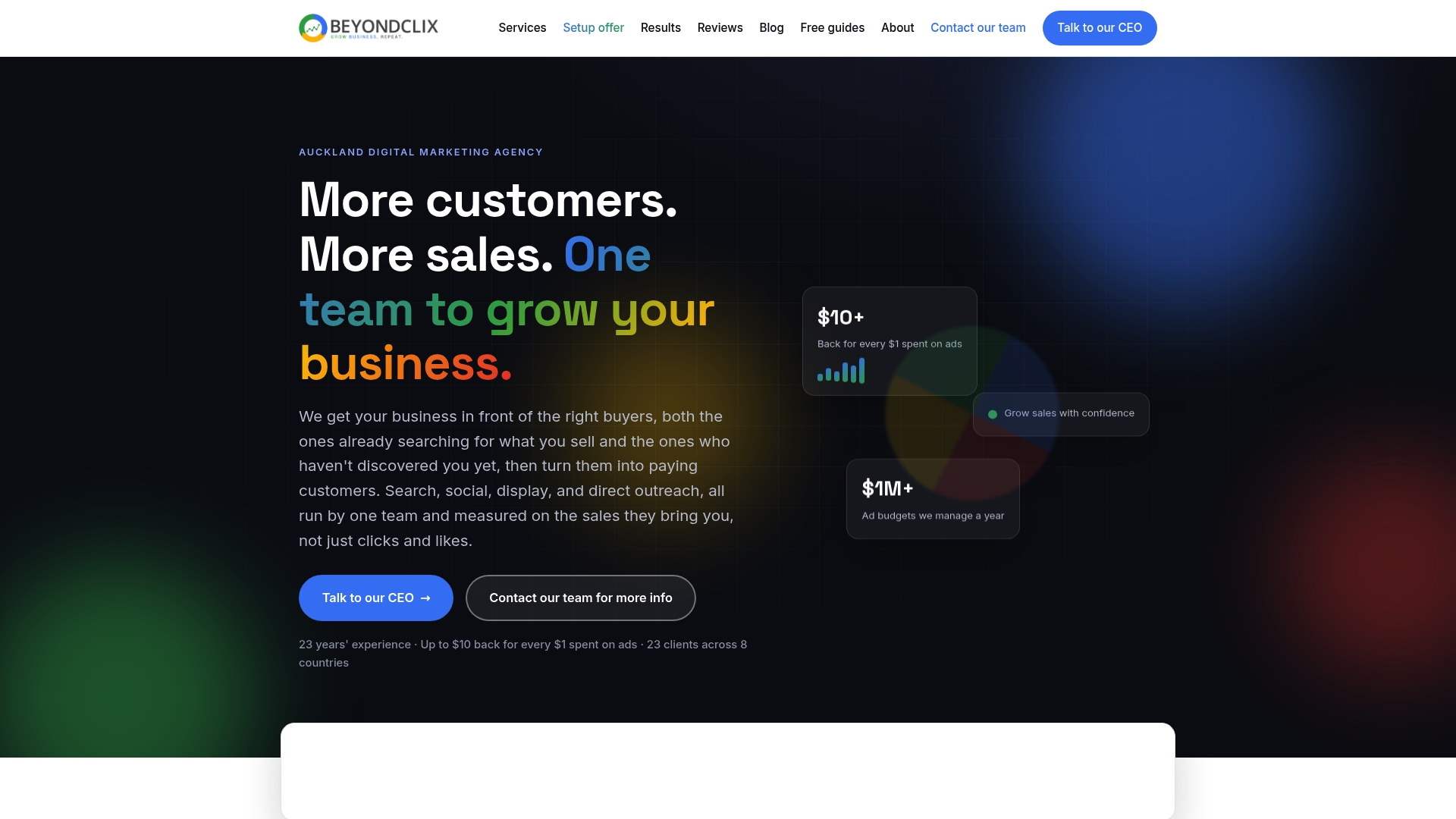
Campaigns have delivered up to 20x ROAS for NZ clients, with the first measurable KPI movement typically within 30 days of go-live. The full service scope covers every specialist type outlined in this article, so you are not managing six separate contractors or waiting months for a full team to be onboarded.
The practical next step is a PPC/SEO readiness assessment to establish your current baseline metrics, followed by a scoped pilot retainer with defined KPIs and a 90-day performance review. Contact Beyondclix to book a strategy call and get a clear picture of what an integrated team would cost and deliver for your specific business.
Useful sources
| Source | What it contains |
|---|---|
| Senior digital performance lead, Spruik® (Auckland) | NZ senior paid-media role with NZ$150,000 salary and attribution responsibilities |
| Growth-driven digital marketing specialist, The Creative Store | Mid-level NZ role with Meta Ads, Google Ads and TikTok Ads; NZ$65,000–$90,000 salary range |
| E-Commerce Lead, Everest People | NZ e-commerce lead role listing Shopify, GA4, Klaviyo and international storefront experience |
| e-commerce lead roles | NZ coordinator role with Klaviyo ownership, paid channel support and AI tooling |
| Digital growth strategy components, Beyondclix Blog | Sequencing and integration methodology for NZ integrated growth teams |
| What is a digital media plan?, Beyondclix Blog | Channel coordination, reporting cadence and media plan structure |
| Why digital marketing drives leads, Beyondclix Blog | Attribution methodology and lead quality evidence for NZ campaigns |
FAQ
What are the core types of digital marketing specialists?
The core specialist types are PPC/paid-media, SEO, paid social, content/social, email/CRM, analytics/CRO, e-commerce developer, creative/design, and strategy/account lead. Each owns a distinct KPI set and integrates with the others through a shared attribution model.
How long does it take to see results from a digital marketing specialist in NZ?
PPC and paid social specialists typically produce measurable results within 2–6 weeks. SEO takes 3–6 months for meaningful organic traffic gains. Analytics/CRO and email/CRM improvements usually show within 4–8 weeks of implementation.
Is it better to hire individual specialists or use an integrated agency?
For most established NZ businesses, an integrated agency retainer at NZ$3,000–$8,000 per month delivers faster results and lower total cost than hiring a senior in-house specialist at NZ$150,000 per year, because the agency provides the full specialist mix and coordination layer from day one.
What certifications should a digital marketing agency hold?
Look for Google Partner status, Meta Business Partner accreditation, and LinkedIn Marketing Partner credentials. These certifications confirm platform-level competency and are now considered baseline trust signals in the NZ market.
Can Beyondclix cover all specialist types under one retainer?
Yes. Beyondclix provides the full integrated specialist mix including Google Ads, Meta Ads, SEO, social media, email/CRM, analytics, and website development under a single retainer, with a strategy lead accountable for ROAS and CAC across all channels.
Recommended
- Why digital marketing drives leads for NZ businesses – BeyondClix Blog
- What is a digital media plan? Your 2026 guide – BeyondClix Blog
- Digital advertising formats for leads: your 2026 NZ guide – BeyondClix Blog
- Wezealor.com alternatives for NZ businesses in 2026 – BeyondClix Blog
Want this run for your business?
Talk to our CEO. We will show you where the money is leaking and what we would do about it.