
A digital media plan is a strategic, evidence-based document that defines how, where, when, and at what cost a brand deploys advertising across digital channels to achieve specific business outcomes. It is not a budget spreadsheet. It is not a list of platforms. It is a living framework that connects audience insights to channel decisions, channel decisions to budget allocations, and budget allocations to measurable results. If your campaigns feel scattered or your ad spend quietly leaks out the back with no clear return, the absence of a proper digital media strategy is usually the culprit.
What is a digital media plan and what does it contain?
A digital media plan sits between your broader marketing strategy and the actual execution of paid campaigns. The marketing strategy defines your overall direction, positioning, and messaging. The media plan translates that strategy into a specific, time-bound, budget-specific document for a particular campaign. Without that translation layer, media buying becomes guesswork.
The core components of a well-built plan include:
- Campaign objectives and KPIs: What does success look like? Define metrics such as cost per acquisition (CPA), return on ad spend (ROAS), click-through rate, or lead volume before a single dollar is committed.
- Target audience profiles: Demographic, psychographic, and behavioural data that describe exactly who you are trying to reach and when they are most receptive.
- Media channel mix: The combination of paid search, social, programmatic display, video, email, and other channels selected to match your audience’s behaviour.
- Budget allocations: How spend is distributed across channels, campaigns, and time periods, guided by performance benchmarks.
- Flighting schedule: The timing and pacing of campaign delivery, including burst periods, always-on activity, and seasonal adjustments.
- Creative asset roadmap: A documented list of all required ad formats, dimensions, and messaging variants to keep production on track.
Think of the plan as a decision document. Every choice in it should trace back to a business goal, not a platform preference.
Why digital media planning matters for your business

Campaigns that skip the planning phase tend to burn budget on the wrong audiences, at the wrong times, across channels that do not work together. Digital media planning solves this by mapping the who, what, when, where, and why of your advertising before any money moves.

The business case for planning is concrete. Multi-channel campaigns coordinated to business goals achieve significantly better purchase rates than single-channel campaigns. That gap exists because coordinated multi-channel plans guide prospects through a logical sequence of touchpoints, rather than hitting them with a single message and hoping for the best.
Key benefits of a structured digital media strategy:
- Better audience targeting reduces wasted impressions and lowers CPA.
- Coordinated channel sequencing builds brand familiarity before asking for a conversion.
- Pre-defined KPIs make performance reviews faster and more objective.
- Budget allocation guided by ROAS benchmarks prevents overspending on underperforming placements.
- Alignment with broader business goals keeps campaigns from drifting into purely tactical activity.
Pro Tip: Before you select a single channel, write down your audience’s top three pain points and the moments in their week when they are most likely to act. Channels are just levers. The audience insight is what makes them work.
Aligning your media plan with business strategy is not optional. Plans disconnected from strategic goals tend to optimise for vanity metrics rather than revenue.
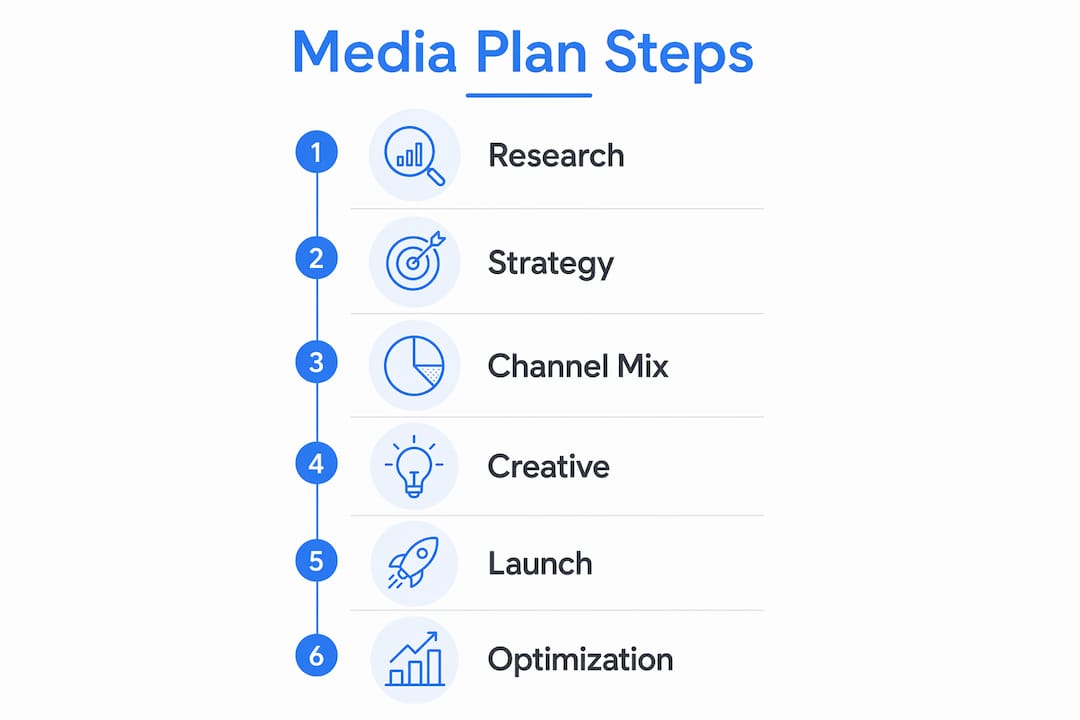
How to create a digital media plan: six key steps
Building a plan from scratch can feel like a lot of moving parts. Break it into six steps and it becomes a repeatable process.
Step-by-step process
-
Define SMART objectives and KPIs. Every plan starts with a clear answer to “what does success look like?” SMART goals are Specific, Measurable, Achievable, Relevant, and Time-bound. “Increase qualified leads by 30% in Q3” is a SMART goal. “Get more traffic” is not.
-
Research and segment your audience. Use first-party data, customer surveys, and platform audience insights to build profiles. Understand where your audience spends time online, what content they engage with, and what triggers a purchase decision. An audience-first approach consistently outperforms a platform-first one.
-
Select your media mix by funnel phase. Match channels to where your audience sits in the buying journey. Awareness channels (YouTube pre-roll, Meta prospecting) work differently from consideration channels (Google Search, retargeting display) and conversion channels (Shopping ads, email sequences).
-
Allocate budget using performance benchmarks. Distribute spend based on historical ROAS and CPA data, not gut feel. Assign a higher share to proven performers while reserving a test budget for new placements.
-
Build your flighting schedule. Decide when campaigns go live, how long each flight runs, and whether you need burst periods around key dates such as product launches or seasonal peaks.
-
Implement tracking before launch. Set up UTM parameters, conversion tags, and campaign analytics dashboards before the first ad serves. Real-time data is only useful if the tracking infrastructure is in place from day one.
Channel performance reference
| Channel | Primary funnel stage | Typical KPI | Best use case |
|---|---|---|---|
| Google Search | Consideration / conversion | CPA, ROAS | High-intent demand capture |
| Meta Ads | Awareness / consideration | CPM, CTR | Prospecting and retargeting |
| Programmatic display | Awareness | CPM, viewability | Broad reach and brand recall |
| YouTube / video | Awareness / consideration | View rate, CPV | Storytelling and product demos |
| Email marketing | Conversion / retention | Open rate, revenue per send | Nurturing warm leads |
| LinkedIn Ads | Consideration (B2B) | CPL, engagement rate | Professional audience targeting |
Must-have components checklist:
- Documented campaign objectives with numeric targets
- Audience personas with behavioural and demographic detail
- Channel mix mapped to funnel stages
- Budget breakdown by channel and flight period
- Creative asset list with formats and deadlines
- Tracking setup confirmed before launch date
What digital media looks like in New Zealand campaigns
New Zealand marketers work with a well-developed digital channel ecosystem. Understanding what each channel does, and where it fits in the user journey, is what separates a plan from a list of platforms.
Common digital media channels used in New Zealand:
- Search engine marketing (Google Ads): Captures high-intent demand from users actively searching for products or services. Google Ads sits at the conversion end of most plans.
- Social media advertising (Meta, LinkedIn, TikTok): Meta reaches broad consumer audiences across Facebook and Instagram. LinkedIn Ads targets professional and B2B segments effectively.
- Programmatic display: Automated ad buying across publisher networks, used primarily for awareness and retargeting.
- Video advertising: YouTube pre-roll and in-feed video ads build brand familiarity before audiences reach the search or social stage.
- Email marketing: Owned channel with strong conversion rates for warm audiences and existing customers.
- Influencer marketing: Growing in New Zealand, particularly for lifestyle, food, and consumer goods categories.
Each channel plays a distinct role. Channels must be orchestrated, not simply activated in parallel. A user who sees a YouTube ad, then a Meta retargeting ad, then a Google Search result is experiencing a designed sequence. That sequence is the plan working as intended.
| Channel | Funnel stage | Role | Message type |
|---|---|---|---|
| YouTube / video | Awareness | Generate attention | Brand story, product intro |
| Meta prospecting | Awareness / consideration | Build familiarity | Value proposition, social proof |
| Google Search | Consideration / conversion | Intercept demand | Direct response, offer |
| Programmatic retargeting | Consideration | Rebuild intent | Reminder, incentive |
| Conversion / retention | Close and retain | Personalised offer, follow-up |
Tips for getting more from your digital media plan
The biggest mistake marketers make is treating a media plan as a static document. You write it, launch the campaign, and revisit it at the end of the quarter. By then, budget has already been wasted on placements that stopped performing in week two.
Best practices for ongoing plan optimisation:
- Review performance dashboards weekly, not monthly. Real-time data lets you shift budget away from underperforming placements before the damage compounds.
- Treat reach and engagement metrics as complementary signals. High reach with low engagement usually means the audience targeting or creative needs adjustment.
- Coordinate creative assets across channels so the message feels consistent, even when the format changes.
- Map every channel to a specific funnel stage and a specific KPI. If a channel cannot be tied to a measurable outcome, question whether it belongs in the plan.
- Align the plan with your broader business calendar. A campaign that ignores a major product launch or a seasonal peak is leaving money on the table.
Pro Tip: Build your creative asset roadmap into the plan before you brief your design team. Document every ad format, size, and messaging variant required for each channel. Production bottlenecks are one of the most common reasons campaigns launch late or go live with placeholder creative.
The shift from “set and forget” to active weekly management is where most plans either earn their keep or quietly fail.
Common pitfalls in digital media planning and how to avoid them
Even experienced marketers fall into predictable traps. Knowing where plans typically break down is half the battle.
Treating the plan as a budget spreadsheet. A media plan that only tracks spend by channel misses the point entirely. The plan should map the user journey from unaware to converted, with each channel assigned a clear role in that sequence. Budget is an output of that thinking, not the starting point.
Skipping audience research. Jumping straight to channel selection without deep audience insight leads to generic targeting and wasted impressions. Spend time understanding your audience’s behaviour, pain points, and decision triggers before you open a single ad platform.
Siloed channel management. Running search, social, and display as separate campaigns with separate teams and separate KPIs produces disconnected experiences for the user. Channels need to work together, not compete for budget or credit.
Ignoring creative in the planning phase. Creative is half the campaign. Plans that treat creative as an afterthought, something to sort out after the media buy is confirmed, routinely launch late or with assets that do not match the channel’s format requirements.
No tracking infrastructure before launch. Launching a campaign without UTM parameters and conversion tags in place means you cannot attribute results accurately. Fix the tracking setup before the first ad serves, not after.
Over-committing to a plan that is not working. A plan is a starting hypothesis, not a contract. If the data shows a channel is not delivering against its KPI after a reasonable test period, reallocate the budget. Stubbornly sticking to the original plan because it took effort to write is a costly mistake.
Real-world digital media planning in New Zealand
New Zealand businesses operate in a market where digital ad spend is concentrated but competitive. A few patterns show up consistently in well-performing local campaigns.
A mid-sized New Zealand e-commerce retailer running a seasonal campaign will typically anchor the plan around Google Shopping and Search for conversion, use Meta prospecting to build awareness in the weeks before the peak period, and deploy retargeting display to recapture users who visited the site but did not purchase. The flighting schedule aligns with key retail dates, and the budget shifts toward conversion channels as the peak window approaches.
For a B2B services firm targeting procurement managers in Auckland and Wellington, the channel mix looks quite different. LinkedIn Ads carry the awareness and consideration load, targeting by job title and company size. Google Search captures branded and category searches from prospects who have already engaged with LinkedIn content. Email sequences nurture leads who have downloaded a resource or attended a webinar.
What both examples share is a deliberate sequence. Neither plan simply “runs ads.” Each one designs a path from first contact to conversion, assigns a channel to each stage, and measures the contribution of every touchpoint. That is what separates a digital media plan from a collection of ad campaigns. Beyondclix works with New Zealand businesses to build exactly this kind of integrated, results-focused approach across paid search, social, and analytics.
If you want to stop guessing and start running campaigns that actually connect strategy to results, get in touch with Beyondclix to build a plan built around your business goals.
Key takeaways
A digital media plan works when it connects audience insight, channel sequencing, and measurable KPIs into a single, actively managed framework rather than a static budget document.
| Point | Details |
|---|---|
| Definition and purpose | A digital media plan is a strategic document linking audience data, channel mix, budget, timing, and KPIs to specific business outcomes. |
| Multi-channel advantage | Campaigns coordinated to business goals achieve significantly better purchase rates than single-channel campaigns. |
| Audience before channels | Research your audience’s behaviour and pain points before selecting any platform or media mix. |
| Active management required | Review performance dashboards weekly and reallocate budget based on real-time data, not end-of-quarter reports. |
| Creative planning is part of the plan | Document all ad formats, sizes, and messaging variants in a creative asset roadmap before briefing your design team. |
FAQ
What is the meaning of digital media planning?
Digital media planning is the strategic process of deciding where, when, and how often to run digital advertising to reach a defined audience at the best possible return on investment. It translates marketing strategy into a specific, time-bound campaign plan before any budget is committed.
What is an example of digital media?
Digital media includes social media ads on Meta or LinkedIn, Google Search and Shopping ads, programmatic display banners, YouTube video ads, and email marketing. Each type serves a different role along the marketing funnel, from building awareness to driving conversions.
What is an example of a media plan?
A New Zealand e-commerce retailer might build a media plan that uses Meta prospecting for awareness in the four weeks before a sale, Google Shopping for conversion during the sale period, and retargeting display to recapture visitors who did not purchase. Each channel has a defined role, budget, and KPI.
How do you create a digital media plan?
Start by defining SMART campaign objectives and KPIs, then research your audience’s behaviour and segment them by funnel stage. Select a channel mix that matches those stages, allocate budget using ROAS and CPA benchmarks, build a flighting schedule, and set up tracking before launch.
Recommended
Want this run for your business?
Talk to our CEO. We will show you where the money is leaking and what we would do about it.