
Forecast digital marketing revenue impact by building from three ingredients: first-party CRM revenue data, a baseline model of historical performance, and three scenarios (best, base, worst) with confidence bands around each. Skip platform dashboards as your primary source. They report clicks and conversions, not the sales your finance team actually books.
- Inputs: CRM-matched revenue by channel, 12+ months of campaign spend, seasonality calendar
- Outputs: A base-case revenue projection, an upside and downside range, and a documented set of assumptions
- Validation: Holdout tests or incrementality experiments before you commit budget to the forecast
Buy-side marketers report up to 75% concern that current measurement approaches underperform on rigor and trust, which is exactly why the CRM link matters more than the platform number.
Pro Tip: Before you model anything, run a one-week data audit. Check your CRM match rates against ad platform data and flag any channel with unexplained gaps. A forecast built on a leaky CRM handshake will be wrong before you’ve written a single formula.
Key Takeaways
A credible digital marketing revenue forecast depends on first-party CRM data, a documented baseline model, and validated scenarios rather than platform-reported numbers.
| Point | Details |
|---|---|
| Start with CRM, not platforms | Reconcile ad platform conversions against CRM-confirmed revenue before trusting any ROAS figure. |
| Build three scenarios | Model best, base, and worst case, each with a stated assumption and confidence band. |
| Adjust for local seasonality | Factor in Christmas shutdowns, school holidays, and Matariki before finalising a baseline. |
| Validate before committing budget | Run holdout tests or incrementality experiments to confirm forecasted lift is real. |
| Consider a specialist for MMM | Beyondclix builds unified CRM-led forecasts with cross-channel adstocking and monthly finance reconciliation. |
Table of Contents
- Which forecasting method should you use?
- Data inputs and metrics you need before modelling
- Step-by-step forecasting workflow you can follow
- Practical modelling techniques and tools worth using
- How do you validate a revenue forecast?
- What mistakes wreck a digital marketing forecast?
- Quick forecast template and checklist you can copy
- How an agency structures a forecast: a short example
- Should you build the forecast yourself or bring in a specialist?
- If you need help forecasting revenue impact
- Sources
- FAQ
Which forecasting method should you use?
The right model depends on your sales cycle, data volume, and how fast you need an answer.
- Simple trend projection: Fast, low-effort, good for a sanity check or a small e-commerce store with limited historical spend variation.
- Regression modelling: Mid-effort, works well once you have 12+ months of consistent spend and revenue data across channels.
- Marketing Mix Modelling (MMM): Higher effort and cost, best suited to enterprise brands with long sales cycles and multiple overlapping channels. Local MMM guidance notes it works without cookies, using historical data to isolate channel contribution.
- Uplift or experiment-based testing: Slower to set up but the most defensible for lead-generation services that need to prove causation, not just correlation.
A mid-market e-commerce brand with steady spend usually gets more value from regression than from a full MMM build.
Data inputs and metrics you need before modelling
A forecast is only as credible as the data feeding it. Before you open a spreadsheet or a modelling tool, gather these sources:
- First-party CRM sales and revenue records, matched to marketing source where possible
- Campaign spend broken down by channel and month
- Server-side conversion logs (not just platform pixel data)
- Web analytics for session and funnel behaviour
- Pricing and promotions calendar, so discount periods don’t distort your baseline.
Then forecast against five metrics that actually matter to the business: revenue, conversions, customer acquisition cost (CAC), return on ad spend (ROAS), and customer lifetime value (LTV). Pipeline velocity matters too if you sell B2B with a longer consideration window.
Run a data quality checklist before you trust any of it: confirm matching keys between CRM and ad platforms line up, deduplicate contact records, align timestamps across systems (a lead logged Tuesday in your CRM but Wednesday in Meta’s dashboard will throw off attribution), and set a minimum sample size threshold. Nearly 48% of marketers admit they’re effectively guessing which channels drive pipeline. That statistic exists because most teams skip this step.
Step-by-step forecasting workflow you can follow
Run the forecast in this order, and don’t skip steps to save time:
- Define the objective and the revenue metric. Are you forecasting total revenue, net new customer revenue, or pipeline value?
- Audit and unify your data. Confirm CRM, ad platform, and analytics data all speak the same language.
- Build a baseline. Use 6 to 12 months of historical trend data as your starting point.
- Choose a model and fit it. Match the method to your resources, using the decision guide above.
- Create three scenarios. Best, base, and worst case, each with a stated assumption behind it.
- Run validation tests. Holdouts or incrementality tests before you present the numbers as fact.
- Present the forecast with confidence bands. Never hand over a single number with no range.
For a quick gut-check, use this formula: incremental revenue = baseline revenue × incremental lift %. If your baseline monthly revenue is $50,000 and your test shows a 10% incremental lift from a new channel, that’s $5,000 in additional monthly revenue, before you account for the CAC required to generate it.
Pro Tip: To fold CAC and LTV into a revenue projection, divide projected new customers by CAC to check spend efficiency, then multiply new customers by LTV to see the full revenue arc, not just the first transaction.

A scenario example: if your base case assumes a 5% uplift from a new campaign, your best case might model 15% uplift at the same spend level, and your worst case might model 5% uplift at 20% higher spend (accounting for rising CPCs). Map each to expected ROAS so stakeholders see the trade-off, not just the top-line revenue number.
Practical modelling techniques and tools worth using
You don’t need enterprise software to build a defensible forecast. Match the tool to your team’s size and skill.
- Small teams: Spreadsheets plus SQL queries against your CRM database cover simple time-series regression and adstocked regression (which accounts for diminishing returns as spend increases).
- Mid-market: R or Python with open-source MMM libraries give you more modelling flexibility without enterprise licensing costs.
- Enterprise: Cloud modelling platforms handle ensemble approaches, combining MMM, regression, and uplift testing into one view.
AI tools are starting to make omnichannel lift testing more accessible, and buy-side teams expect measurement frequency to increase two to three times over the next year or two. That upside comes with a governance cost.
Pro Tip: Document every assumption, model version, and data transformation as you go. The IAB has flagged black-box modelling as a genuine risk. A forecast nobody can explain six months later is a forecast nobody will trust.
How do you validate a revenue forecast?
A forecast without validation is a guess with better formatting. Test it properly:
- Run holdout groups or geo-based incrementality tests wherever your budget and traffic allow.
- Track the resulting lift back to CRM revenue, not platform-reported conversions.
- Back-test monthly against closed CRM revenue and update your model’s assumptions as new data comes in.
Always present forecasts with sensitivity bands attached, alongside a plain-language statement of what you assumed. Given that 85% of marketers say proving ROI is now the industry’s central focus, a forecast without a validation trail won’t survive a budget conversation.
What mistakes wreck a digital marketing forecast?
Most forecasting failures trace back to a handful of repeat offenders:
- Trusting platform-reported ROAS instead of reconciling it against CRM-confirmed revenue.
- Ignoring local calendar effects. Christmas shutdowns, school holidays, and Matariki all skew baseline demand if you don’t adjust for them.
- Overfitting a model to a small sample, then presenting the output with false precision.
- Failing to write down assumptions, so nobody can tell why last quarter’s forecast missed.
Quick forecast template and checklist you can copy
Build this straight into a spreadsheet:
- Baseline period: pick 6 to 12 months of clean historical data
- Columns: month, channel spend, CRM revenue, conversions, CAC, ROAS
- Scenario cells: baseline revenue × lift % for best, base, and worst case
Before you trust the output, confirm: data audit passed, minimum sample size met, assumptions documented in a visible tab, and a validation test scheduled on the calendar. A practical ROI calculator is a fast way to sanity-check channel-level numbers before you build the full model.
How an agency structures a forecast: a short example
Beyondclix approaches forecasting the same way: start with a single source of truth. That means unifying CRM revenue, ad spend, and analytics into one dataset before any modelling begins, then attributing revenue back to CRM-confirmed sales rather than platform-reported conversions.
- Cross-channel adstocking to account for diminishing returns per channel
- Scenario modelling paired with an incrementality test to confirm the lift is real
- Documented assumptions at every stage, so the model survives staff turnover
- Monthly reconciliation against finance, not just marketing dashboards
Should you build the forecast yourself or bring in a specialist?
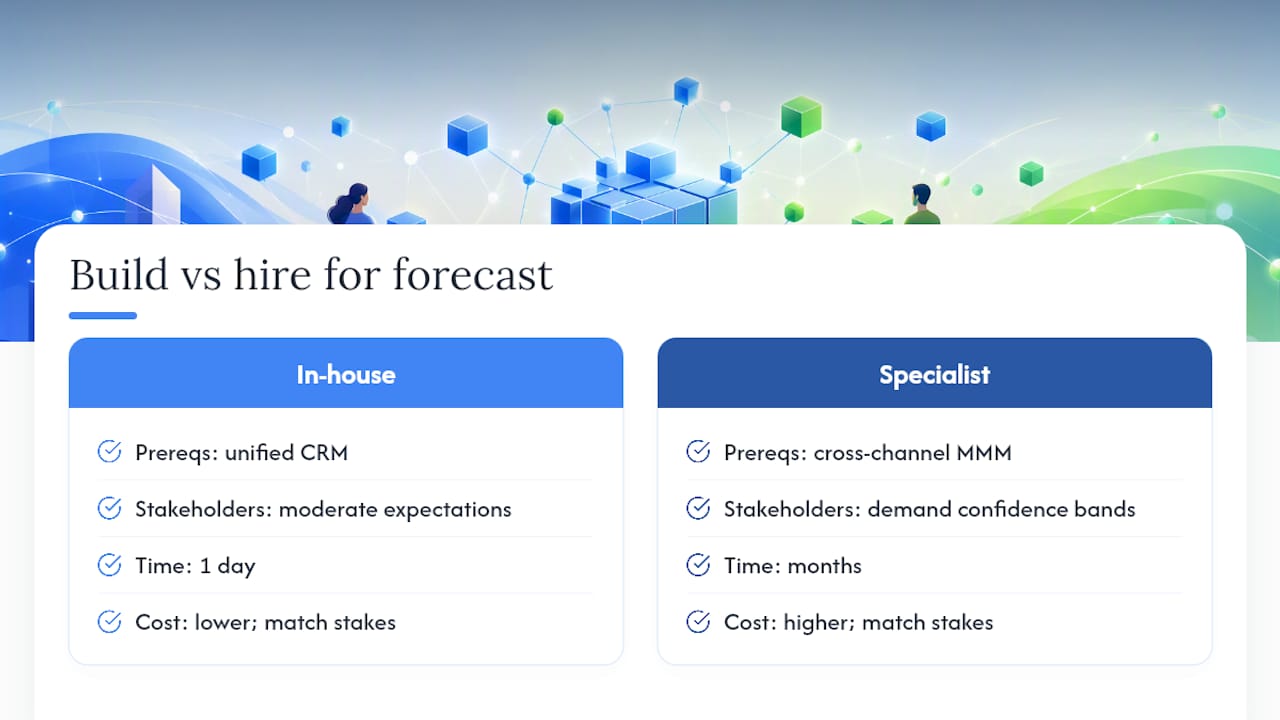
Handle it in-house if you have unified CRM data and moderate stakeholder expectations. Bring in a specialist when stakeholders demand formal confidence bands, or when cross-channel MMM is genuinely required. A DIY trend projection takes a day; a proper MMM engagement runs months, and the cost difference should match the stakes riding on the number.
If you need help forecasting revenue impact
There’s a real gap between a spreadsheet projection and a forecast finance will actually sign off on, and closing that gap usually means unifying data most teams have never connected. Beyondclix works with established businesses and e-commerce stores to build exactly that connective layer: CRM integration, cross-channel data ingestion, and monthly reconciliation, so your forecast reflects revenue that actually landed in the bank, not clicks a platform decided to credit itself.

The scope typically covers data integration between your CRM and ad platforms, MMM and uplift testing to validate what’s actually driving lift, and ongoing dashboarding so the forecast updates as new data comes in rather than going stale after month one. Beyondclix structures engagements around outcomes, not a fixed list of deliverables, combining channel management and analytics under one roof so nobody’s forecast depends on stitching together three vendors’ worth of half-matching data. If your CRM and ad accounts have never properly talked to each other, that’s the first thing worth fixing. Start with a look at Beyondclix’s services to see where a forecasting engagement would begin for your business.
Sources
FAQ
What data do I need to forecast digital marketing revenue impact?
You need first-party CRM revenue matched to channel spend, server-side conversion logs, and at least 6 to 12 months of historical data to build a credible baseline.
Which forecasting model is best for a small e-commerce store?
Simple trend projection or regression modelling usually suits smaller stores better than a full MMM build, given the lower data volume and faster turnaround needed.
How do I validate a marketing revenue forecast?
Run holdout groups or incrementality tests, then back-test the resulting lift against CRM-confirmed revenue on a monthly basis to update your assumptions.
Why shouldn’t I trust platform-reported ROAS on its own?
Platform dashboards report their own attributed conversions, which routinely overstate impact compared to revenue actually confirmed in your CRM.
When should I bring in a specialist like Beyondclix for forecasting?
Bring in a specialist when you lack unified CRM data, stakeholders demand formal confidence bands, or the project requires cross-channel MMM that in-house teams don’t have the tooling to run.
Recommended
- Connect marketing spend to revenue in three steps – BeyondClix Blog | Digital Marketing Insights
- Media mix modelling for marketers: measure channel impact and optimise budgets – BeyondClix Blog | Digital Marketing Insights
Want this run for your business?
Talk to our team. We will show you where the money is leaking and what we would do about it.