
B2B demand generation is a data-driven, full-funnel engine that builds brand authority and converts it into pipeline. It’s not a campaign, and it’s not a lead form. It’s the combined work of creating demand where none existed and capturing it the moment a buyer starts looking.
Three things to do before you read another word: audit what’s actually contributing to pipeline right now (not just what’s generating form fills), confirm your ideal customer profile and target account list are current, and agree an SLA with sales that spells out follow-up times and lead acceptance criteria. Then pick one demand-capture pilot (a bottom-funnel offer like a pricing calculator or ROI tool) and one demand-creation pilot (a LinkedIn thought-leadership series or a webinar). Gartner’s research found 61% of B2B buyers now prefer a rep-free buying experience, which tells you why the capture side of that pilot matters as much as the creation side. Agencies running integrated programmes, Beyondclix included, treat these two motions as one system rather than two departments fighting for budget.
Key Takeaways
Effective B2B demand generation requires balancing demand creation and demand capture, wiring measurement to pipeline from day one, and giving programmes 6 to 12 months to show meaningful results.
| Point | Details |
|---|---|
| Define before you tactic | Separate demand creation (building awareness) from demand capture (converting existing intent) before choosing channels. |
| Build the SLA first | Agree lead acceptance criteria and follow-up times with sales before scaling any campaign. |
| Prioritise pipeline metrics | Track pipeline contribution and account engagement rate over raw MQL volume. |
| Set a realistic timeline | Expect early signal at 3 to 6 months and meaningful pipeline impact closer to 6 to 12 months. |
| Run it as one system | Beyondclix manages paid media, SEO, CRM and analytics together so demand creation and capture reinforce each other rather than compete for budget. |
Table of Contents
- What is B2B demand generation and how is it different from lead generation?
- How do you build a full-funnel demand generation framework?
- Which channels actually drive B2B pipeline in 2026?
- What technology and data infrastructure does demand generation need?
- Which KPIs actually prove demand generation is working?
- How do you build a demand generation programme from scratch?
- What separates working programmes from wasted budget?
- How does Beyondclix run demand generation for clients?
- Sources
What is B2B demand generation and how is it different from lead generation?
Demand creation is the work of making a market aware it has a problem and that your category solves it, before anyone has typed a search query. Demand capture is what happens next: turning people who are already looking into pipeline. Most B2B teams only budget for capture, which is why so many programmes stall the moment paid search costs rise.
The distinction matters because demand gen and B2B lead generation optimise for different things entirely.
- Goal: Demand generation builds category awareness and trust over months; lead generation converts existing intent into a named contact today.
- Timeframe: Demand gen plays out over quarters and years; lead gen is measured campaign by campaign.
- Content gate strategy: Demand gen tends to give away its best thinking ungated to build reach; lead gen gates offers behind a form to capture contact details.
Gated content that sits at the top of the funnel is one of the most common demand generation mistakes. If a buyer isn’t ready to talk to sales, forcing an email address in exchange for a blog post kills the reach you needed to build awareness in the first place.
| Demand generation | Lead generation |
|---|---|
| Builds awareness before intent exists | Captures contacts who already show intent |
| Measured on pipeline influence, brand search | Measured on form fills, cost per lead |
| Content mostly ungated | Content often gated |
Salesforce’s framework treats demand generation as the umbrella strategy and lead generation as one tactic inside it, reporting that 83% of marketers using integrated demand gen say they have clear visibility into their pipeline impact. That visibility is the entire point: demand gen without measurement is just brand marketing with better slides.
How do you build a full-funnel demand generation framework?
Four pillars carry a full-funnel programme: awareness, engagement and nurture, capture, and validation. Awareness work (thought leadership, organic content, paid social) meets buyers before they know your name. Engagement and nurture keeps warming people who aren’t ready to buy. Capture converts active intent into a sales conversation. Validation, the pillar most teams skip, gives late-stage buyers the proof (case studies, ROI calculators, peer reviews) they need to justify the purchase internally.
Mapping these pillars to a real buying group means going beyond the single “buyer persona” most teams still use. B2B deals close through committees, and each stakeholder needs different content.
- List every role likely to touch the deal: economic buyer, technical evaluator, end user, procurement, and often a champion who has no formal authority but plenty of influence.
- Assign each role a content need: the economic buyer wants ROI proof, the technical evaluator wants integration detail, procurement wants pricing transparency.
- Flag which roles show up early (technical evaluator) versus late (procurement) so nurture sequencing matches reality.
Not every signal deserves a sales handoff. Explicit signals, a demo request, a visit to the pricing page, a free trial signup, should route to sales within your agreed SLA window. Behavioural signals, repeat visits from a target account, multiple stakeholders engaging with content, or intent data showing research on competitor terms, belong in a nurture or ABM track until they cross an explicit threshold.
Pro Tip: Build your handoff criteria around observed behaviour, not marketing’s internal scoring model alone. A sales team that gets three “hot” leads a week that go nowhere will stop trusting your funnel within a month, no matter how good the campaigns behind it are.
Which channels actually drive B2B pipeline in 2026?
The channel mix hasn’t changed as much as the execution has. What separates a channel that creates demand from one that captures it is the objective you assign it, not the platform itself.
LinkedIn (organic and ads) does both jobs depending on format. Organic thought-leadership posts from founders and subject-matter experts build awareness cheaply; LinkedIn’s ad platform, especially Conversation Ads and Document Ads, captures intent from people already engaging with your content. Beyondclix’s LinkedIn ads strategy guide walks through targeting by job title, company size and account list, which matters more on LinkedIn than almost any other paid channel because the audience data is so precise.
Google Ads (search and display) remains the sharpest demand-capture tool available. Search ads intercept people actively typing solution-aware queries; display and YouTube extend reach for demand creation when layered with in-market and affinity audiences. Beyondclix’s guide to digital advertising formats breaks down which formats suit which funnel stage.
Content and SEO is the slowest channel to compound and the hardest to kill once it’s working. Comparison pages, buyer’s-guide content, and problem-aware blog posts capture people mid-research; category-education content and original data builds long-term authority. Beyondclix’s content marketing guide covers how content and paid work together rather than competing for budget.
Webinars and virtual events still convert well for complex B2B products because they let a prospect self-select into a room full of peers with the same problem. Run them for engagement and validation, not top-of-funnel awareness. Email nurture is where most of that webinar audience gets warmed over the following weeks, using behavioural triggers rather than a single blast.
ABM and programmatic for target account lists flips the funnel: instead of broad reach, you pick the accounts first and build every tactic (ads, content, outreach) around them. Abmatic AI’s framework recommends tiering accounts, Tier 1 gets personalised ABM, Tier 2 gets programmatic ABM, Tier 3 gets broad lead gen, so budget scales with deal size rather than spreading evenly.
Partner co-marketing, short-form video, and community or “dark social” channels round out a modern mix. Partner webinars borrow someone else’s audience. Short-form video, particularly on LinkedIn native video, gets disproportionate organic reach right now. Dark social, private Slack communities, forwarded newsletters, LinkedIn DMs, is invisible in most attribution tools but drives real referral traffic; ask new leads how they heard about you and you’ll often find channels your dashboard never credited.
Two quick play examples:
- Demand creation play: Publish an original research report on a topic your ICP argues about internally. Promote it organically on LinkedIn for four weeks before running any paid spend behind it, then retarget engagers with a Conversation Ad inviting them to a related webinar.
- Demand capture play: Run Google Search ads against high-intent, solution-aware keywords, landing on a page with a pricing calculator or ROI tool rather than a generic contact form, since Gartner’s data shows most buyers want to self-serve as far into evaluation as possible.
Pro Tip: *Match your CTA to the funnel stage.
What technology and data infrastructure does demand generation need?
The minimum stack covers four functions: a CMS with basic SEO capability, a CRM to hold contact and account records, an ad platform account for LinkedIn and Google, and an analytics tool to see what’s converting. That’s enough to run a lean demand-capture programme.
A recommended stack adds marketing automation (HubSpot is the common example for mid-market teams) integrated with a CRM (Salesforce is the standard for larger sales organisations), intent data to spot in-market accounts before they visit your site, and server-side or Conversions API tracking to keep attribution intact as browser-based cookies keep degrading. Beyondclix’s CRM and lead nurturing service exists specifically because most mid-market teams have a CRM but no automation logic connecting it to marketing activity.
The data flow itself is simple to describe and hard to execute: a visitor hits your site, gets tracked into a CDP or marketing automation platform, that record syncs to the CRM once they take a meaningful action, and analytics ties the whole chain back to revenue. The failure point is almost always hygiene. De-duplicate contact records regularly, normalise company names so “Acme Corp” and “Acme Corporation” don’t split into two accounts, and append firmographic data so lead scoring has something real to work with. MuleSoft’s case studies show how much of this breaks down without proper integration between systems that were never designed to talk to each other.
Consent and first-party data aren’t a compliance afterthought anymore, they’re the attribution model. As third-party cookies keep disappearing, the accounts and contacts who’ve explicitly opted in are the only ones you can reliably track from first touch to closed deal.
Which KPIs actually prove demand generation is working?
Pipeline contribution is the number that ends budget arguments. Everything else supports it: account engagement rate, MQL-to-SQL-to-opportunity conversion, cost per acquisition, deal velocity, and win rate specifically for accounts your programme influenced. Industry guidance now recommends shifting away from raw MQL volume toward pipeline-influenced and account engagement metrics, because volume alone rewards low-quality leads that never close.
Attribution rarely needs to be perfect to be useful. Multi-touch models that weight first-touch and last-touch more heavily than middle-funnel touches give a reasonable approximation without a data science team. If you don’t have the infrastructure for full multi-touch attribution yet, track brand search volume alongside pipeline-influenced revenue as a practical shortcut, ZoomInfo notes this pairing correlates well with genuine demand generation, since rising branded search usually means your top-of-funnel work is landing.
None of this works without a written SLA between marketing and sales.
A working SLA states, in writing: sales will follow up on a marketing-qualified lead within one business day, leads must meet defined acceptance criteria (role, company size, engagement threshold) before routing, and sales reports disposition (contacted, disqualified, opportunity created) back to marketing within a set window so the feedback loop actually closes.
How do you build a demand generation programme from scratch?
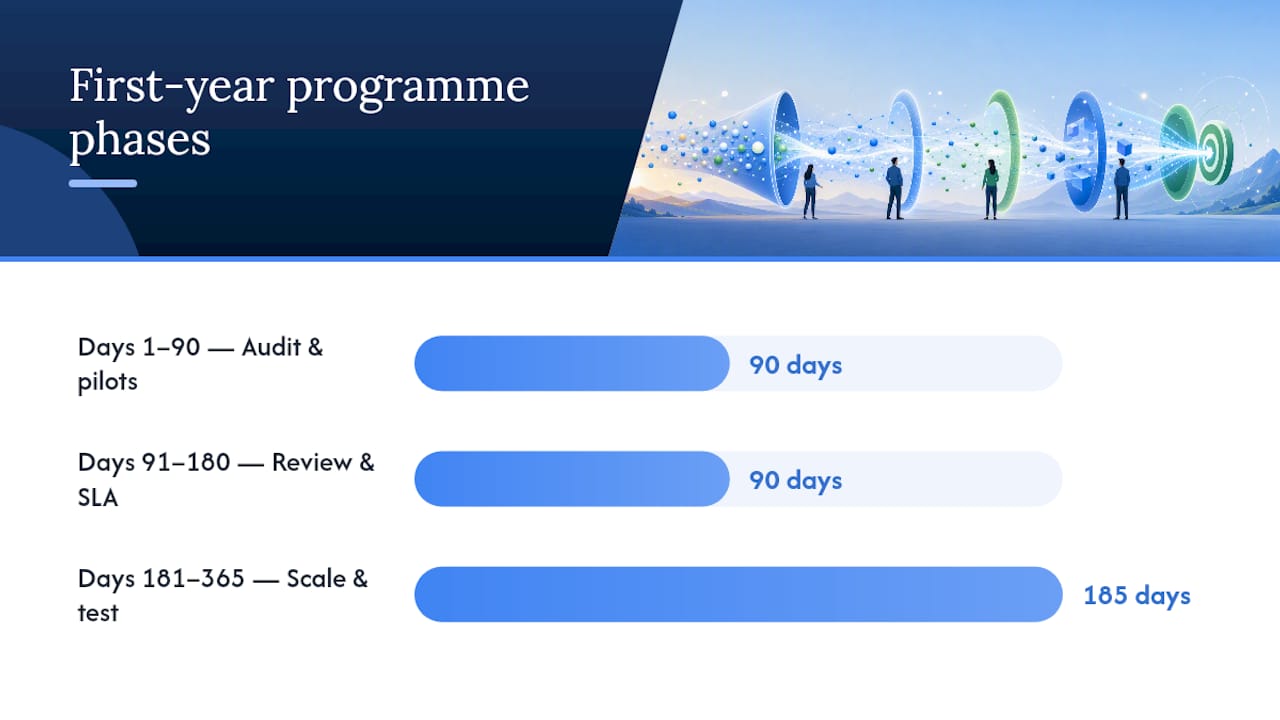
Treat the first year as three phases, not one long campaign.
- Days 1 to 90: Audit existing pipeline sources to see what’s actually working today. Confirm or rebuild your ICP and target account list. Launch one demand-creation pilot and one demand-capture pilot, small enough to learn from quickly. Wire up basic tracking so you know which channel touched which deal.
- Days 91 to 180: Review pilot results against pipeline contribution, not just clicks or form fills. Kill what didn’t work, double down on what did. Build the SLA with sales if you haven’t already, and start reporting pipeline-influenced revenue monthly rather than lead volume.
- Days 181 to 365: Scale the channels that proved out, layer in account tiering for your highest-value prospects, and start testing adjacent channels (partner co-marketing, short-form video) with the budget freed up from cutting underperformers.
Every campaign inside that roadmap needs the same readiness checklist before it launches: a clear objective (create or capture demand), a defined audience, creative built for the format, an offer matched to funnel stage, a landing page that doesn’t force friction the offer hasn’t earned, tracking confirmed before spend goes live, an SLA for any leads it generates, and a reporting cadence agreed in advance.
Scaling decisions should follow evidence, not enthusiasm. Increase spend when cost per pipeline dollar is trending down over at least two reporting cycles. Add headcount when campaign volume outstrips your team’s ability to build creative or follow up on leads within SLA. Add a new channel only after your current channels are optimised, chasing a fifth channel while your best-performing one is under-resourced is one of the most common ways budget disappears without a trace.
Pro Tip: Run a simple A/B test matrix for every new channel pilot: test one variable at a time (offer, creative, audience) against a control, and give it enough budget to reach statistical relevance before you judge it. Beyondclix’s PPC and SEO questionnaire is a useful discovery tool if you’re trying to work out where your current programme has gaps before you start testing.
What separates working programmes from wasted budget?
Alignment with sales beats almost every other variable. Programmes that skip a shared SLA generate leads sales ignores, which quietly kills marketing’s credibility for the next planning cycle. Quality over volume matters just as much: a smaller list of well-targeted accounts converts at a far higher rate than a broad list padded to look impressive in a board deck. Over-gating top-funnel content chokes reach before it starts, and messy CRM data (duplicate records, missing firmographics) breaks lead scoring no matter how good the campaigns feeding it are.
Set expectations early. At three months, expect pilot data and early signal, not pipeline. At six months, expect a clearer read on which channels are working. ZoomInfo’s research puts the six-to-twelve month mark as the realistic window for demand generation to show measurable pipeline impact, and by twelve months you should have enough data to defend or reallocate next year’s budget with confidence.
How does Beyondclix run demand generation for clients?
The process starts with discovery: a deep look at current pipeline sources, existing tech stack, and where the biggest gaps sit between marketing activity and closed revenue. From there, Beyondclix builds or refines the ICP and target account list before touching creative, because targeting decisions made too late waste every dollar spent afterward. Channel and creative design follows, matched to whichever pilot the data suggests will move fastest, then a measurement layer gets wired in before spend scales.
- Discovery and audit of current pipeline contribution and tech stack
- ICP and target account list confirmation, followed by creative and channel design
- Pilot launch, measurement wiring, then scale decisions based on pipeline data
Engagements typically run as a retainer once the initial diagnostic and pilot phase confirms direction, though project-based scopes suit teams that need a specific gap filled, an analytics and tracking rebuild, for example, without a longer commitment.
Beyondclix’s proof points include campaigns achieving up to 20x return on ad spend in rapid campaign results, the kind of outcome that only shows up when demand capture and demand creation are managed as one system rather than two separate budgets.
What I’d tell a CMO weighing ABM against broad demand creation
The false choice most teams make is picking ABM or broad demand generation, when the answer is almost always both, split by account tier. I’ve seen more budget wasted chasing perfect attribution than lost to imperfect measurement; a rough multi-touch model shipped this quarter beats a perfect one still being built next year. And the teams that win consistently invest in content before they scale paid, because paid amplifies what already works and does very little for an offer nobody’s proven yet.
Get a diagnostic before you commit budget to guesswork
Running demand creation and demand capture through separate teams, separate dashboards, and separate budgets is the single biggest reason B2B programmes stall before they prove pipeline impact. Beyondclix operates as one unit across paid media, SEO, CRM and analytics, so a LinkedIn campaign, a Google Ads account, and your CRM’s lead scoring are all built to talk to each other from day one instead of getting reconciled in a spreadsheet three months later.
The engagement starts with a short diagnostic that maps your current pipeline sources against the services most likely to close the gap, whether that’s a LinkedIn ads rebuild, an SEO foundation, or CRM automation that finally connects marketing activity to closed revenue. From there it moves into a pilot on one or two channels before scaling spend, the same 90/180/365 approach outlined earlier in this article, run with a team that’s already built the tracking to prove what’s working. If you want an estimate of what a properly wired demand generation programme could do for your pipeline, get in touch with Beyondclix and ask for that diagnostic directly.
Sources
For deeper study, Salesforce’s overview of demand generation strategy and metrics covers pipeline alignment in more depth, while HubSpot’s FAQ guide is useful for channel-level tactics. Gartner’s research on rep-free buying explains the shift toward self-serve content, and Leadfeeder’s 95:5 rule breakdown is worth reading before setting intent data strategy. For BeyondClix-specific execution guides, see the LinkedIn ads strategy and services overview pages.
- What Is B2B Demand Generation? Strategy, Tactics & Metrics
- Gartner sales survey: 61 percent of B2B buyers prefer a rep‑free buying experience
- Demand Generation vs. Lead Generation
FAQ
What does B2B demand generation mean?
It’s the full-funnel strategy of building market awareness for a problem your product solves, then converting that awareness into measurable pipeline, combining both demand creation and demand capture rather than just running lead-gen campaigns.
What does “B2B demand” mean?
B2B demand refers to the level of active or latent need among business buyers for a category of product or service, whether or not they’re currently searching for a solution.
What is B2B SaaS demand generation?
It applies the same full-funnel principles, content, paid social, search, nurture, to software buyers specifically, usually with heavier emphasis on free trials, product-led growth signals, and self-serve pricing pages given how many SaaS buyers now prefer to evaluate without a sales rep.
What is the rule of 7 in B2B?
The rule of 7 is a marketing principle suggesting a prospect typically needs multiple meaningful exposures to a brand before they’re ready to engage or buy. It’s a rough heuristic rather than a proven fixed number, but it underscores why demand generation depends on sustained, repeated presence rather than a single campaign.
How is demand generation different from B2B lead generation?
Demand generation builds long-term category awareness and trust, often with ungated content; lead generation focuses on converting existing intent into named contacts, usually through gated offers. Most effective programmes, including those Beyondclix runs for clients, treat lead generation as one tactic inside a broader demand generation strategy rather than the whole strategy itself.
Recommended
- LinkedIn ads strategy for NZ B2B marketers – BeyondClix Blog | Digital Marketing Insights
- Digital advertising formats for leads: your 2026 NZ guide – BeyondClix Blog
Want this run for your business?
Talk to our team. We will show you where the money is leaking and what we would do about it.