

If your Google Ads costs looked a little different this month, or your website traffic wobbled in the middle of November, you’re not imagining it. Google made two changes in the past three weeks that touch almost every New Zealand business that advertises on Google or relies on being found there. Neither one needs you to panic. Both are worth ten minutes of your attention before the Christmas rush.
The first: on 28 October 2026, Google announced that its ads now appear inside its AI search answers in New Zealand, not just around them. The second: on 10 November 2026 (US time), Google started rolling out a “core update”, a broad change to how it ranks websites in normal search results. This post explains both in plain words, tells you whether you should care, and lists the five things worth doing before Black Friday on 27 November.
Change 1: your Google ads can now show inside AI answers
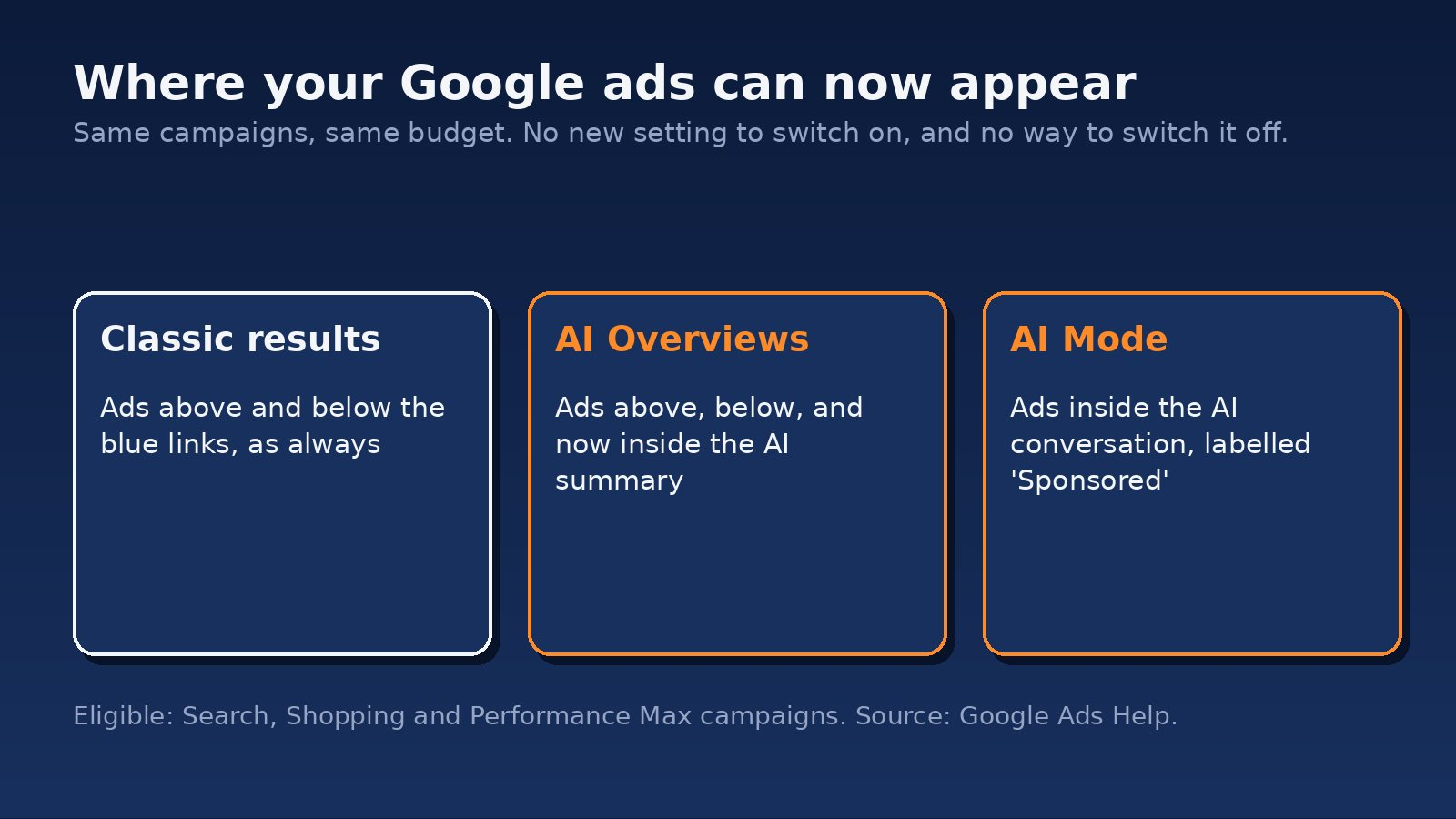
Quick background. Google now gives many searchers an AI-written answer before the usual list of websites. There are two versions. AI Overviews are the short summaries that appear at the top of normal search results. AI Mode is a separate, chat-style search where people ask a full question and can keep asking follow-ups.
Until now, New Zealand advertisers could only appear around those answers. That has changed. In a post titled “Ads in AI Mode expand to new markets”, published 28 October 2026, Shashi Thakur, Google’s VP and GM of Search Ads, named ten countries where ads in AI Mode are now scaling: Australia, Canada, India, Kenya, Malaysia, New Zealand, Nigeria, Pakistan, the Philippines and Singapore. Google’s own help page on ads in AI-powered search now lists New Zealand among the countries where ads can appear within both AI Overviews and AI Mode, in English. The ads carry a “Sponsored” label.
What it means for your account
Here’s the part most business owners won’t hear from Google directly. According to that same help page:
- You’re already in. Existing Search, Shopping and Performance Max campaigns are automatically eligible. There’s no new campaign to build and no separate budget.
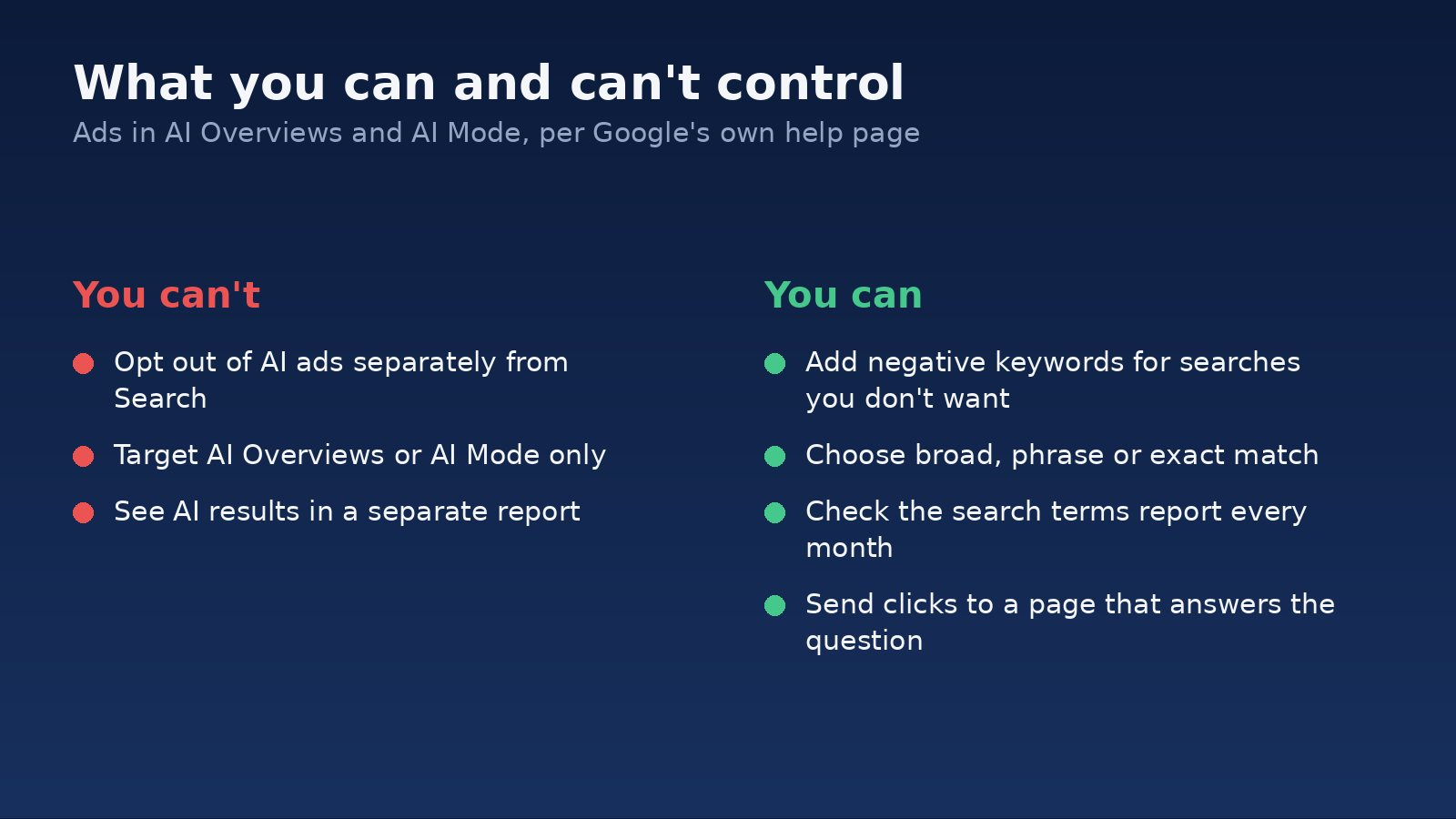
- You can’t opt out on its own. Google says you can’t target ads only at AI Overviews or AI Mode, or opt out of showing in them separately from Search. If you run Search ads, you’re in.
- You can’t see it separately. Results from AI placements are rolled into your normal campaign reports, and the searches that triggered them appear in your search terms report alongside everything else.
- Your keyword settings decide how far it reaches. Broad match keywords and Google’s AI Max for Search setting can match against both the person’s question and the AI’s answer. Exact and phrase match keywords only qualify when the question shows clear buying intent.
That last point matters most. If your campaigns lean on broad match, your ads can now be matched to longer, chattier questions, some of them people who are researching rather than ready to buy. That’s not automatically bad. It does mean your money could be going to a different kind of search than it was in September, and the standard reports won’t flag it.
Why Google is doing this
Google said why on its 28 October results call. Chief Business Officer Philipp Schindler told investors that strong growth in AI Mode use had weighed on revenue “because of the lower monetization we were seeing in AI Mode”, and that Google is now scaling ads within AI Overviews and AI Mode “to more users and more queries” (Alphabet Q3 2026 earnings call transcript). Google Search and other advertising revenue still grew 12% to US$63.3 billion for the quarter.
In plain terms: people are using the AI answers more, Google earns less from them, so ads are moving in. That’s the direction of travel, and it won’t reverse.
Should you care?
Yes, a little, and mostly about where your money goes. Google says its research shows people find these ads relevant, and that click-through rates are already similar between sponsored and organic product listings inside AI Mode. That claim comes from Google’s own US data from August and September 2026, so treat it as Google’s view of its own product rather than independent proof. Nobody outside Google has New Zealand results yet.
The practical risk isn’t that AI placements are bad. It’s that your spend shifts without you noticing, because nothing in your reports separates it out. The fix is the same housekeeping a good account already gets, done more often. More on that below.
What’s coming next
Google is also launching “multiturn” ads in the US, which can appear on follow-up questions in an AI Mode conversation, not just the first one. That’s US-only for now. Google says it plans to bring AI Mode ads to more countries, including Brazil, Mexico and the United Kingdom, later this quarter. If multiturn ads follow the same path as AI Mode ads, expect them here eventually. We’ll write about it when Google confirms it.
Change 2: the November core update
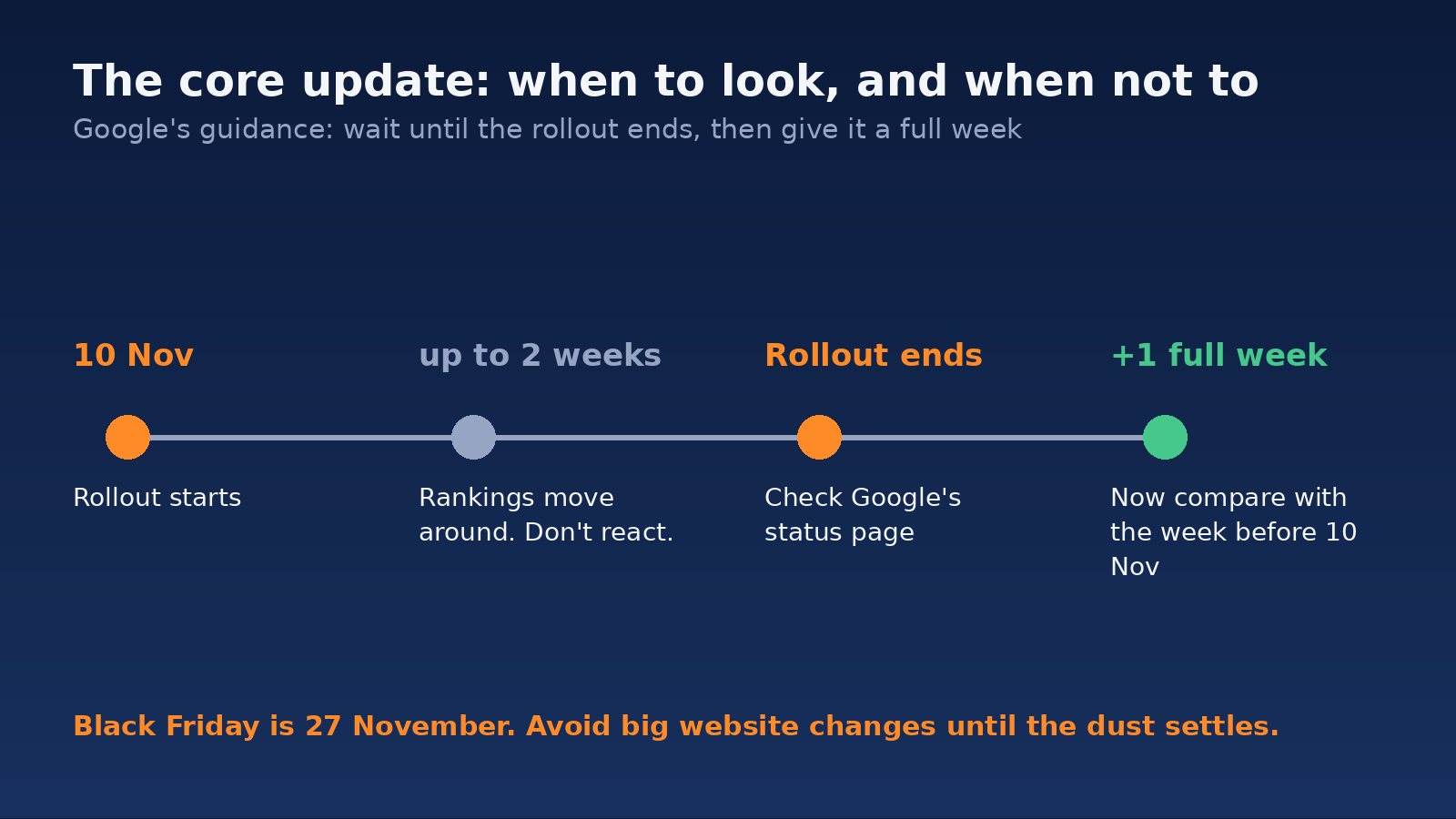
The second change has nothing to do with ads. On 10 November 2026, Google posted on its Search Status Dashboard: “Released the November 2026 core update, which applies globally and to all languages. The rollout may take up to 2 weeks to complete.”
A core update is Google re-weighing how it judges which pages best answer a search. Google runs several a year. This is the third core update of 2026, after March and May. During the rollout, rankings move around, sometimes a lot, and then settle. If your organic traffic or enquiries jumped or dipped from mid-November, this is the most likely reason.
What Google says to do if your traffic dropped
Google publishes plain guidance on core updates, and it’s sensible:
- Wait until the rollout finishes. Check the Search Status Dashboard for the end date before drawing conclusions.
- Then wait at least a full week, and compare that week with the week before the update began. Comparing mid-rollout numbers tells you very little.
- Small drop? Usually do nothing. Google specifically warns against rushing to change content that’s already performing well.
- Big, lasting drop? Review the whole site honestly, starting with the pages that lost the most. Google calls deleting content “a last resort”.
- Be patient with recovery. Some improvements show up in days, but Google says it can take several months, and sometimes until the next core update, for its systems to recognise them.
Should you care?
Watch it, don’t react to it yet. The awkward part this year is the timing. If the rollout runs its full two weeks, it ends just before Black Friday on 27 November, with Cyber Monday on 30 November and the Christmas run straight after. That’s the worst possible time to launch a rushed website overhaul because rankings looked shaky for a few days.
If organic search is a big source of your enquiries, keep Google Ads running steadily through the period. Paid ads don’t depend on your organic rankings, so they’re your cushion while things settle.
What the two changes have in common
Both point the same way: Google wants to answer full questions, not match a few keywords. On the same results call, Google said AI Mode queries are on average three times longer than traditional searches, and one in five AI Mode searches globally use voice, images or documents (Alphabet Q3 2026 earnings call).
For a business owner, that has one clear lesson. The pages your ads send people to, and the pages you want to rank, should answer the questions customers actually ask, in the words they use. “How much does it cost to rewire a 1970s house in Auckland?” is the kind of question people now type or say. A service page that only says “Quality electrical services, call today” doesn’t answer it, for the AI or the person. A page that gives a price range, what affects the price, and how long it takes does both.
If you want the longer version of how to get mentioned in AI answers without paying for ads, our earlier post on getting your business mentioned when customers ask AI covers it.
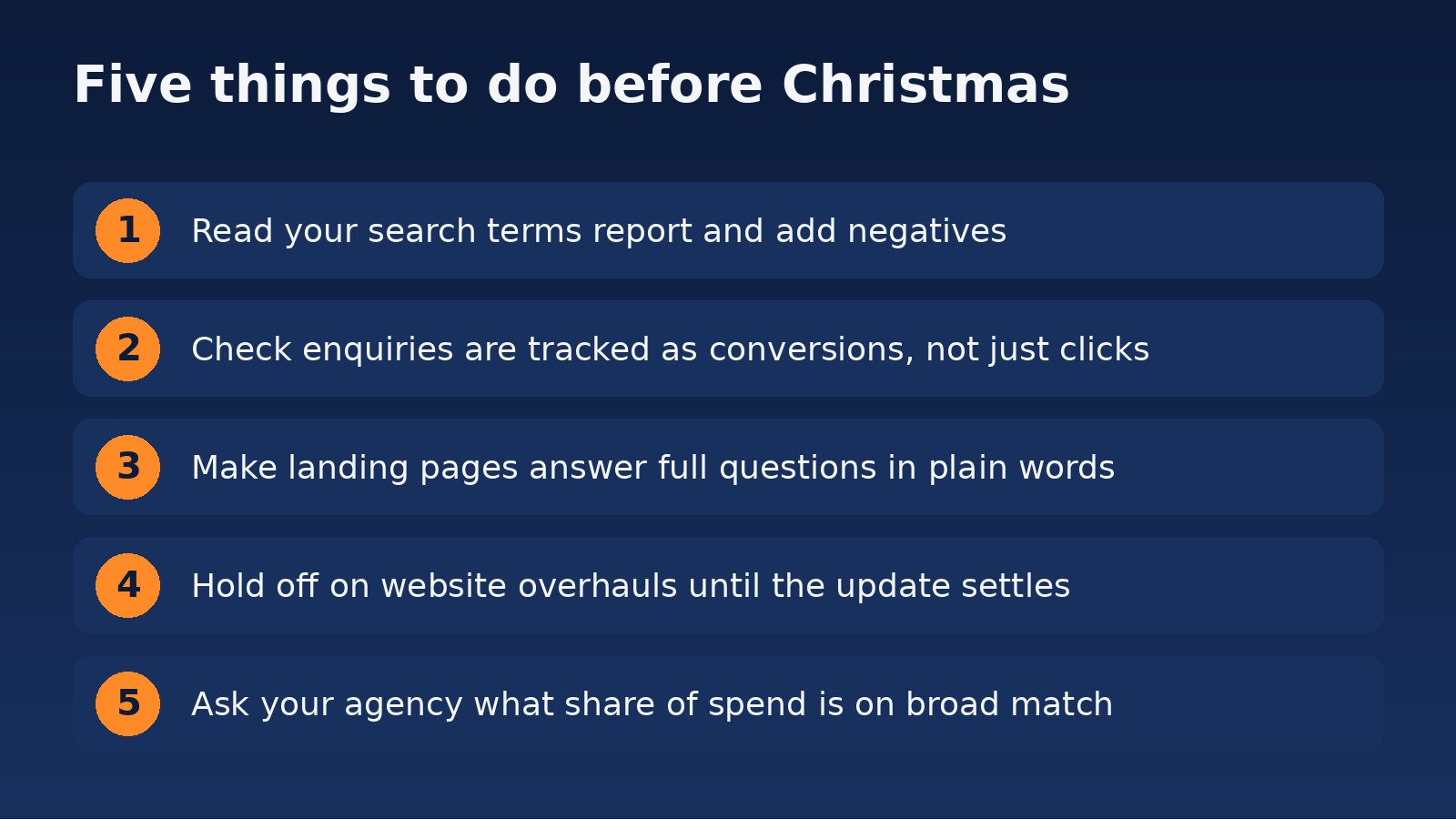
Five things to do before Christmas
- Read your search terms report and add negatives. This is the list of what people actually typed before clicking your ad. With AI placements mixed in, expect longer and stranger searches. Anything that will never turn into a customer (“free”, “DIY”, “jobs”, “course”) goes on the negative list. Do it monthly from now on, not quarterly.
- Make sure you’re tracking enquiries, not just clicks. Because AI placements aren’t reported separately, the only way to know whether the change is helping is whether calls and form fills held up against cost. If your account counts page views or clicks as “conversions”, fix that first. Our post on which ads actually made the phone ring explains how.
- Make your landing pages answer full questions. Price ranges, timeframes, what’s included, where you work. That helps your ad quality, your organic rankings and your chances of being quoted in an AI answer at once.
- Hold off on website overhauls until the core update settles. Fix genuine errors, by all means. Leave redesigns and big rewrites until you’ve seen a clean week of data after the rollout ends.
- Ask your agency one question. “What share of our spend is on broad match or AI Max, and what did the search terms look like in the last 30 days?” A good agency answers in a sentence and shows you the list. If yours can’t, that tells you something. Our guide on how to judge a marketing agency has more questions worth asking.
The short version
Your Google ads can now show inside AI answers in New Zealand, automatically, with no off switch and no separate reporting. Keep a closer eye on what your ads match and whether enquiries hold up. Separately, Google’s November core update is shuffling organic rankings until roughly late November. Don’t make big website decisions until it’s finished and you’ve given it a week.
If you’d like someone to check your search terms, conversion tracking and keyword settings before the Christmas rush, that’s exactly what our Google Ads and SEO services cover, and our pricing plans are published. We’ll tell you plainly whether anything needs changing, even if the answer is “nothing yet”.
Frequently asked questions
Are Google ads now showing in AI Mode in New Zealand?
Yes. On 28 October 2026 Google announced it is bringing ads in AI Mode to ten new countries, including New Zealand. Google’s help page lists New Zealand among the countries where ads can appear within AI Overviews and AI Mode, in English, labelled “Sponsored”.
Do I need to set anything up to appear in AI Mode?
No. Google says existing Search, Shopping and Performance Max campaigns are automatically eligible. There’s no separate campaign or budget.
Can I stop my ads appearing in Google’s AI answers?
Not separately. Google says advertisers can’t opt out of AI Overviews or AI Mode on their own, or target them exclusively. You can still control which searches your ads match through keyword match types and negative keywords.
Can I see how my ads performed in AI Mode?
Not on its own. Google includes AI Overview and AI Mode results in your standard campaign reports, and the searches that triggered your ads appear in the search terms report in aggregate.
What is the Google November 2026 core update?
It’s a broad change to how Google ranks pages in search, released on 10 November 2026 and applying globally in all languages. Google said the rollout may take up to two weeks. Rankings can move around during that time before settling.
My website traffic dropped in November. What should I do?
Wait. Google advises confirming the update has finished, waiting at least a full week, and comparing that week with the week before the update started. Small drops usually need no action. For a large, lasting drop, review the site as a whole rather than making quick fixes.
Sources
- Google: Ads in AI Mode expand to new markets (Shashi Thakur, 28 October 2026). Vendor statement about Google’s own product.
- Google Ads Help: About ads in AI Overviews and AI Mode (countries, eligibility, opt-out and reporting, checked 18 November 2026)
- Alphabet: Q3 2026 earnings call transcript (28 October 2026)
- Google Search Status Dashboard: November 2026 core update (10 November 2026)
- Google Search Central: Google Search’s core updates and your website
Want this run for your business?
Talk to our team. We will show you where the money is leaking and what we would do about it.