
Data silos reduce marketing performance by fragmenting the customer truth your campaigns depend on, slowing decisions to the point where optimisation windows close before you act, and quietly draining budget into channels that look productive but aren’t. The fix is straightforward in principle: unify data access across your martech stack and align governance so every team works from the same definitions. Australian and NZ firms struggle with poor data at scale — Salesforce research found the average company runs hundreds of applications, yet only a minority of those are interconnected, with New Zealand leaders estimating a higher share of company data is siloed than their Australian counterparts.
Three things a marketing leader can do this week:
- Audit your conversion counts across your CRM, ad platforms, and analytics tool — if the numbers don’t match, you have a silo problem affecting attribution right now.
- Name a data steward for your marketing function, even informally, so someone owns the question of what “a conversion” means across every system.
- List every tool your team uses to store or report on customer data and mark which ones share data with each other — most teams are surprised by how few connections exist.
Key takeaways
Data silos reduce marketing performance by fragmenting customer truth, corrupting attribution, and slowing decisions — and the fix requires governance and people changes before technology.
| Point | Details |
|---|---|
| NZ data quality is low | Only 9% of NZ firms have completely clean data; 40% skip regular cleansing, per Datacom research. |
| Integration gaps are widespread | Just 39% of NZ organisations use a platform-led integration approach, leaving most exposed to shadow integrations. |
| Attribution errors cost real budget | Mismatched conversion counts across platforms lead to misallocated spend; reconcile counts as your first diagnostic step. |
| Governance beats technology | Naming a data steward and standardising definitions delivers faster gains than buying a new platform. |
| Beyondclix integrates the fix | Beyondclix connects analytics, CRM, and campaign management as one team, improving attribution and time-to-insight for NZ businesses. |
Table of Contents
- Why data silos hurt marketing performance
- Why do data silos form in the first place?
- How silos damage campaigns and KPIs
- How do you know if your organisation has a silo problem?
- How to dismantle silos: governance first, technology second
- Which technology pattern fits your marketing stack?
- What does the New Zealand evidence actually show?
- Quick wins NZ marketing teams can act on now
- Why integrated teams win — and why the tech is the easy part
- Beyondclix helps NZ marketing teams fix the data foundation
- Sources
- FAQ
Why data silos hurt marketing performance
A data silo is any dataset, system, or repository that is accessible to one team or tool but not others that need it. In a marketing tech stack, silos appear constantly and often invisibly. Your CRM holds contact records and deal stages, but those records are never matched to the ad events that generated the leads. Your Google Ads and Meta Ads accounts each report conversions using their own attribution models, neither of which talks to your analytics platform. Your loyalty programme sits in a separate database that your personalisation engine cannot query. Your customer support tickets, which contain rich signals about churn risk and unmet needs, never reach the campaign team.
The result is that no single system holds a complete picture of your customer. Each tool sees a fragment. Decisions get made on fragments.
A “single source of truth” is often cited as the goal, but the more useful concept for most marketing teams is interoperability: the ability to act across systems in real time without necessarily centralising everything in one place. A data warehouse might hold your historical records while a customer data platform (CDP) handles real-time activation. What matters is that the right data reaches the right system at the right moment, not that everything lives in one monolithic repository.
Why do data silos form in the first place?
Silos rarely appear because someone decided to hide information. They form gradually, through a combination of organisational structure, cultural habits, and accumulated technical debt.
Organisational causes are often the most stubborn:
- Teams structured around channels (paid media, SEO, CRM, social) naturally build their own reporting and their own definitions of success.
- Incentive misalignment means the paid media team is measured on cost-per-click while the CRM team is measured on email open rates — neither has a reason to share data with the other.
- Ownership gaps appear when no one is accountable for the connection between systems, only for the systems themselves.
Cultural causes compound the structural ones. Information hoarding is real in marketing departments where data access feels like competitive advantage within the organisation. Teams resist sharing raw data because they fear losing control of the narrative around their own performance. Shared definitions — what counts as a “lead,” a “customer,” an “active user” — are rarely agreed on formally, so each team builds its own.
Technical causes are usually the most visible but often the least fundamental. Legacy CRM systems that predate modern APIs, analytics platforms that export only aggregated data, and ad platforms that guard their attribution models all create genuine technical barriers. But the deeper issue is unmanaged app sprawl: marketing teams adopt new tools quickly, and integrations between those tools are rarely planned. Shadow integrations — unofficial connections built by individual contributors using Zapier or similar tools — multiply without governance, creating fragile data flows that break silently.
Pro Tip: If your team’s first response to a data quality problem is “we need a new tool,” that’s a governance problem wearing a technical costume. Ask who owns the definition of the metric in question before you buy anything.
Kellogg Programme research into New Zealand data interoperability found that the real barriers are governance, trust and commercial alignment rather than purely technical constraints — a finding that holds well beyond the wine industry it studied.
How silos damage campaigns and KPIs
The harms are concrete and measurable. Here is where fragmented data shows up in your marketing numbers.
Broken customer profiles and wasted targeting spend. When your CRM and ad platforms don’t share data, you’re targeting audiences built on incomplete records. You serve ads to existing customers at full acquisition CPM rates. You exclude prospects who converted offline. Lookalike audiences are built on a partial seed list, so the model learns the wrong pattern. Every dollar spent on a misbuilt audience is a direct cost of the silo.
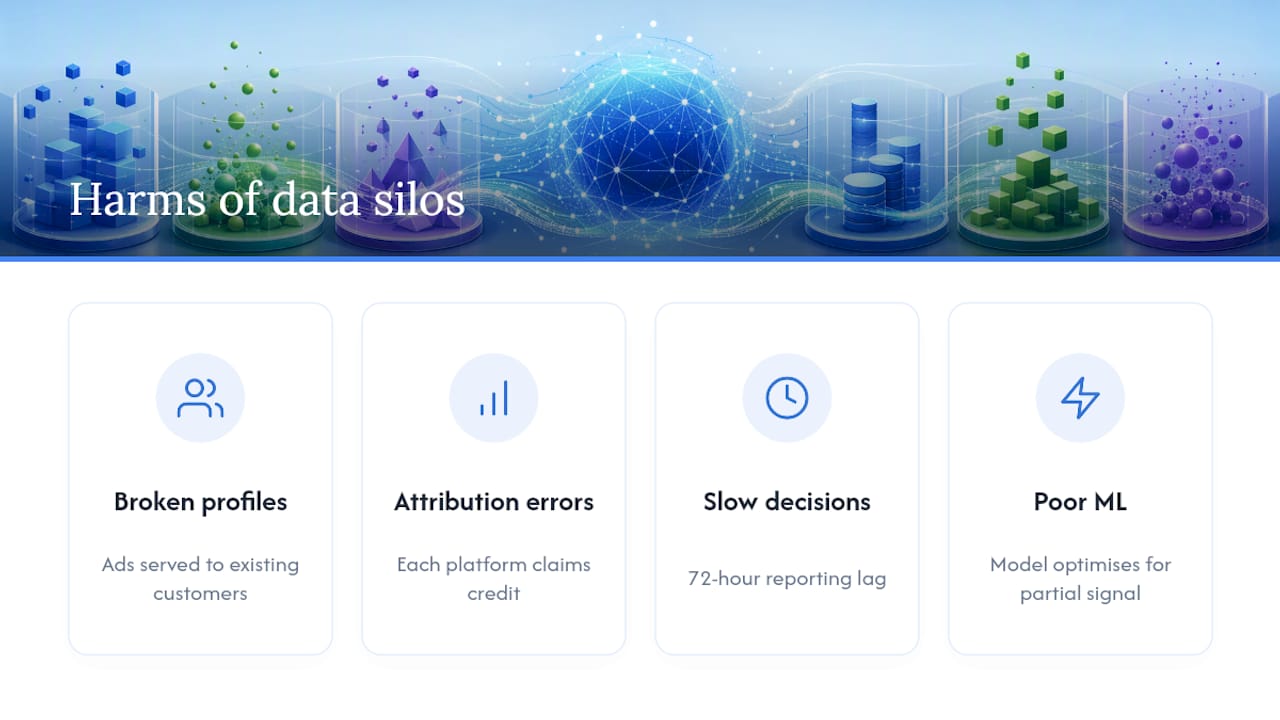
Attribution errors that misallocate budget. Each platform claims credit for conversions using its own model. Without a unified attribution layer, your media mix looks different depending on which dashboard you open. The channel that gets credit in Google Ads is rarely the same one that gets credit in Meta Ads. Marketing leaders end up making budget decisions based on whichever platform’s story they find most convincing, rather than on a reconciled view of what actually drove revenue. EY guidance on eliminating data silos shows that unifying sales and marketing data materially improves attribution accuracy and gives marketing the evidence it needs to demonstrate revenue influence.
Slower decisions and missed optimisation windows. When pulling a campaign performance report requires manual exports from three platforms and a spreadsheet merge, it takes days. By the time the insight reaches the person who can act on it, the campaign has already spent through its budget on the wrong audience segment. Paid search and social campaigns can shift performance significantly within 48 hours; a 72-hour reporting lag is a structural disadvantage.
Poor AI and machine learning outcomes. Predictive models and automated bidding systems are only as good as the data they train on. Feed a Smart Bidding algorithm conversion signals from only one channel while offline conversions, CRM data, and loyalty events sit in separate silos, and the model optimises for a partial signal. The result is a model that looks like it’s performing well inside the platform while the actual business outcome is mediocre. Rushing to adopt AI without fixing the data foundation first tends to amplify existing errors rather than correct them.
Inconsistent customer experience and churn risk. A customer who contacts support about a billing issue and then receives a promotional email the same afternoon — because the campaign team’s suppression list doesn’t include support ticket data — is a customer who notices the disconnect. Inconsistent messaging across channels is a direct symptom of siloed data, and it erodes the trust that drives repeat purchase and lifetime value.
Consider a practical scenario: a NZ e-commerce retailer runs a Google Shopping campaign and a Meta retargeting campaign simultaneously. The Google campaign reports 120 conversions; Meta reports 95. The actual number of unique purchases in the order management system is 140. Neither platform’s number is right, and the overlap is invisible without a unified view. The retailer over-credits Google, increases its budget, and the true incremental driver — an email remarketing sequence — gets cut because it “can’t be attributed.” Customer acquisition cost rises. The silo cost is real, and it compounds every month.
How do you know if your organisation has a silo problem?
Diagnosis before prescription. Run through this numbered checklist and score how many apply to your current setup.
- Conversion count mismatch. Your ad platforms report more conversions than your CRM or order management system records for the same period.
- Duplicate audience segments. The same customer appears in multiple lists with different identifiers — email address in one system, phone number in another, cookie ID in a third — and no system reconciles them.
- Attribution window conflicts. Your Google Ads account uses a 30-day click attribution window; your analytics platform uses last-click with a 7-day window. Reports never agree.
- Manual reporting merges. Someone on your team spends more than two hours per week copying data between systems or building spreadsheet bridges between platforms.
- No shared definition of “lead” or “customer.” Ask your paid media lead and your CRM manager independently what counts as a qualified lead. If the answers differ, you have a definitional silo.
- Suppression list lag. Recent purchasers or churned customers continue to receive acquisition ads because the suppression list updates weekly rather than in real time.
- Insight-to-action delay. Your team regularly identifies an optimisation opportunity but cannot act on it within 48 hours because the data needed to execute sits in a system someone else controls.
Diagnostic metrics worth tracking regularly: data availability rate (what percentage of your planned reports can be produced without manual intervention), connected app ratio (how many of your active martech tools share data bidirectionally with at least one other tool), duplication rate in your CRM or CDP, attribution discrepancy rate between platforms, and average time-to-insight from data collection to decision.
For the audit itself, involve marketing operations, your analytics lead, IT, and whoever owns data governance or privacy compliance. A one-hour workshop where each person maps the data flows they rely on — and marks which ones are manual — surfaces most of the critical gaps within a single session.
How to dismantle silos: governance first, technology second
The most common mistake is buying a new integration tool before fixing the governance problems that created the silos. Technology without governance produces new silos faster than it removes old ones.
The high-level roadmap:
- Clarify ownership. Assign a named data steward for marketing data. This person is accountable for canonical definitions, data quality standards, and integration health — not for building everything themselves, but for ensuring it gets done.
- Standardise definitions. Agree on a shared taxonomy: what is a lead, a customer, a conversion, an active user. Document it. Put it somewhere every team can find it. Review it quarterly.
- Prioritise integration points. Not every system needs to connect to every other system. Map the five data flows that most directly affect campaign performance and attribution, and fix those first.
- Pilot interoperability before scaling. Run a single integration between your CRM and your primary ad platform, validate the data quality, and measure the impact before expanding.
People and governance changes that make technical fixes stick:
- Establish data SLAs: how fresh does data need to be for each use case? Real-time for suppression lists; daily for audience segments; weekly for attribution reports.
- Create shared KPIs between marketing and sales so both teams have a reason to maintain data quality at the handoff point.
- Align consent and privacy practices across systems. Under New Zealand’s Privacy Act 2020, personal data collected for one purpose cannot be freely repurposed across systems without appropriate consent — a governance requirement that also happens to enforce good data hygiene.
- Introduce an event taxonomy: a standardised naming convention for every customer interaction tracked across your stack (page views, form submissions, purchases, support contacts). This single change prevents the most common source of new silos.
For a realistic timeline: at three months, you should have a named data steward, a shared definitions document, and one pilot integration running. At six months, your top five integration points should be operational and your attribution discrepancy rate should be measurably lower. At twelve months, a formal data governance charter should be in place, with regular hygiene reviews built into your campaign planning cycle.
Pro Tip: Embed a five-minute data health check into every campaign planning meeting. Ask: “Do we have clean, connected data for this campaign’s audience, suppression, and attribution?” If the answer is no, fix the data before you set the budget.
Roles worth hiring or upskilling for this work are covered in the NZ digital marketing specialists guide — particularly the analytics lead and marketing operations roles that sit at the intersection of data and campaign execution.
Which technology pattern fits your marketing stack?
There is no single right architecture. The right pattern depends on your scale, real-time requirements, budget, and how much vendor lock-in risk you can tolerate.
Customer Data Platform (CDP). Collects, unifies, and activates customer data in real time across channels. Best suited to organisations with multiple customer touchpoints that need real-time personalisation and audience activation. Adobe Experience Platform (AEP) is one of the more capable enterprise options available in New Zealand, with strong identity resolution and real-time segmentation. Cost and implementation complexity are high; expect a 3–6 month deployment for a meaningful use case.

Data warehouse (e.g., BigQuery, Snowflake, Redshift). Centralises historical data for analysis and reporting. Excellent for attribution modelling, cohort analysis, and feeding BI tools. Not designed for real-time activation on its own. Pairs well with a reverse ETL layer to push warehouse segments back into ad platforms and CRM systems.
iPaaS (Integration Platform as a Service). Tools like Boomi and Fivetran connect disparate systems through pre-built connectors and managed pipelines. Boomi is particularly relevant for NZ organisations: Boomi/Omdia research found that only 39% of NZ organisations have a platform-led approach to integration, meaning the majority are still managing connections ad hoc. Fivetran specialises in ELT pipelines, moving data reliably from source systems into a warehouse. Both reduce the engineering burden of maintaining custom integrations.
Reverse ETL. Takes data from your warehouse and pushes it into operational tools — your CRM, ad platforms, email system. This is the pattern that makes warehouse data actionable without rebuilding your entire stack. Census and Hightouch are the leading tools in this category.
API-first integrations. Direct connections between systems using their native APIs. Highest control, highest maintenance burden. Appropriate when a pre-built connector doesn’t exist or when data transformation requirements are complex.
Tag management (e.g., Google Tag Manager, Tealium). Controls how tracking tags fire across your website and app. Critical for data collection hygiene at the source. A well-governed tag management setup prevents the most common source of duplicate and inconsistent event data.
Practical integration patterns from Martech recommend staged rollouts over big-bang replacements — start with one use case, validate the data quality, then expand.
For NZ organisations, data residency matters. Check that any cloud-based platform you adopt can store data in Australia or New Zealand if your privacy obligations or customer expectations require it. Local vendor support also affects implementation speed; platforms with ANZ-based partners or support teams reduce the risk of a deployment stalling.
When selecting any integration tool, look for: vendor-neutral APIs (so you’re not locked into one ecosystem), real-time connectors for suppression and activation use cases, audit trails that show when data was last updated and by which system, and documented data lineage so you can trace any metric back to its source.
What does the New Zealand evidence actually show?
The local data is sobering. Datacom research found that only 9% of New Zealand firms regard their data as completely clean, and 40% do not conduct regular data cleansing. Common issues include incomplete records, duplicates, and inaccurate data — the exact conditions that make silo-driven errors worse, because bad data flowing between systems multiplies the problem rather than solving it.
The Boomi/Omdia research adds another layer: with only 39% of NZ organisations taking a platform-led approach to integration, the majority are managing connections manually or through unmanaged shadow integrations. That exposes them to silent data failures — integrations that break without alerting anyone — and limits their ability to measure ROI from AI initiatives, because the data feeding those models is neither clean nor connected.
An integrated agency approach to this problem starts with a discovery sprint: mapping every data source the marketing function relies on, identifying the five highest-impact integration gaps, and running a data cleansing pass on the priority customer lists before any campaign work begins. The staged plan then looks like this: clean and connect the CRM to the primary ad platform in the first month, add attribution reconciliation in month two, and introduce a CDP or reverse ETL pilot for a single personalisation use case in month three.
Expected KPI improvements from this sequence, based on the pattern described in EY and Martech guidance: attribution discrepancy between platforms typically falls significantly once a unified conversion tracking layer is in place, and time-to-insight drops when manual reporting merges are replaced by automated pipelines. For digital marketing driving leads in NZ, the compounding effect of better attribution and cleaner audiences shows up in lower customer acquisition cost over a 90-day period.
Quick wins NZ marketing teams can act on now
You don’t need a 12-month data transformation programme to reduce the worst impacts of silos. Here is what’s achievable in 30, 60, and 90 days.
30-day wins:
- Assign a canonical customer identifier — email address is the most practical for most NZ businesses — and confirm it is present and consistent across your CRM, email platform, and primary ad accounts.
- Reconcile conversion counts for your top three campaigns: pull the numbers from your ad platform, your analytics tool, and your CRM, and document the discrepancy. That number is your baseline.
- Identify your top three duplicate audience segments and merge or suppress them. Measure the reduction in duplicate records as your first success metric.
60-day wins:
- Standardise event names across your tag management setup. Every form submission, purchase, and key page view should fire with a consistent name and parameter structure across every platform.
- Implement a rapid reverse ETL for one campaign channel: push CRM suppression data into your Meta or Google Ads account on a daily automated schedule rather than a weekly manual upload.
- Run a data cleansing sprint on your priority email and CRM lists: remove hard bounces, merge duplicates, and flag records missing key fields. Track the improvement in deliverability rate and match rate against ad platform custom audiences.
90-day wins:
- Deploy a small CDP or iPaaS pilot for a single use case. Personalisation based on purchase history or attribution reconciliation across two channels are both achievable in this window without a full platform deployment.
- Establish a monthly data hygiene ritual: a standing 30-minute review of data quality metrics (duplication rate, attribution discrepancy, suppression list freshness) built into your campaign planning cycle.
- Measure the impact: target a reduction in attribution discrepancy rate, an improvement in audience match rate, and a reduction in time-to-insight compared to your 30-day baseline.
Why integrated teams win — and why the tech is the easy part
The organisations that solve their data silo problem fastest are rarely the ones with the biggest technology budgets. They’re the ones where a marketing leader decided that data quality was a team accountability, not an IT project.
Integrated data lets marketers act faster and with more confidence. When your suppression list updates in real time, you stop wasting spend on existing customers. When your attribution model draws on CRM data as well as platform data, your budget decisions reflect what’s actually driving revenue. When your audience segments are built on clean, unified records, your personalisation works. The compounding effect on ROAS, CAC, and customer lifetime value is substantial — and it starts with decisions, not tools.
The pitfall most teams fall into is treating integration as a one-off IT project with a completion date. Data governance is ongoing. New tools get adopted, new teams join, definitions drift, and integrations break silently. The organisations that sustain the gains are the ones that build data health into their operating rhythm: regular audits, named ownership, and a standing commitment to fixing the data before scaling the spend.
The insight from ecommerce expert Bridget Perry is worth holding onto: the real problem isn’t data volume, it’s inaction caused by fragmented context. Most marketing teams already have enough signals to make better decisions. The silo is what stops those signals from reaching the person who can act on them, at the moment when acting still matters.
Beyondclix helps NZ marketing teams fix the data foundation
Fragmented data is a solvable problem, and you don’t need to solve it alone. Beyondclix works with established NZ businesses and e-commerce stores as a single integrated team across analytics and tracking, CRM integration, campaign management, and governance support — the exact combination that addresses silo causes rather than just their symptoms.
When you engage Beyondclix, the immediate outcomes are faster time-to-insight through automated reporting pipelines, improved attribution accuracy by connecting your CRM and ad platform data, and better personalisation from cleaner, unified audience segments. Every channel — Google Ads, Meta, LinkedIn, email, SEO — operates from the same data, so budget decisions reflect what’s actually working. If you’re ready to stop making campaign decisions on fragmented numbers, see what Beyondclix offers and take the first step toward marketing that measures itself honestly.
Sources
- Australian & NZ firms struggle with poor data amid AI ambitions
- NZ businesses struggle with data quality for AI adoption
- Poor data foundations cutting into AI returns for ANZ organisations, Boomi report finds
- Breaking down data silos: A practical guide to integrated marketing data
- Overcoming barriers to data interoperability within New Zealand’s wine industry
- How to demonstrate marketing impact on sales by eliminating data silos
FAQ
What is a data silo in marketing?
A data silo is a dataset or system that one team or tool can access but others cannot, preventing a unified view of the customer. In marketing, common examples include CRM records not linked to ad platform events, or loyalty data isolated from personalisation engines.
Why are silos bad for marketing performance?
Silos corrupt attribution, waste ad spend on the wrong audiences, slow decision-making, and degrade AI model accuracy. Without connected data, budget decisions are made on partial information, which compounds into higher customer acquisition costs and lower return on ad spend over time.
How do you fix data silos without replacing your entire stack?
Start with governance: name a data steward, standardise your definitions, and reconcile conversion counts across your top campaigns. Then add targeted integrations — a reverse ETL to push CRM suppression data into your ad platforms, or an iPaaS tool like Boomi or Fivetran to connect priority systems — before considering a full CDP deployment.
How bad is the data silo problem for NZ businesses specifically?
Significant. Datacom research found only 9% of NZ firms regard their data as completely clean, and Boomi/Omdia data shows just 39% of NZ organisations have a platform-led approach to integration. Most NZ marketing teams are making campaign decisions on fragmented, partially connected data.
Can Beyondclix help with data integration for marketing?
Yes. Beyondclix works as an integrated team across analytics, CRM setup, campaign management, and tracking — addressing the root causes of siloed marketing data rather than treating each channel in isolation. NZ businesses can review Beyondclix’s services to see where integration support fits their situation.
Recommended
- What is a scalable marketing strategy? – BeyondClix Blog
- How content marketing powers your paid strategy in NZ – BeyondClix Blog
- Why digital marketing drives leads for NZ businesses – BeyondClix Blog
- Types of digital marketing specialists: NZ hiring guide 2026 – BeyondClix Blog
Want this run for your business?
Talk to our team. We will show you where the money is leaking and what we would do about it.