

You run a building company out of Henderson. The work is good, the referrals keep coming, and you’ve got a website a mate’s nephew built a few years ago. Someone in Glen Eden needs a deck rebuilt. They search, find your Google listing, tap through to your site on their phone, and see a slider that takes six seconds to load, a “Services” page with four lines of text, and a phone number buried in the footer. They go back and ring the next builder.
You never knew they existed. That’s the problem with a website that isn’t working: it doesn’t fail loudly. It just quietly hands jobs to someone else. This guide is for West Auckland business owners weighing up a new site or a rebuild. It covers who your customers actually are across Henderson, New Lynn, Te Atatū and Titirangi, what the site needs to do for each, what it costs, and how you’d know it’s paying for itself.
West Auckland is three markets with one name
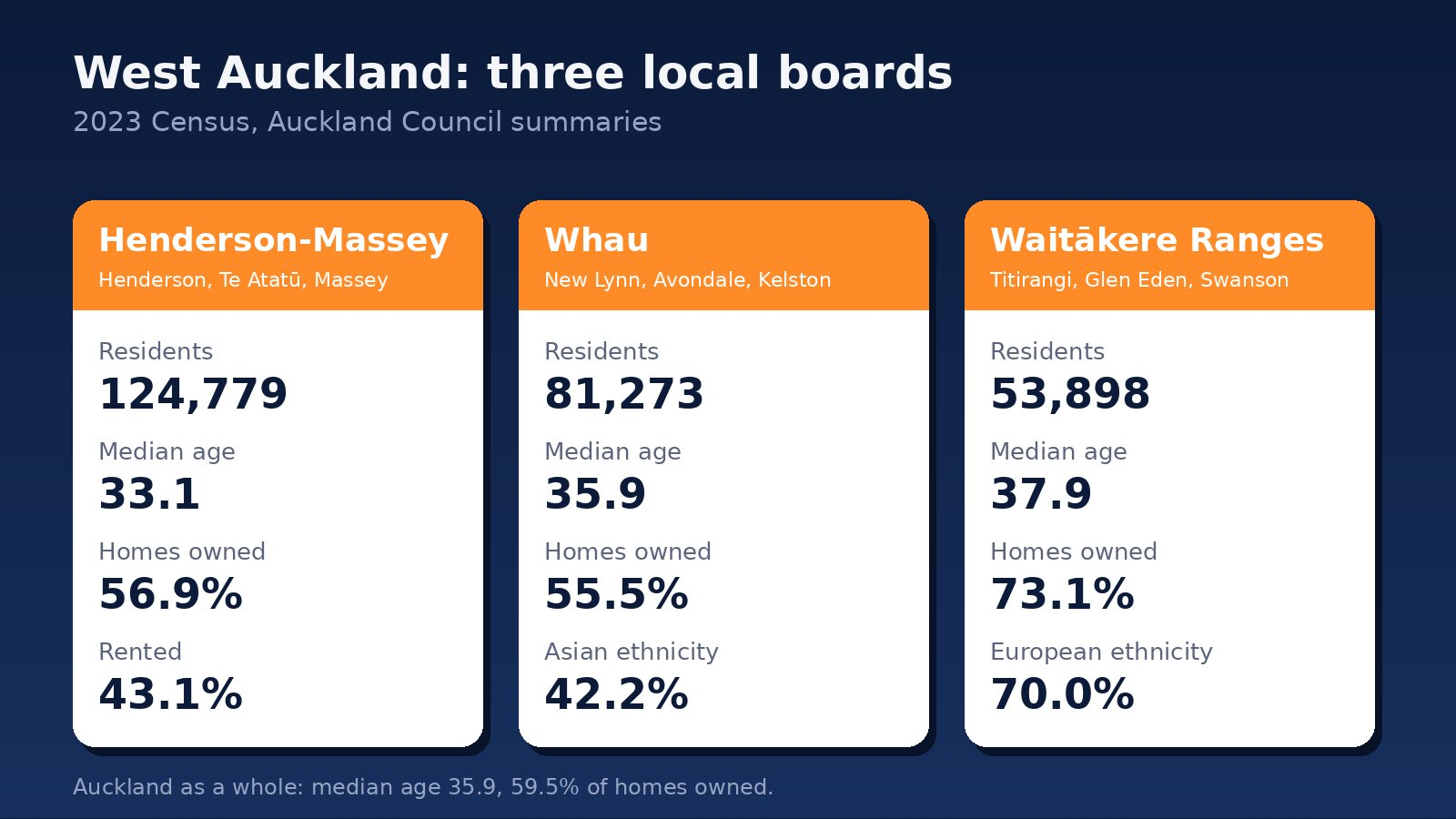
“West Auckland” covers three local board areas, and the 2023 Census shows they are not the same customer. Between them they held almost 260,000 usual residents.
- Henderson-Massey (Henderson, Te Atatū, Massey) is the big one: 124,779 residents, the second-highest of any Auckland local board. It is young, with a median age of 33.1 against 35.9 for Auckland, and 43.1% of homes are rented (Auckland Council, Henderson-Massey 2023 Census summary).
- Whau (New Lynn, Avondale, Kelston) had 81,273 residents. Since 2018, Asian ethnicity has become its largest ethnic group, at 42.2% of residents against 31.3% across Auckland, and 19.7% identified as Pacific Peoples. Just over half of homes (55.5%) were owned (Auckland Council, Whau 2023 Census summary).
- Waitākere Ranges (Titirangi, Glen Eden, Swanson and the west coast) is smaller and settled: 53,898 residents, a median age of 37.9, and nearly three in four homes (73.1%) owned, against 59.5% for Auckland. 70.0% identified with a European ethnicity, though its Asian population grew 29.3% since 2018 (Auckland Council, Waitākere Ranges 2023 Census summary).
Why does a census table matter for a website? Because the person reading your homepage is one of these people. A young renting household in Te Atatū with a broken oven wants a phone number and a time today. A Titirangi homeowner planning a kitchen wants to see finished kitchens, a process and a rough price range before they’ll pick up the phone. A family in New Lynn may be comparing three businesses and looking for signs that someone will understand them. One site has to serve all three. Most don’t.
What your website actually does in the sale
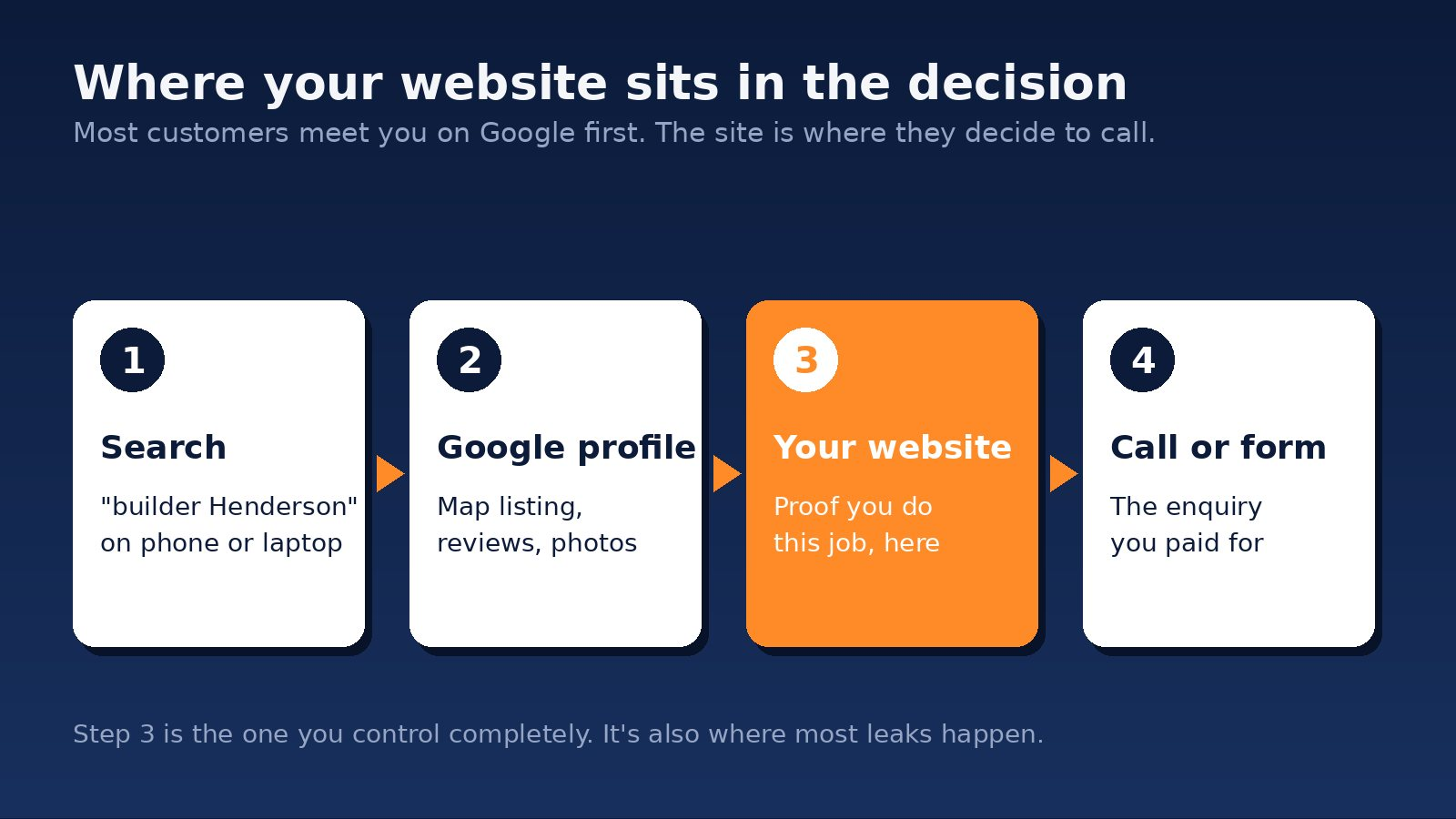
Very few customers type your web address. They search for what they need, often with a suburb on the end, and Google shows them a map listing first. Google says local results are “mainly based on relevance, distance, and popularity” (Google Business Profile Help, Tips to improve your local ranking). We covered how to win that map listing in our local SEO guide for West Auckland.
The website is the next step. Once someone has found you, the site is where they decide whether you’re the right business, and whether you’re worth the call. If you’re paying for Google Ads, it’s also where every click you’ve paid for lands. A weak site makes every other bit of marketing more expensive.
Google reads the site the same way your customers do: on a phone. Its own documentation says it “uses the mobile version of a site’s content, crawled with the smartphone agent, for indexing and ranking” (Google Search Central, Mobile-first indexing best practices). If the phone version of your site is thinner than the desktop version, that thinner version is what Google judges you on.
Don’t swing too far the other way, though. Statcounter recorded 53.63% of New Zealand web page views on desktop in October 2026, and 43.47% on mobile (Statcounter, Desktop vs mobile vs tablet, New Zealand). That’s page views, not people. The quick check of your hours happens on a phone. The long comparison of three renovation quotes often happens on a laptop at night. Your site has to work on both.
Build the pages around the people, suburb by suburb
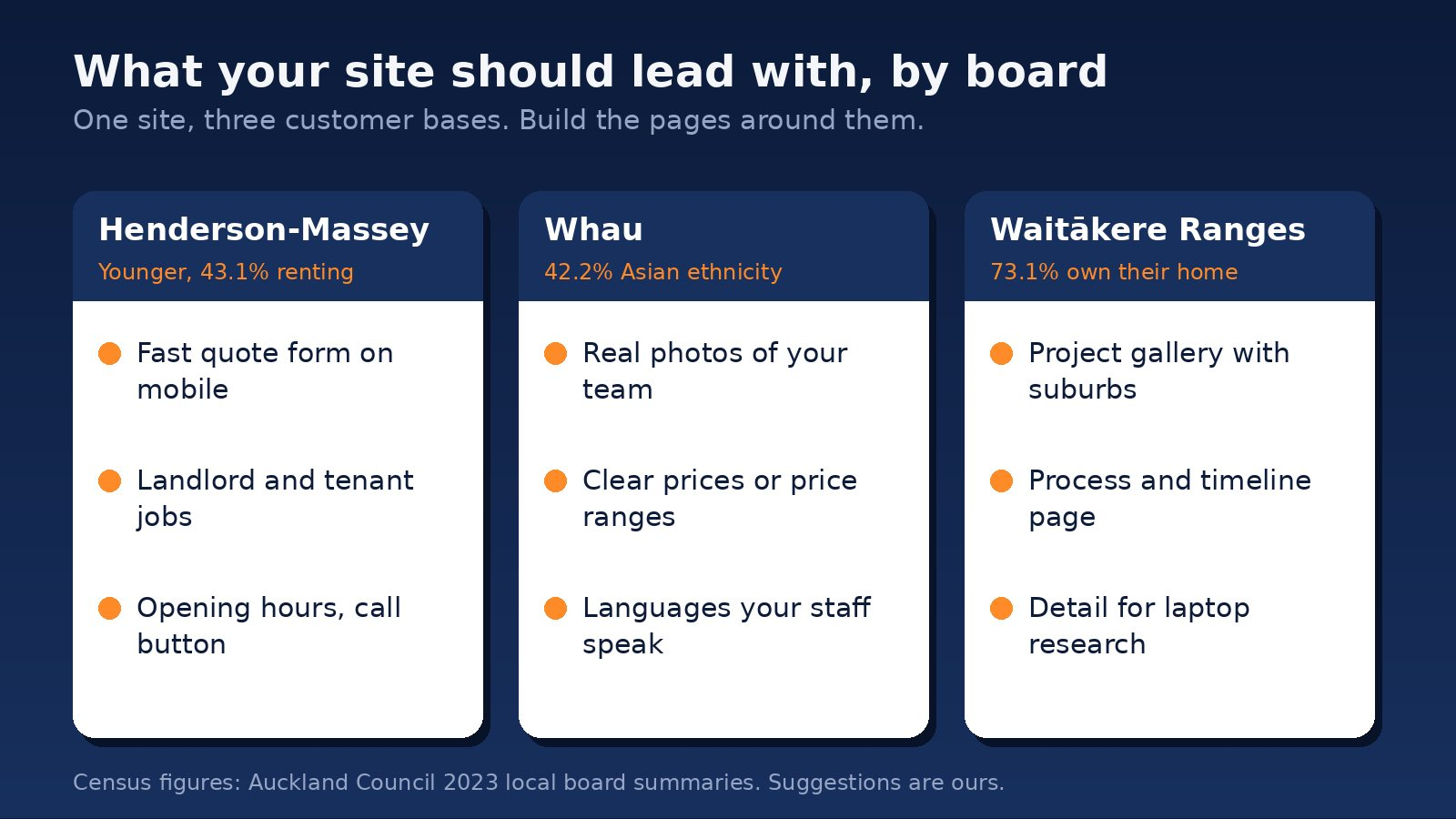
Here’s where a West Auckland site earns its keep. The census numbers above don’t tell you what any one customer wants, but they do tell you who is most likely to be reading. Use them to decide what each page leads with.
Henderson-Massey: make the first call easy
A younger board with a lot of renters means plenty of urgent, one-off jobs, and plenty of landlords and property managers booking them. Put a tappable phone number at the top of every page. Keep the quote form short. If you do work for landlords, say so on its own page, because a property manager searching for a reliable tradie is a repeat customer worth having. Show your hours, and if you answer after hours, say that too.
Whau: show who you are
New Lynn and Avondale are among the most diverse parts of the city. Don’t guess at anyone’s preferences from a census table. Do the things that build trust with every customer: real photos of your real team instead of stock images, plain prices or price ranges where you can give them, and, if your staff speak other languages, say which ones. A line like “We speak Hindi, Samoan and Mandarin” is a reason to call you that no competitor’s stock photo can match.
Waitākere Ranges: give them the detail
Owner-occupiers in Titirangi and Glen Eden spending real money on a renovation, a landscaping job or a financial decision will read. Give them a gallery of finished work with the suburb named (with the client’s permission), a page explaining how a job runs from first call to sign-off, and honest timeframes. And if you service the bush-clad streets and long driveways of the Ranges, say so: plenty of businesses quietly don’t.

One site, not three
None of this needs three websites. It needs one site with a page for each service you want calls for, real local examples on those pages, and an honest list of the suburbs you actually serve. Avoid the old trick of fifty near-identical pages with the suburb name swapped in. Google tells site owners to avoid “search engine-first content made primarily to gain search engine rankings” (Google Search Central, Creating helpful content), and customers can smell it too.
Speed, forms and the boring bits that cost you leads
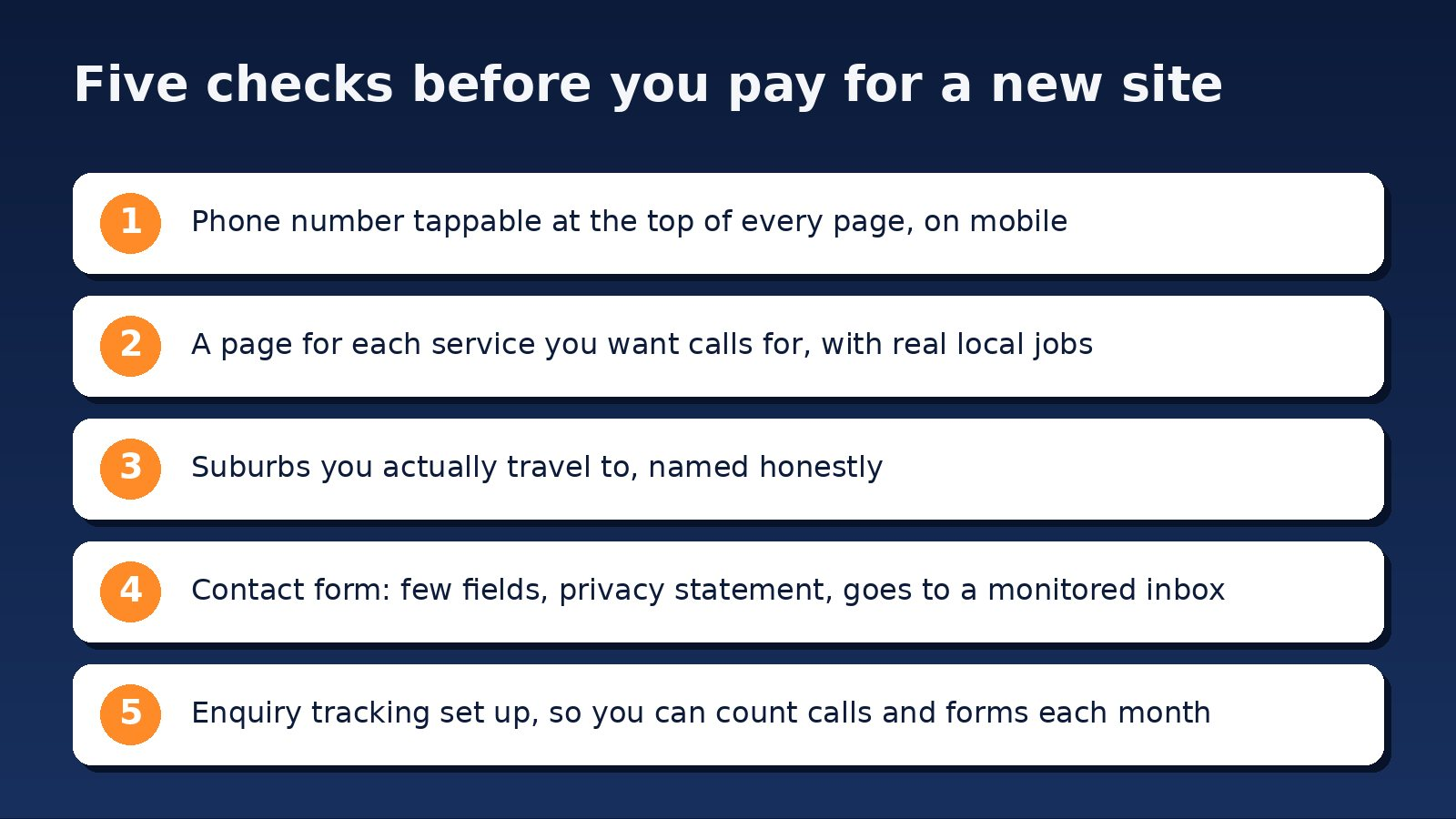
A good-looking site can still leak enquiries. Three things to check:
- Speed. Google’s “good” bar is a main page element loaded within 2.5 seconds, a response to a tap within 200 milliseconds, and a layout that doesn’t jump around (web.dev, Web Vitals). Big photo sliders and too many plugins are the usual culprits.
- Forms. Ask for what you need to quote and nothing more. And because a form collects personal information, the Privacy Act applies: you need to tell people what you’re collecting, why, and who will see it, among other things (Office of the Privacy Commissioner, Principle 3). A short privacy statement linked beside the button covers it.
- Where the enquiry goes. Test your own form. If it lands in an inbox nobody checks, the best site in West Auckland is worth nothing.
We go deeper on the technical side, including protecting your existing Google rankings when you relaunch, in our new website checklist.
What it costs and how long it takes
There are two honest answers on cost. A simple brochure site for a sole trader and a site for a multi-service business with a project gallery, booking or e-commerce are different jobs, and anyone who quotes a single price without asking what you need is guessing. Our published plans are on the pricing page, and our website design service explains what’s included.
What matters more than the build price is what you get for it. Ask any web designer, us included, three things:
- Who owns the domain, the hosting account and the site once it’s paid for? (It should be you.)
- Will enquiry tracking be set up, so we can count calls and form submissions each month?
- Who writes the content for each service page, and will it include real local jobs?
On time: a small site with content ready can be live in a few weeks. A larger rebuild usually takes longer, and the thing that slows most projects isn’t the design. It’s waiting on photos, prices and page content from the business. Get those started early.
How you’d know it’s working
Don’t judge a new site on how it looks. Judge it on enquiries. Before launch, write down how many calls and form enquiries the old site produced in a typical month, even roughly. After launch, with tracking in place, compare. Three numbers are worth a monthly look:
- Enquiries per month from the website, calls and forms counted separately.
- Which pages they came from. If the deck page brings in work and the fencing page brings in nothing, you know which page to improve.
- Where the enquirers are. If you wanted more Titirangi work and you’re still getting calls from across the motorway, the suburb pages need work.
If you can’t see these numbers, that’s the first fix. We explain how to set up call and form tracking in plain English in which ads actually made the phone ring, and the same approach works for a website.
Thinking about a new site?
BeyondClix builds websites for Auckland businesses that need the phone to ring, not just a nice homepage. If you’re in Henderson, New Lynn, Te Atatū, Titirangi or anywhere out west and your current site is costing you jobs, get in touch. We’ll look at what you have, tell you straight whether it needs a rebuild or just fixes, and show you what we’d change first.
Frequently asked questions
Do I need a new website, or can my old one be fixed?
Often it can be fixed. If the site is reasonably fast, works on a phone and you can edit it yourself, better service pages, a clearer call button and enquiry tracking may be enough. If it’s slow, hard to update or broken on mobile, a rebuild is usually cheaper in the long run.
Should I have a separate page for each West Auckland suburb?
Only for suburbs you genuinely serve and can say something real about, such as jobs you’ve done there. One honest service-area page beats dozens of near-identical suburb pages.
How much does a website cost for a West Auckland small business?
It depends on the number of pages, features like booking or online sales, and who writes the content. Our published plans are on our pricing page. Always ask who owns the domain and hosting once the site is paid for.
Is a website more important than a Google Business Profile?
You need both. The Google profile usually gets you found; the website is where customers decide whether to call. A strong profile sending people to a weak site wastes the work.
How fast should my website be?
Google’s “good” thresholds are the main content loaded within 2.5 seconds, a response to taps within 200 milliseconds, and a layout that stays stable while it loads.
How will I know if my new website is working?
Count enquiries. Set up call and form tracking, note how many enquiries the old site produced, and compare month by month after launch.
Sources
- Auckland Council (Knowledge Auckland): Henderson-Massey Local Board, 2023 Census results
- Auckland Council (Knowledge Auckland): Whau Local Board, 2023 Census results
- Auckland Council (Knowledge Auckland): Waitākere Ranges Local Board, 2023 Census results
- Google Business Profile Help: Tips to improve your local ranking on Google (vendor documentation)
- Google Search Central: Mobile site and mobile-first indexing best practices (vendor documentation)
- Google Search Central: Creating helpful, reliable, people-first content (vendor documentation)
- web.dev (Google): Web Vitals
- Statcounter Global Stats: Desktop vs mobile vs tablet market share, New Zealand (October 2026)
- Office of the Privacy Commissioner: Privacy Principle 3
Want this run for your business?
Talk to our team. We will show you where the money is leaking and what we would do about it.